
Last updated: 23 September 2026
Agentic AI is ushering in a new era of autonomous work, in which software can pursue goals, make decisions, and take actions with limited human direction. Agentic AI solutions — systems built around AI agents that can accomplish tasks autonomously — are at the forefront of this shift, automating complex, multi-step work that previously required constant human involvement. They are reshaping how work gets done across functions and industries.
These solutions matter because they change what can be automated. Where earlier automation handled only simple, rule-based tasks, agentic AI solutions can reason, plan, use tools, and adapt, allowing them to take on far more of the work that fills modern organisations. This is powering a future in which more work is handled autonomously, freeing people to focus on the activities that most need human judgement and creativity.
This article explores the top categories of agentic AI solutions powering the future of autonomous work, what they are, how they are transforming work, and how organisations can adopt them. From customer-facing agents to development, research, and operations solutions, the goal is a clear understanding of the agentic AI solutions shaping the future of work and how to benefit from them.
What are Agentic AI Solutions?
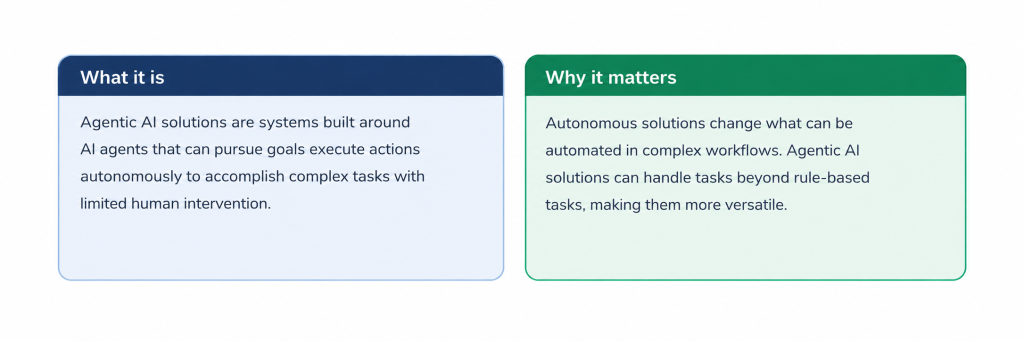
Agentic AI solutions are systems built around AI agents that can pursue goals and take actions autonomously.With the ability to do reasoning, planning, using tools, and adapting to accomplish complex, multi-step tasks with limited human direction, agentic AI solutions enable a future where more tasks are handled by software, freeing people for higher-value activities.
Agentic AI Solutions Guide Summary
| Topic | Agentic AI Solutions |
| Best for | Business leaders, IT/operations teams, product owners & digital strategists |
| Covered here | What agentic AI solutions are; How they enable autonomous work; Customer-facing and support solutions; Development, research, and operations agents; Multi-agent platforms and orchestration; Adopting agentic AI solutions effectively |
Agentic AI Solutions summed up
What Are Agentic AI Solutions?
Agentic AI solutions are systems built around AI agents.These are AI models that can pursue goals and take actions autonomously rather than simply responding to prompts. These solutions apply the capabilities of AI agents to accomplish real work, handling complex, multi-step tasks by reasoning goals, planning steps, taking actions, and adapting as they go. This makes them powerful tools for automating work.
What distinguishes agentic AI solutions from earlier automation is their autonomy and flexibility. Traditional automation follows fixed rules and handles only simple, predictable tasks, breaking down when situations vary. Agentic AI solutions can analyse, adapt, and handle ambiguity, allowing them to take on work that is too complex or variable for rule-based automation. This dramatically expands what can be automated.
Agentic AI solutions come in many forms, addressing different kinds of work across functions and industries. What they share is the use of autonomous agents to accomplish tasks that previously required human direction. Understanding the categories of agentic AI solutions and what they can do helps organisations identify how to apply them to their own work and benefit from the shift towards autonomous work.
The Rise of Autonomous Work
Agentic AI solutions are powering a shift towards an autonomous workplace — a future in which more tasks are handled by software operating with limited human direction. This represents a significant change from previous ways of working, where automation could handle only a narrow range of tasks, and most work required ongoing human involvement. Autonomous work extends automation to far more of what organisations do.
The rise of autonomous work is significant in shifting the balance between human and machine effort. As agentic AI solutions take on more complex work, people are freed from routine and repetitive tasks to focus on activities that require judgement, creativity, and human interaction. This has the potential to make work more productive and more focused on what people do best.
Understanding the rise of autonomous work helps organisations appreciate the significance of agentic AI solutions and prepare for the changes they bring. Rather than replacing human workers, autonomous solutions propose that agents handle tasks while people provide direction, oversight, and higher-value contributions. This evolving relationship between people and autonomous agents is central to the future of work that agentic AI is powering.
Customer-Facing and Support Solutions
One of the most impactful categories of agentic AI solutions is customer-facing and support agents. Rather than simply answering questions like basic chatbots, these agents can handle customer enquiries end to end — understanding requests, retrieving information, taking actions across systems, and resolving issues autonomously. This allows a large share of customer interactions to be handled automatically.
Microsoft provides a practical example of this approach through Ask Microsoft, a customer-facing agent built with Copilot Studio. Rather than relying on a single chatbot, the system uses a network of specialised AI sub-agents that can handle different areas of Microsoft products, services, pricing, and trials. A coordinating agent determines which sub-agents are relevant to a customer’s request, combines the information they provide, and delivers a response or escalates the interaction when human support is needed. Microsoft reports that this multi-agent approach has reduced human-handled chat volume by up to 70%, demonstrating how agentic AI can move customer support beyond simple question answering toward more autonomous, end-to-end service.
Software Development Solutions
Software development is a rapidly growing area for agentic AI solutions. Development agents can assist with writing, testing, and debugging code, taking on multi-step engineering tasks under the supervision of developers. Rather than just suggesting code, these agents can understand requirements, write and test code, and fix issues, handling substantial parts of the development process.
GitHub provides a real-world example through GitHub Copilot coding agent, an autonomous software development agent that can be assigned software-building tasks and work on them in the background. Rather than simply suggesting code, the agent can implement new features, fix bugs, address technical debt, improve test coverage, and update documentation. It works in its own development environment, creates a draft pull request, and asks a developer to review the work before it is merged.
GitHub itself uses the Copilot coding agent in the development of GitHub’s platform. Engineers can assign issues to Copilot, which then works on the task and opens a pull request for human review. GitHub reports that its engineers have used the coding agent to handle time-consuming development work within its core repository, demonstrating how agentic AI can participate directly in an existing software development workflow rather than simply acting as a code suggestion tool .
Research and Knowledge Solutions
Research and knowledge agents are a valuable category of agentic AI solutions that automate information-intensive work. These agents can gather information from multiple sources, synthesise it, and produce findings, automating research that would otherwise require extensive manual effort. They can handle multi-step research tasks, from gathering and analysing information to producing results.
For example, Qualtrics Research Hub can help teams find and reuse insights from previous studies instead of starting research from scratch. Its AI-powered search and summaries can identify relevant past research, surface recurring findings, and highlight knowledge gaps. This allows researchers to consolidate information from multiple studies and use existing organisational knowledge to inform new projects.
Another practical use case is analysing large volumes of open-ended feedback. Similarly, Qualtrics’ specialised agentic AI, through conversational feedback, can ask targeted follow-up questions based on an employee’s response, turning broad comments such as concerns about career growth into more detailed, actionable information.
Operations and Workflow Solutions
Operations and workflow agents are a powerful category of agentic AI solutions that automate complex business processes. These agents can handle multi-step workflows that span systems and require decisions — from data gathering and processing to document handling and reporting — taking on operational work that was previously labour-intensive and difficult to automate.
Most operations and workflow solutions created by agentic AI solutions providers are customised to the client organisation’s policies. They combine volume with the need for interpretation and judgement. These custom solutions handle processes end-to-end. For example, tailored operations agents reduce processing times and costs, improve accuracy, and free staff from repetitive administrative work. This is valuable across the many operational processes that keep organisations running.
Other types of enterprise AI agent systems can automate complex, multi-step processes. Since there are multiple agents, they interact with one another, retrieving and processing data across the organisation. They provide their human counterparts with the information they need for effective oversight, from monitoring to reporting, to collecting across silos and providing summaries of processes. They represent a broad and valuable application of autonomous work, applicable to the operational activities that underpin virtually every organisation.
Multi-Agent Platforms and Orchestration
Beyond individual agents, multi-agent platforms and orchestration solutions enable multiple agents to work together on complex tasks. These solutions coordinate agents with different roles, allowing them to collaborate, divide work, and combine their results to accomplish outcomes that would be difficult for a single agent. They represent a sophisticated frontier of agentic AI solutions.
These solutions transform what agentic AI can accomplish by enabling collaboration among agents. Just as complex work is often best handled by teams of specialists, multi-agent solutions allow specialised agents to work together on complex problems, orchestrated towards a shared goal. This extends the reach of autonomous work to larger and more complex tasks than a single agent could handle.
Multi-agent platforms and orchestration also address the challenge of coordinating and managing multiple agents, providing the infrastructure to build and run sophisticated agentic systems. As agentic AI matures, these solutions are becoming increasingly important for tackling complex work. They represent an advanced and powerful category of agentic AI solutions, pointing towards the sophisticated autonomous work that the future may hold.
Adopting Agentic AI Solutions
Adopting agentic AI solutions effectively begins with identifying the right opportunities. The best situations are those that are complex enough to benefit from agents’ capabilities, valuable enough to justify the effort, and suitable for automation with appropriate oversight. Selecting opportunities where agentic AI solutions genuinely add value is the foundation of successful adoption.
Starting with focused, well-scoped applications and proving value is far more effective than attempting ambitious, open-ended deployments. A successful initial application builds confidence, demonstrates value, and provides lessons for expansion. From there, organisations can extend or expand their use of agentic AI solutions to further tasks in a controlled, value-driven way, capturing the benefits progressively.
Successful adoption also depends on sound implementation. It is essential to ground agents in good information, design appropriate oversight and guardrails, ensure security, and combine agents with human judgement. By choosing the right opportunities and implementing solutions thoughtfully, organisations can benefit from agentic AI solutions and the autonomous work they enable.
For some organisations, partnering with technology providers such as User Experience Researchers (USER, website: user.com.sg). MNCs typically sign up with such providers as they deliver tailored solutions patterned after their complex policies and structures, allowing teams to move efficiently and work seamlessly with their agentic AI solution. The Future of Autonomous Work
The future of autonomous work powered is one of steadily expanding capability. As agents become more capable, more reliable, and easier to build and deploy, the range of work they can handle autonomously will grow, extending the benefits of autonomous work across more functions and industries. This trajectory suggests that autonomous work will become an increasingly central part of how organisations operate.
This future is likely to involve people and autonomous agents working together in evolving ways, with agents handling more of the routine and complex work while people focus on direction, judgement, creativity, and interaction. Rather than replacing people, agentic AI solutions will reshape roles, amplify what people can accomplish, and changing the nature of work in significant ways.
Preparing for the future means building the capability to adopt and benefit from agentic AI solutions. By understanding these solutions, adopting them thoughtfully, and adapting to the changes they bring, organisations can position themselves to thrive in a future where autonomous work is increasingly important. The agentic AI solutions available today are the foundation of this future, and those who learn to use them well stand to benefit most.
Overcoming Challenges in Adopting Agentic AI Solutions
While agentic AI solutions offer significant benefits, adopting them involves challenges that organisations must address. Because agents take actions and can make mistakes that compound over multiple steps, ensuring they are reliable and well-governed is essential. Designing appropriate oversight, guardrails, and testing is necessary to deploy agentic AI solutions responsibly, particularly for consequential work.
Other challenges include ensuring good data and integration, managing security, and building the skills and understanding needed to adopt agentic AI solutions effectively. Agents rely on good information and secure access to the systems they use, and implementing them well requires expertise. Addressing these considerations is important to realising the benefits of agentic AI solutions rather than encountering difficulties.
Overcoming these challenges is achievable with a thoughtful approach. An organisation may start with focused applications with a small in-house team or partner with a solutions provider, such as Singapore-based User Experience Researchers, to ensure sound design, robust data quality and security measures, and evolving capabilities. Recognising and addressing the challenges, rather than being deterred by them, is what allows organisations to capture the value of autonomous work while managing its risks responsibly.
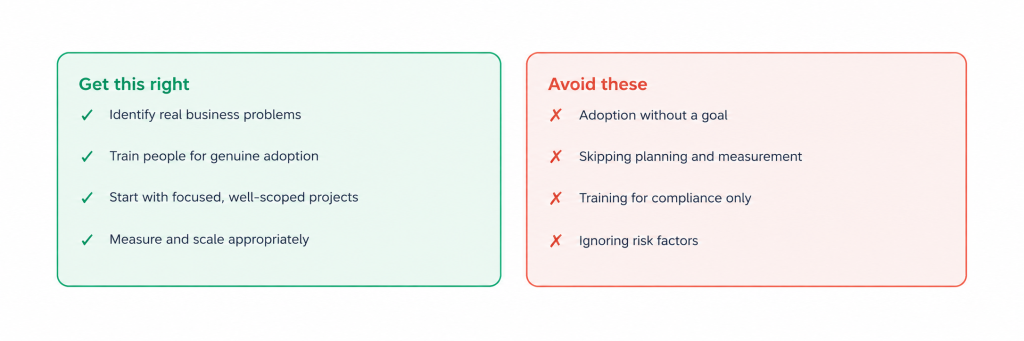
What to get right with Agentic AI Solutions — and the common mistakes to avoid.
Key takeaways
- Agentic AI Solutions is best approached around clear business outcomes, not tools or hype.
- Examples of solutions include customer-facing and support solutions, development, research, and operations agents.
- Pilot, measure, and then scale — with security, governance, and adoption built in.
- Partners such as USER (user.com.sg) can help you plan, implement, and optimise Agentic AI Solutions for your context.
Conclusion
Agentic AI solutions are powering a significant shift towards autonomous work, in which software can pursue goals and accomplish complex tasks with limited human direction. Across customer service, software development, research, operations, personal productivity, and multi-agent systems, these solutions are automating work that previously required constant human involvement, transforming how work gets done. By reasoning, planning, using tools, and adapting, agentic AI solutions extend automation to far more of what organisations do, freeing people for higher-value activities.
Realising the benefits of these solutions depends on adopting them thoughtfully — identifying the right opportunities, starting focused and proving value, implementing soundly, and combining agents with human oversight. Approached this way, agentic AI solutions can transform work across functions and industries, delivering efficiency, capacity, and new capabilities. As these solutions continue to advance, the future of autonomous work they are powering will become increasingly central to how organisations operate, making the capability to adopt and benefit from them an important advantage.
Want to Explore Agentic AI Solutions?
If you are eyeing Agentic AI Solutions for your organisation, the most valuable next step is a focused conversation about your goals, current state, and the outcomes that matter most. The USER tech team can recommend the right discovery, planning, or implementation pathway for your organisation’s context.
Frequently Asked Questions
Agentic AI solutions are systems built around AI agents that can pursue goals and take actions autonomously — reasoning, planning, using tools, and adapting to accomplish complex, multi-step tasks with limited human direction. They enable a future of autonomous work by automating tasks that previously required human involvement.
Autonomous work refers to a future in which more tasks are handled by software operating with limited human direction, enabled by agentic AI solutions. As agents take on complex work, people are freed to focus on activities requiring judgement, creativity, and interaction, changing the balance between human and machine effort.
Categories include customer-facing and support agents, software development agents, research and knowledge agents, operations and workflow agents, personal productivity agents, and multi-agent platforms that coordinate multiple agents. Each addresses different kinds of work across functions and industries.
Traditional automation follows fixed rules and handles only simple, predictable tasks, while agentic AI solutions can reason, adapt, and handle ambiguity, taking on complex, multi-step work. This autonomy and flexibility dramatically expand what can be automated beyond rule-based tasks.
Customer-facing agents handle enquiries end to end — understanding requests, retrieving information, taking actions, and resolving issues autonomously — rather than just answering questions. This resolves routine interactions instantly and around the clock while freeing human agents for complex, high-value interactions.
Multi-agent platforms and orchestration solutions enable multiple agents with different roles to work together on complex tasks, collaborating and combining their results. Like a team of specialists, they can tackle problems difficult for a single agent, extending autonomous work to larger, more complex tasks.
Organisations should identify valuable, suitable opportunities, start with focused applications and prove value before scaling, implement soundly with good information and oversight, and combine agents with human judgement. This considered approach captures the benefits while managing the risks.
The future involves steadily expanding capability as agents become more capable and widely applied, with people and agents working together in evolving ways. Agents will handle more routine and complex work while people focus on direction, judgement, and creativity, reshaping roles rather than simply replacing people.

