
AI agents open up a vast landscape of possibilities, from practical automation of everyday work to creative and innovative applications limited only by imagination. As agents become more capable and accessible, the question for many is not whether they can help but what to build with them. Exploring ideas for AI agents — both proven use cases and creative applications — is a great way to understand their potential and spark innovation.
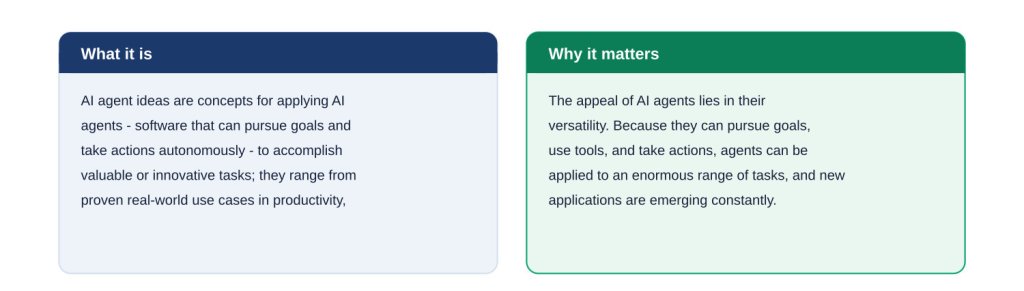
The appeal of AI agents lies in their versatility. Because they can pursue goals, use tools, and take actions, agents can be applied to an enormous range of tasks, and new applications are emerging constantly. Understanding the kinds of ideas that work well, and the creative possibilities they open up, helps individuals and organisations identify valuable and innovative ways to use agents.
This guide explores top ideas for AI agents, from real-world use cases across productivity, business, and customer engagement to creative and innovative applications. It also covers how to turn ideas into reality and how to evaluate which ideas are worth pursuing. Whether you are looking for practical applications or creative inspiration, the goal is to spark ideas for how AI agents can add value and enable innovation.
What are AI Agent Ideas?
AI agent ideas are concepts for applying AI agents — essentially, software that can pursue goals and take actions autonomously to accomplish valuable or innovative tasks. They range from proven real-world use cases in productivity, business, and customer engagement to creative and novel applications, reflecting the versatility of agents and the wide range of possibilities they unravel.
AI Agent Ideas — Summary
| Element | Detail |
| Topic | AI Agent Ideas |
| Last updated | 6 May 2026 |
| Best for | Business leaders, IT/operations teams, product owners & digital strategists |
| Covered here | What makes a good AI agent idea; Productivity and personal assistance ideas; Business and operations ideas; Customer engagement and research ideas; Creative and innovative applications; Turning ideas into reality |
What Makes a Good AI Agent Idea
A good AI agent idea starts with a task that genuinely benefits from what agents do well. Agents excel at tasks that involve multiple steps, require some reasoning or decision-making, and can be accomplished by gathering information and taking action. Ideas that match these strengths, such as automating complex, multi-step work, tend to make the most valuable and effective agents.
Good ideas are also well-defined and valuable. An agent designed around a clear, specific task with a defined goal is far more likely to work well than one asked to do everything. And ideas that address a real need or opportunity — saving significant time, enabling something new, or solving a genuine problem — deliver the most value. Focusing on clear, valuable tasks is key to good agent ideas.
Finally, good ideas consider feasibility and appropriateness. The best ideas are those that agents can accomplish reliably and where appropriate oversight is possible, particularly for consequential tasks. Balancing ambition with realism and being responsible helps identify ideas that will succeed. With these principles in mind, a vast range of valuable and creative agent ideas becomes possible, as the following sections explore.
Ideas for Productivity and Personal Assistance
Some of the most immediately useful AI agent ideas involve personal productivity and assistance. Agents can act as capable assistants that handle multi-step tasks on a person’s behalf, like conducting research, drafting documents, managing schedules, organising information, and handling routine work. These ideas amplify individual productivity by taking on time-consuming tasks.
Specific productivity ideas include agents that research a topic and produce a summary, agents that draft and refine documents or communications, agents that help manage and prioritise tasks and information, and agents that handle multi-step administrative work. These practical applications address the everyday demands of work, freeing people to focus on their most valuable activities.
Productivity and personal assistance ideas become especially compelling when they reflect the realities of specific roles. For a relationship manager in a bank, an agent might help prepare for client meetings by summarising account history, flagging follow-ups, and drafting tailored communications. Another example is for a project or team leader in software development. An agent could track dependencies, summarise stand-ups, surface blockers, and turn scattered updates into clear next steps. By fitting into the everyday workflows of specialists, these agents deliver practical, immediate value while creating a foundation for more advanced applications.
Ideas for Business and Operations
AI agents offer a wealth of ideas for automating business and operational work. Agents can handle complex business processes that span systems and require decisions — from processing and reporting to managing workflows and handling administrative tasks. These ideas address the operational work that keeps organisations running, often automating tasks that were previously labour-intensive.
Specific business ideas include agents that automate multi-step processes such as handling orders or requests, agents that gather and process data and produce reports, agents that manage routine administrative workflows, and agents that support specific business functions. These applications can significantly improve efficiency and free staff from repetitive work, delivering clear business value.
Business and operations ideas are valuable because they address work that is common across organisations and often time-consuming. By automating complex operational processes, these ideas can improve efficiency, accuracy, and capacity. They represent a broad and practical category of agent ideas, applicable to the operational activities that underpin virtually every organisation and offering substantial returns.

Ideas for Customer Engagement
Customer engagement offers compelling AI agent ideas that improve how organisations interact with their customers. Agents can handle customer interactions end to end, providing responsive, around-the-clock service. These ideas transform customer engagement by combining efficiency with quality.
Specific customer engagement ideas include agents that handle customer enquiries and support autonomously, agents that assist customers through processes such as onboarding or transactions, agents that provide personalised recommendations and assistance, and agents that manage routine customer communication. These applications improve customer experience while increasing efficiency.
Customer engagement ideas is valuable because interaction with customers is central to many organisations and often resource-intensive. By handling customer interactions autonomously while freeing people for complex or high-value interactions, these ideas improve both experience and efficiency. They represent an important and high-impact category of agent ideas, addressing a key area of work for customer-facing organisations.
Ideas for Research and Analysis
Research and analysis offer powerful AI agents that automate information-intensive work. Agents can gather information from multiple sources, synthesise it, and produce findings or analysis, handling research tasks that would otherwise require extensive manual effort. These ideas amplify what people can accomplish in research and analytical work.
Some examples of research agents include those that research a topic and produce a comprehensive summary, agents that gather and analyse information to answer questions, agents that monitor sources and surface relevant developments, and agents that support analysis by gathering and processing data. These applications help people acquire insights faster and handle more information than when doing so manually.
Research and analytics ideas are valuable because they enhance intellectual and analytical work, which is central to many roles. By automating the labour-intensive aspects of research while people provide direction and judgement, these agents make knowledge work more productive. They represent an important category of agent ideas, applicable to the many activities that involve working with information and producing insights.
Creative and Content Applications
AI agents enable creative and content-focused ideas that support and enhance creative work. Agents can assist with generating ideas, creating and refining content, and supporting creative projects, making creative capabilities more accessible and helping people produce content more efficiently. These ideas open up creative possibilities for a wide range of people.
Creative AI agents can help in brainstorming and developing ideas, assist with creating various forms of content, and support creative projects through multiple steps. Some agents can also help refine and improve creative work. These applications amplify human creativity by handling aspects of the creative process while people provide vision and judgement.
Creative and content agents are versatile because they extend the creative capability of people and make creative work more accessible. By supporting and enhancing creativity rather than replacing it, these ideas enable more people to pursue creative projects and produce content effectively. They represent an exciting category of agent ideas, revealing creative possibilities and demonstrating the versatility of agents beyond routine tasks.
Innovative and Novel Applications
Beyond established use cases, AI agents enable innovative and novel applications that push the boundaries of what is possible. As agents become more capable, people are finding creative and unexpected ways to apply them, combining their capabilities in new ways and addressing problems in novel fashions. These innovative ideas are where much of the excitement and potential of agents lies.
Innovative applications often involve combining agents’ capabilities creatively, applying them to new domains, or using multiple agents together to accomplish sophisticated tasks. They may address niche needs, enable entirely new kinds of solutions, or reimagine how tasks are done. This frontier of agent ideas is constantly expanding as people explore the possibilities and discover new applications.
Novel and innovative applications are valuable because they represent the cutting edge of what agents can do and the source of new opportunities. By exploring creative possibilities and pushing boundaries, people can discover valuable new applications and drive innovation. These ideas embody the open-ended potential of AI agents, inviting experimentation and creativity in finding new ways to apply this versatile technology.
Niche and Specialised Agents
AI agents also enable valuable ideas focused on niche and specialised needs. Rather than general-purpose applications, these ideas involve agents tailored to specific domains, tasks, or industries, addressing needs with focused capabilities. Specialised agents can deliver significant value by excelling at a specific, well-defined task.
Specific specialised ideas include agents designed for particular industries or professions, agents that handle specific technical or domain tasks, and agents tailored to the unique needs of a particular workflow or problem. By focusing on a specific area, these agents can be highly effective and valuable, addressing needs that general applications might not serve well.
Niche and specialised agent ideas are valuable because they address specific needs precisely and can excel at focused tasks. While less broadly applicable than general ideas, they can deliver substantial value in their domain and represent significant opportunities, particularly for those with specialised needs or expertise. They demonstrate how the versatility of agents can be applied to specific, valuable purposes.
Turning Ideas into Reality
Realising AI agents begins with defining the idea clearly — the specific task, the goal, and what success looks like. A well-defined idea is far easier to build into an effective agent than a vague one. From there, building an agent involves selecting a reasoning model, designing the agent’s capabilities and tools, and assembling them, supported by a growing ecosystem of frameworks.
Building an effective agent also requires attention to reliability and oversight. Because agents have the initiative to act, it is important to test them, set appropriate boundaries, and design oversight for consequential tasks. Starting with a focused version of the idea and refining it is more effective than attempting an over-ambitious agent from the outset. This disciplined approach helps turn ideas into agents that work.
For many, turning ideas into reality benefits from expertise and support, particularly for more ambitious or business-critical applications. By defining ideas clearly, building thoughtfully, and testing carefully, individuals and organisations can bring their agent ideas to life. Support in designing and building effective agents can accelerate this process and improve the results — exactly the kind of help user.com.sg provides to organisations exploring AI agents.
Evaluating and Prioritising Ideas
With so many possible AI agent ideas, evaluating and prioritising them is valuable. Good criteria include the value the idea would deliver, how well it matches agents’ strengths, how feasible it is to build reliably, and whether appropriate oversight is possible. Assessing ideas against these criteria helps identify those most worth pursuing.
Prioritisation helps focus effort where it will deliver the most value. Starting with ideas that are valuable, feasible, and well-suited to agents — often focused, well-defined tasks with clear benefits — builds success and provides a foundation for more ambitious applications. This measured approach helps ensure that effort is directed towards ideas that will succeed and deliver value.
Evaluating and prioritising ideas also helps balance ambition with realism. While creative and innovative ideas are exciting, ensuring they are feasible and appropriate is important to success. By thoughtfully assessing and prioritising ideas, individuals and organisations can pursue the most promising applications of AI agents, turning the vast landscape of possibilities into valuable, achievable projects that deliver real benefits.
Common Pitfalls to Avoid with AI Agent Ideas
When pursuing AI agent ideas, several common pitfalls are worth avoiding. One is choosing ideas that are too broad or ambitious, asking an agent to do everything rather than focusing on a specific, well-defined task. Overly ambitious ideas tend to produce unreliable agents, whereas focused ideas are far more likely to succeed. Keeping ideas well-scoped is key to good results.
Another pitfall is pursuing ideas that do not genuinely benefit from what agents do well, or that lack real value. Applying agents to tasks better suited to simpler tools, or to tasks that do not address a real need, wastes effort. The best ideas match agents’ strengths and address genuine needs, so assessing ideas against these criteria helps avoid pursuing the wrong ones.
A further pitfall is neglecting reliability and oversight, particularly for ideas involving consequential actions. Because agents take actions, ideas must be implemented with appropriate testing, boundaries, and oversight to ensure they behave safely and reliably. By avoiding these pitfalls — keeping ideas focused, valuable, and well-governed — individuals and organisations can pursue agent ideas that succeed and deliver real value.
Key takeaways
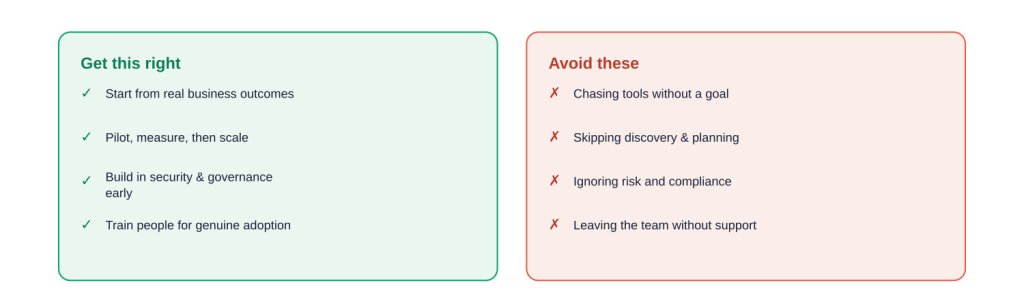
- AI Agent Ideas is best approached around clear business outcomes, not tools or hype.
- What makes a good AI agent idea.
- Productivity and personal assistance ideas.
- Business and operations ideas.
- Customer engagement and research ideas.
- Pilot, measure, and then scale — with security, governance, and adoption built in.
- user.com.sg can help you plan, implement, and optimise AI Agent Ideas for your context.
Conclusion
AI agents open up a vast landscape of ideas, from practical real-world use cases to creative and innovative applications. Across productivity and personal assistance, business and operations, customer engagement, research and analysis, creative work, and novel applications, agents can be applied to an enormous range of valuable and innovative tasks. Exploring these ideas reveals the versatility and potential of agents and provides inspiration for how they can add value and enable innovation.
Turning ideas into reality requires defining them clearly, building thoughtfully with attention to reliability and oversight, and evaluating and prioritising to focus on the most promising applications. Whether pursuing proven use cases or creative possibilities, the principles of focusing on clear, valuable tasks and building carefully apply. As agents continue to advance, the landscape of possible ideas will only expand, offering ever more opportunities for individuals and organisations to apply this versatile technology in valuable and innovative ways.
Work with USER on AI Agent Ideas
If you are exploring AI Agent Ideas for your organisation, the most valuable next step is a focused conversation about your goals, current state, and the outcomes that matter most. User Experience Researchers (USER) can help you with AI agent ideas customised for your organisation’s needs. Contact the USER team at user.com.sg to get the best recommendations for the discovery, planning, or implementation pathway for your business context.
Frequently asked questions
A good AI agent idea involves a task that benefits from agents’ strengths — multiple steps, some reasoning, and the ability to gather information and take actions — is well-defined and valuable, and is feasible to build reliably with appropriate oversight. Focusing on clear, valuable tasks is key.
Practical ideas include personal productivity agents that research, draft, and manage tasks; business agents that automate operational processes; customer engagement agents that handle enquiries; and research agents that gather and synthesise information. These address common, valuable needs across work.
Yes. Agents can support creative and content work by helping brainstorm ideas, create and refine content, and support creative projects. They amplify human creativity by handling aspects of the creative process while people provide vision and judgement, making creative capabilities more accessible.
Innovative applications push the boundaries of what agents can do — combining their capabilities creatively, applying them to new domains, or using multiple agents together for sophisticated tasks. This constantly expanding frontier is where much of the potential and opportunity of agents lies.
Start by defining the idea clearly — the task, goal, and success criteria — then build the agent by selecting a model, designing its capabilities and tools, and assembling them, using available frameworks. Test carefully, set boundaries, and start with a focused version before expanding.
Evaluate ideas by the value they would deliver, how well they match agents’ strengths, how feasible they are to build reliably, and whether oversight is possible. Prioritise valuable, feasible, well-suited ideas — often focused tasks with clear benefits — to build success and deliver value.
Yes. Specialised agents tailored to specific domains, tasks, or industries can deliver significant value by excelling at a focused, well-defined task. While less broadly applicable than general agents, they address specific needs precisely and represent valuable opportunities, especially for specialised needs.
Agents are best suited to tasks that involve multiple steps, require some reasoning or decision-making, and can be accomplished by gathering information and taking actions. Well-defined, valuable tasks where appropriate oversight is possible make the best agent applications.

