
Last updated: 6 August 2026
AI agents are becoming a strategic enterprise capability, enabling organisations to automate complex, multi-step workflows, improve decision-making, and scale operations without proportional increases in headcount. Executives evaluating AI agents should focus on business outcomes rather than technology alone, prioritising use cases that address operational inefficiencies, rising costs, fragmented processes, and productivity challenges.
For businesses, understanding where AI agents deliver value is essential to capturing the benefits they offer. Agents are being applied across customer service, sales and marketing, operations, finance, human resources, and technology, transforming each of these functions in significant ways. Knowing the top use cases helps businesses identify where agents can make the greatest difference for them.
This guide explores the top use cases for AI agents transforming modern businesses, examining how agents are being applied across key business functions, the value they deliver, and how to implement them effectively. From customer service to operations and beyond, the goal is a clear understanding of how AI agents are transforming businesses and how organisations can benefit.
The Importance of Knowing AI Agent Use Cases
AI agent use cases in business vary vastly. As such, it is crucial to know the use cases where they can best transform work with their functions and processes, automating complex, multi-step work across areas such as customer service, sales, operations, finance, HR, and technology to improve efficiency, capacity, and capability.
AI Agent Use Cases — Summary
| Element | Detail |
| Topic | AI Agent Use Cases |
| Last updated | 6 August 2026 |
| Best for | Business leaders, IT/operations teams, product owners & digital strategists |
| Covered here | How AI agents transform business; Customer service and support; Sales, marketing, and operations; Finance, HR, and technology; Implementing agents in business; Measuring the business impact |
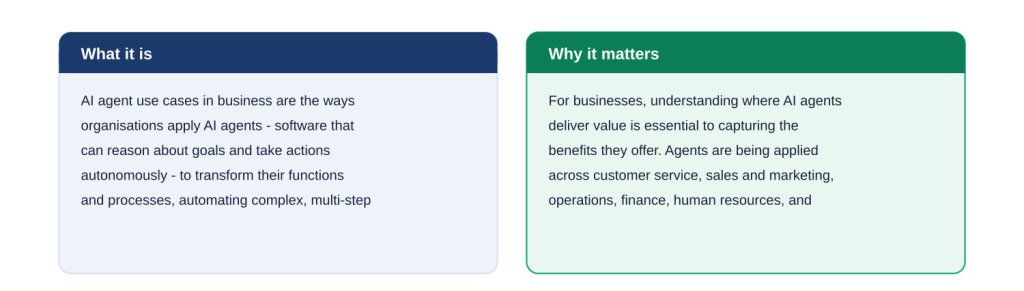
AI Agent Use Cases: what it is, and why it matters for your organisation.
“If you are evaluating AI Agent Use Cases, focus on the core concepts, real-world use cases, and trade-offs first — so any decisions, investments, or implementations are aligned to real outcomes.”
How AI Agents Transform Business
AI agents transform business by automating complex, multi-step work across functions, enabling organisations to operate more efficiently and effectively. Unlike simple automation that handles only narrow tasks, agents can reason about goals, gather information, make decisions, and take actions, allowing them to complete entire processes. This ability to handle end-to-end work is what makes their impact on business significant.
The transformation agents bring shows up across the organisation. They can perform work faster and at greater scale than manual effort, reduce costs by handling work that would require human time, improve quality and consistency, and free employees for higher-value activities. These benefits apply across business functions, making agents broadly transformative rather than useful only in specific areas.
Understanding how agents transform business helps organisations appreciate their potential and identify where to apply them. Because agents can automate the complex, multi-step work found in every function, they offer opportunities to transform operations across the organisation. The following sections explore the top use cases by function, illustrating how agents are transforming modern businesses and where the greatest value lies.
Use Case: Customer Service and Support
Customer service is one of the most impactful areas for AI agents in business. Rather than simply answering questions like basic chatbots, agents can handle customer enquiries end to end — understanding requests, retrieving information, taking actions across systems, and resolving issues autonomously. This allows a large share of customer interactions to be handled automatically and instantly.
The transformation in customer service is significant. Agents can resolve common issues without human involvement, reducing support costs and providing faster, around-the-clock service, while human agents focus on complex, sensitive, or high-value interactions. This improves both the efficiency of support and the customer experience, transforming a function that is central to many businesses.
Customer service is among the most widely adopted agent use cases, reflecting the substantial value it offers. By handling routine customer interactions autonomously while freeing human agents for what needs them, agents transform how businesses deliver customer service. This use case exemplifies the impact of agents on a key business function, delivering efficiency and improved experience together.
Use Case: Sales and Marketing
Sales and marketing offer valuable use cases for AI agents that help businesses engage customers and drive growth. Agents can support a range of tasks — researching prospects, personalising outreach, qualifying leads, generating content, and handling routine interactions — automating time-consuming work and enabling personalisation at scale. This helps sales and marketing teams operate more efficiently and effectively.
The transformation agents bring to sales and marketing comes from automating work and enabling scale. By handling research, content, and routine interactions, agents free sales and marketing professionals to focus on relationships, strategy, and high-value activities. They also enable personalisation and responsiveness at a scale that would be difficult manually, enhancing how businesses engage customers.
Sales and marketing use cases are valuable because these functions are central to business growth and often resource-intensive. By automating time-consuming work and enabling personalisation at scale, agents help businesses engage customers more effectively and efficiently. This use case demonstrates how agents can transform the customer-facing functions that drive business growth and revenue.

Use Case: Operations and Administration
Operations and administration offer broad and valuable use cases for AI agents. Agents can automate complex operational and administrative processes that span systems and require decisions — from processing and reporting to managing workflows and handling administrative tasks. These use cases address the operational work that keeps businesses running, often automating tasks that were previously labour-intensive.
The transformation agents bring to operations comes from automating work that combines volume with the need for interpretation and judgement. By handling these processes end to end, agents reduce processing times and costs, improve accuracy, and free staff from repetitive administrative work. This is valuable across the many operational and administrative processes that businesses depend on.
Operations and administration use cases are valuable because this work is common across businesses and often time-consuming. By automating complex operational processes, agents improve efficiency, accuracy, and capacity across the organisation. This use case represents a broad and impactful application of agents, transforming the operational activities that underpin virtually every business function.
Use Case: Finance and Accounting
Finance and accounting offer valuable use cases for AI agents that automate information-intensive financial work. Agents can automate processes such as transaction handling, reconciliation, reporting, and analysis, interpreting the documents and exceptions that defeat simple automation. These use cases transform financial operations by handling complex, multi-step work efficiently and accurately.
The transformation agents bring to finance comes from automating work that is both high-volume and detail-intensive. By handling financial processes end to end, agents reduce processing time and cost, improve accuracy, and free finance staff for analysis and higher-value work. This is valuable in a function where efficiency and accuracy are highly important and where much work is document-heavy.
Finance and accounting use cases are valuable because this work is essential, detailed, and often time-consuming. By automating complex financial processes accurately, agents improve efficiency and reliability in a critical function. This use case demonstrates how agents can transform finance and accounting, handling the information-intensive work that is central to managing a business’s finances.
Use Case: Human Resources
Human resources may find valuable use cases for AI agents that automate and enhance HR processes. Agents can support tasks such as handling employee queries, assisting with onboarding, managing HR processes, and processing information, automating work that is often administrative and time-consuming. These use cases help HR functions operate more efficiently and serve employees better.
The transformation agents bring to HR comes from automating routine processes and freeing HR professionals for higher-value work. By handling employee queries, administrative tasks, and process management, agents reduce the administrative burden on HR teams and improve responsiveness to employees. This allows HR to focus on strategic and people-focused activities that add the most value.
Human resources use cases are valuable because HR involves significant administrative and process work that agents can automate. By handling this work efficiently while freeing HR professionals for strategic activities, agents transform how HR functions operate. This use case demonstrates how agents can enhance a function that is central to managing an organisation’s people and supporting its workforce.
Use Case: IT and Software
IT and software offer valuable use cases for AI agents that enhance technology functions. Agents can assist with software development — writing, testing, and debugging code — as well as IT support and operations, handling multi-step technical tasks. These use cases transform how technology functions operate, improving productivity and efficiency in a critical area.
The transformation agents bring to IT and software comes from automating technical work and increasing productivity. In software development, agents free developers to focus on design and complex problems, accelerating delivery. In IT operations and support, agents can handle routine tasks and issues, improving efficiency and responsiveness. This is valuable in functions where skilled talent is in high demand.
IT and software use cases are valuable because technology is central to modern business and these functions involve significant complex work. By automating technical tasks and enhancing productivity, agents transform how technology functions operate. This use case demonstrates the impact of agents in a technical domain that is essential to how modern businesses run and innovate.
Use Case: Data and Analytics
Data and analytics offer powerful use cases for AI agents that automate information-intensive analytical work. Agents can gather, process, and analyse data, produce reports and insights, and support decision-making, handling multi-step analytical tasks that would otherwise require significant manual effort. These use cases transform how businesses work with data and derive insights.
The transformation agents bring to data and analytics comes from automating the gathering, processing, and analysis of information. By handling these tasks, agents help businesses get to insights faster and handle larger volumes of data than they could manually, supporting better and more timely decisions. This is valuable as businesses increasingly rely on data to guide their decisions and operations.
Data and analytics use cases are valuable because working with data is central to modern business and often labour-intensive. By automating analytical work while people provide direction and judgement, agents make it easier for businesses to derive value from their data. This use case demonstrates how agents can transform the data-driven activities that are increasingly important to competitive, well-run businesses.
Implementing AI Agents in Business
Implementing AI agents in business effectively begins with identifying the right use cases. The best opportunities are processes that are complex enough to benefit from agents, valuable enough to justify the effort, and suitable for automation with appropriate oversight. Selecting use cases where agents genuinely add value is the foundation of successful implementation.
Starting with focused, well-scoped use cases and proving value is more effective than attempting ambitious, organisation-wide deployments at once. A successful initial application builds confidence, demonstrates value, and provides lessons for expansion. From there, businesses can extend their use of agents to further functions and processes in a controlled, value-driven way, capturing the benefits progressively.
Successful implementation also depends on sound execution — grounding agents in good information, designing appropriate oversight and guardrails, ensuring security, and combining agents with human judgement. By choosing the right use cases and implementing them thoughtfully, businesses can capture the transformative value of AI agents. This outcome-led, disciplined approach to implementation is exactly the kind of support user.com.sg provides.
Measuring the Business Impact
To ensure AI agents deliver value, businesses should measure their impact. Useful measures include the work automated and volume handled, reductions in processing time and cost, improvements in quality and accuracy, and effects on capacity and customer or employee experience. Comparing these before and after implementation makes the impact of agents concrete and demonstrates their value.
Measuring impact also helps businesses understand where agents are delivering the most value and where to focus their efforts. By tracking how agents perform across use cases, businesses can identify their most valuable applications, refine their implementations, and decide where to extend agent adoption. This ensures that investment in agents is guided by evidence and directed towards the greatest returns.
Measuring the business impact of agents is essential to realising and demonstrating their value. By tracking the benefits agents deliver and using this understanding to guide their use, businesses can maximise the transformation agents bring. This focus on measurement ensures that the adoption of agents delivers real, evidence-based value, supporting continued investment and expansion where it makes the greatest difference.
The Future of AI Agents in Business
The role of AI agents in business is set to grow as the technology matures and organisations learn to apply it effectively. Agents are becoming more capable, more reliable, and easier to deploy, expanding the range of business use cases they can handle and the value they can deliver. This trajectory suggests that agent adoption will deepen and broaden across business functions.
As businesses accumulate experience, the patterns of successful use are becoming clearer, making it easier for others to adopt agents effectively across their functions. The combination of improving technology and growing understanding is accelerating the practical, value-driven application of agents in business, moving them firmly from novelty to established capability that transforms how businesses operate.
For businesses, the implication is that building the capability to apply AI agents effectively is increasingly important to competitiveness. By understanding where agents deliver value, adopting them thoughtfully, and learning from experience, businesses can capture the substantial benefits on offer. The future points towards AI agents becoming a standard part of how businesses operate, making the ability to use them well a significant and lasting advantage.
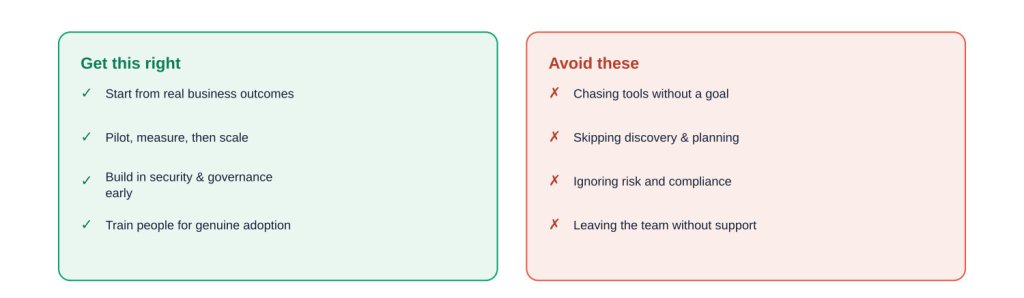
What to get right with AI Agent Use Cases — and the common mistakes to avoid.
Key takeaways
- AI Agent Use Cases is best approached around clear business outcomes, not tools or hype.
- How AI agents transform business.
- Customer service and support.
- Sales, marketing, and operations.
- Finance, HR, and technology.
- Pilot, measure, and then scale — with security, governance, and adoption built in.
- user.com.sg can help you plan, implement, and optimise AI Agent Use Cases for your context.
Conclusion
AI agents are transforming modern businesses by automating complex, multi-step work across every function. From customer service and sales to operations, finance, human resources, IT, and data analytics, agents are being applied to transform how businesses operate, delivering efficiency, capacity, and improved capability. By handling end-to-end work that previously required constant human involvement, agents free employees for higher-value activities and enable organisations to work faster and at greater scale, making their impact broadly transformative.
Capturing this transformative value depends on how agents are implemented. The businesses seeing the greatest impact identify valuable, suitable use cases, start focused and prove value before scaling, implement soundly with good information and oversight, and measure results. Approached this way, AI agents become a powerful source of transformation across the business. As agents continue to advance, their use cases will expand further, making the ability to apply them effectively an increasingly important advantage for modern businesses.
Work with USER on AI Agent Use Cases
If you are exploring AI Agent Use Cases for your organisation, the most valuable next step is a focused conversation about your AI goals, current state, and the outcomes that matter most. User Experience Researchers (USER) is an AI transformation expert that can help guide your team to create the most effective outcomes. See more about USER’s capabilities at user.com.sg to find recommended discovery, planning, or implementation pathway for your context.
Frequently asked questions
AI agents transform businesses by automating complex, multi-step work across functions, enabling organisations to operate more efficiently and at greater scale. Because agents can reason, gather information, make decisions, and take actions, they complete entire processes, delivering efficiency, capacity, and improved capability.
Top use cases include customer service and support, sales and marketing, operations and administration, finance and accounting, human resources, IT and software, and data and analytics. Agents transform each of these functions by automating complex, multi-step work.
Agents handle customer enquiries end to end — understanding requests, retrieving information, taking actions, and resolving issues autonomously — rather than just answering questions. This resolves routine interactions instantly and around the clock while freeing human agents for complex, high-value interactionsklp
Yes. Agents automate financial processes such as transaction handling, reconciliation, reporting, and analysis, interpreting documents and exceptions that defeat simple automation. This reduces processing time and cost, improves accuracy, and frees finance staff for higher-value analytical work.
Agents automate complex operational and administrative processes that span systems and require decisions, handling them end to end. This reduces processing times and costs, improves accuracy, and frees staff from repetitive work, transforming the operational activities that underpin business functions.
A business should identify valuable, suitable use cases, start with focused applications and prove value before scaling, implement soundly with good information and oversight, and combine agents with human judgement. This disciplined approach captures the transformative value while managing risks.
Businesses can measure impact through the work automated and volume handled, reductions in processing time and cost, improvements in quality and accuracy, and effects on capacity and experience. Comparing these before and after implementation makes the value concrete and guides where to expand.
AI agents benefit functions with complex, multi-step, information-intensive work — including customer service, sales and marketing, operations, finance, HR, IT, and data analytics. Because such work exists across the organisation, agents offer broad opportunities to transform business functions.

