
Last Updated: 11 November 2026
AI adoption in consultancy is growing fast: a 2026 survey of 100 consulting leaders found 79% of firms use generative AI daily. By analysing data and supporting decisions, AI helps consultants develop more precise, adaptable business frameworks aligned with organisational goals.
Rather than relying entirely on manual assessments and traditional planning methods, consultants can use AI-powered tools to examine operations, evaluate performance, identify gaps and develop data-driven recommendations. These capabilities can be applied across different business functions, from logistics and human resources to education and government services.
For organisations, the opportunity goes beyond automation. AI can help create stronger business frameworks that connect strategy, people, processes, technology and performance. Consultancies combine these insights with industry knowledge and human judgement to recommend practical improvements that support long-term growth.
This guide explains how AI enhances consultancy services, the technologies that support business framework development, its applications across industries, and how organisations can adopt AI effectively.
Summary
| Element | Detail |
| Topic | Using AI to build a smarter framework for business consultancy |
| Covered here | How AI enhances consultancy services; The technologies that support business analysis; Building a data-driven business framework; Applications across logistics, HR, education and government; Business benefits, implementation challenges and best practices |
| Who is this for | Business leaders, organisation executives, consultants, operations managers, HR professionals, educators, government agencies, and digital transformation teams |
What AI Brings to the Business Consultancy Industry
Traditional business consultancy involves reviewing organisational data, interviewing stakeholders, assessing existing processes and identifying areas for improvement. These activities remain important, but they can require considerable time and resources, particularly in large or complex organisations.
AI can support this work by analysing information more quickly, identifying patterns and helping consultants explore possible solutions. Its value comes from improving the quality and speed of analysis, allowing consultants to focus on strategic recommendations and implementation.
- Data Analysis and Business Intelligence
AI can analyse financial reports, operational records, customer feedback and performance data to identify trends, inefficiencies and potential opportunities.
Consultants can use these insights to understand business performance, compare results and support recommendations with relevant evidence.
- Predictive Analytics and Forecasting
Predictive analytics uses historical and current data to estimate possible future outcomes. Consultants can use it to examine demand, resource requirements, operational risks and business performance.
These forecasts help organisations prepare for changes and make more informed plans, although predictions should always be assessed against real-world conditions.
- Planning & Process Assessment, and Optimisation
AI strengthens analytics and assessment by examining how work moves across departments, surfacing recurring delays and highlighting activities suited to automation or process redesign. It can also organise information, summarise research and compare possible business scenarios, giving consultants a clearer evidence base.
Combined with workflow analysis and robotic process automation (RPA), these capabilities reduce repetitive manual work and keep operations running more smoothly. Human decision-makers can then evaluate options and shape recommendations around organisational priorities with better-informed insight. Final decisions still rest on professional judgement, stakeholder input and an understanding of business risks.
AI Tools and Technologies Used in Consultancy Services
Different AI technologies support different parts of consultancy work. The right combination depends on the organisation’s objectives, available data and existing systems.
- Microsoft 365 Copilot
Microsoft 365 Copilot works inside Word, Excel, PowerPoint and Teams to draft reports, summarise meetings and analyse spreadsheet data. It helps consultants move from raw client information to client-ready deliverables faster.
- ChatGPT
ChatGPT supports brainstorming, document summarisation and first-draft analysis across research and proposal work. Consultants use it to speed up early-stage thinking, provided outputs are verified and confidential client data is handled through approved enterprise settings.
- Deep Research (Perplexity)
Deep Research is a mode within Perplexity that runs dozens of searches, reads hundreds of sources and compiles the findings into a structured, cited report in a few minutes. It helps consultancies produce market, competitor and industry briefings in far less time, with source links that make the evidence easy to verify before it reaches a client.
- Predictive Analytics
Predictive analytics helps organisations estimate future demand, resource requirements, operational risks and performance trends. It supports planning by allowing consultants to examine possible outcomes before decisions are made.
- Robotic Process Automation and Intelligent Automation
RPA automates repetitive, rule-based activities across business applications. When combined with AI, it can support more complex workflows involving document interpretation, information extraction and decision support.
- Copilot in Power BI (Microsoft)
Copilot in Power BI lets consultants ask questions of client data in plain language and have it build charts, dashboards and written report summaries automatically. It supports business intelligence by turning raw operational and financial data into visual insights, so consultants and business leaders can monitor performance and spot areas requiring action without manual report building.
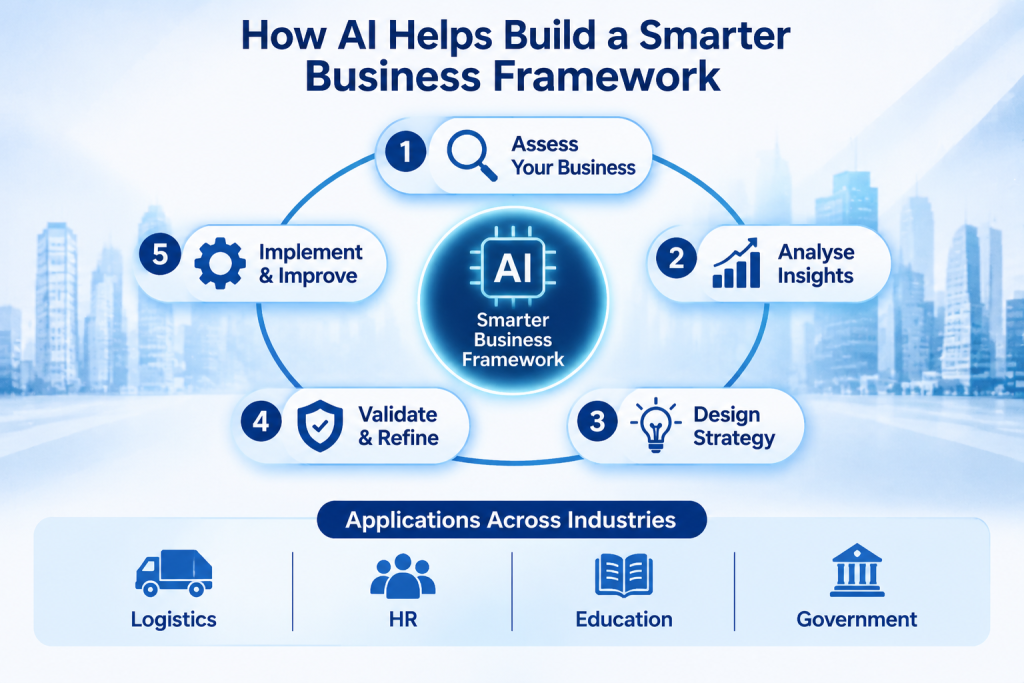
How AI Helps Build a Smarter Business Framework
A business framework provides the structure an organisation uses to connect its goals, people, processes, resources and performance measures. It helps establish how work is organised, how decisions are made and how progress is evaluated.
AI can strengthen framework development by helping consultants assess an organisation’s current position and identify opportunities for improvement.
A practical approach involves the following stages:
- Discovery and Organisational Assessment
Consultants begin by understanding the organisation’s objectives, existing structure, operations, challenges and available resources.
AI tools can help review documents, analyse performance data and organise information gathered from different departments. This creates a clearer picture of the organisation’s current state.
- Data Analysis and Gap Identification
After gathering relevant information, consultants use AI-supported analysis to identify performance gaps, operational bottlenecks, resource constraints and potential risks.
For example, a logistics company may discover recurring delivery delays, while an educational institution may identify gaps in student support services. These findings help determine which areas should be prioritised.
- Framework Design and Strategy Development
Consultants use the assessment results to develop a framework that connects business objectives with practical actions.
Depending on the organisation, this may include:
- Business strategy and governance: Defines objectives, responsibilities, decision-making structures and accountability.
- Organisational structure: Establishes departments, reporting relationships and functional responsibilities.
- People and workforce planning: Aligns employee capabilities, staffing requirements and development priorities with business needs.
- Operational processes: Defines workflows, service standards and opportunities for improvement.
- Technology and data management: Identifies the systems, tools and information required to support operations.
- Risk and compliance management: Establishes controls, policies and procedures for managing organisational risks.
- Performance management: Defines key performance indicators (KPIs), reporting practices and review processes.
- Continuous improvement: Creates a process for evaluating results and adapting the framework as needs change.
- Validation and Stakeholder Review
AI-generated insights and proposed recommendations must be reviewed before implementation. Consultants work with management, employees and relevant stakeholders to confirm that the framework is realistic, relevant and aligned with organisational requirements.
This stage also helps identify potential data issues, operational limitations, compliance concerns and unintended consequences.
- Implementation and Continuous Improvement
Once approved, the framework is translated into operational plans, policies, workflows and performance measures.
AI-supported monitoring can help track progress, identify emerging issues and provide information for future reviews. Regular assessment allows the organisation to refine its framework as its objectives, resources and operating environment change.
Where AI Consultancy Delivers Value: Industry Applications
AI-supported consultancy is not limited to one industry. Different organisations can use it to address sector-specific challenges while following a common approach: understand the business, analyse relevant information, design improvements and measure results.
- Logistics and Supply Chain
In logistics, AI can help consultants examine delivery performance, inventory levels, transportation costs and supply chain operations.
Predictive analytics can support demand forecasting and resource planning, while AI-powered route optimisation can help identify more efficient delivery schedules. These insights allow consultants to recommend improvements in logistics planning, warehouse operations and supply chain visibility.
- Human Resources and Workforce Management
For HR consultancy, AI can support workforce planning, skills assessment, recruitment analysis and employee development.
Consultants can use workforce data to identify skills gaps, review job structures and recommend improvements to recruitment, performance management and retention strategies. AI can also help organise employee feedback and identify recurring engagement concerns, subject to appropriate privacy and fairness safeguards.
- Education and Learning Institutions
Educational institutions can use AI-supported consultancy to assess enrolment trends, student performance, resource allocation and administrative processes.
AI can help identify areas where students may need additional support, inform learning resource planning and improve administrative workflows. Consultants can use these insights to recommend improvements in academic operations, student services and institutional planning.
- Government Agencies and Public Services
Government agencies can apply AI to analyse service demand, review administrative processes and support resource planning.
Consultants may use AI to identify service bottlenecks, examine public feedback and assess operational performance. These insights can support recommendations for more efficient public service delivery, better resource allocation and data-informed policy development.
Government applications require particular attention to transparency, accountability, privacy and the responsible use of public data.
- Finance and Business Operations
In finance and business operations, AI can support financial analysis, budget forecasting, transaction monitoring and process reviews.
Consultants can use these capabilities to identify cost inefficiencies, improve reporting and assess financial risks. This can help organisations develop stronger financial controls and more informed resource allocation strategies.
The Benefits of AI-Enabled Businesses
When applied with reliable data and appropriate oversight, AI can improve the way consultancy services assess business challenges and develop recommendations.
The key benefits include:
- Greater data precision: Supports more detailed analysis and helps identify patterns across business data.
- Faster, more in-depth assessments: Reduces the time needed to review documents, reports and operational information.
- More informed decision-making: Provides evidence and insights to support business planning.
- Improved efficiency: Identifies repetitive tasks and processes that may be streamlined or automated.
- Stronger adaptability: Helps organisations assess changing conditions and adjust their strategies.
- Measurable performance: Supports the use of KPIs and data-driven monitoring to evaluate improvements.
The value of AI is not simply in producing reports faster. It is in helping consultants turn organisational information into practical recommendations that support better business outcomes.
Implementation Challenges and How to Overcome Them
Despite its potential, AI consultancy can deliver limited results when organisations overlook the requirements for successful implementation.
Data Quality and Availability
Incomplete, outdated or inconsistent information can affect the accuracy of AI-generated insights. Organisations should review their data sources, establish clear standards and address quality issues before relying on AI analysis.
Data Privacy and Security
Business information may include employee records, customer details, financial data and confidential operational information. Organisations should apply access controls, security measures and appropriate data protection practices when using AI tools.
Integration with Existing Systems
AI tools may need to connect with existing enterprise systems, databases and operational platforms. Consultants should assess compatibility, integration requirements and technical limitations before recommending a solution.
Accuracy and Reliability
AI-generated outputs may contain errors, incomplete analysis or misleading conclusions. Consultants should verify important findings against reliable sources and involve subject matter experts in the review process.
Employee Adoption and Change Management
New technologies and processes can affect how employees perform their work. Organisations should communicate the purpose of changes, provide relevant training and involve stakeholders throughout implementation.
Governance and Accountability
Organisations need clear rules on how AI is used, who reviews its outputs and who remains accountable for decisions. Human oversight is especially important in sensitive areas such as employment, education and public services.
Best Practices for Successful AI-Enabled Businesses
Successful AI adoption starts with clear organisational objectives, not the selection of a particular tool.
Organisations and consultants should focus on the following practices:
- Start with business objectives: Define the problems to solve and the outcomes the organisation wants to achieve.
- Assess current operations: Understand existing processes, systems, resources and organisational challenges.
- Use reliable data: Check data quality, relevance, security and availability before analysis.
- Select suitable AI tools: Match technologies to specific requirements rather than adopting tools without a clear purpose.
- Validate recommendations: Review AI-generated insights with consultants, specialists and relevant stakeholders.
- Maintain human oversight: Keep people accountable for important decisions and sensitive business processes.
- Start with focused initiatives: Test AI in manageable areas, measure results and expand when value is demonstrated.
- Monitor and improve: Review performance regularly and adjust the framework as organisational needs change.
The strongest consultancy outcomes come from combining AI capabilities with industry knowledge, sound governance and practical implementation planning.
Measuring the Success and ROI of AI Consultancy
AI-supported consultancy should be evaluated based on its contribution to business performance. The right measures depend on the organisation’s industry, objectives and the improvements being introduced.
| Business Area | Example Metrics |
| Logistics | Delivery time, fulfilment rate, inventory accuracy, transportation cost |
| Human resources | Employee turnover, time to hire, training completion, workforce productivity |
| Education | Student retention, course completion, service response time, resource utilisation |
| Government | Service processing time, case resolution rate, service accessibility, operating cost |
| Finance and operations | Cost per transaction, reporting accuracy, budget variance, process completion time |
Organisations should establish baseline performance before implementation and compare results over time. This helps determine whether the consultancy recommendations and AI-supported initiatives are delivering measurable improvements.
ROI should consider both direct financial outcomes and wider operational benefits, such as improved service quality, reduced delays, stronger decision-making and better resource utilisation.
AI and the Future of Business Consultancy
AI is moving consultancy services towards more data-driven, predictive, and adaptive approaches. As AI technologies develop, consultants will have more opportunities to analyse complex business environments, explore different scenarios and identify potential improvements before issues become more difficult to address.
Generative AI and AI agents may also support research, documentation and coordination across business processes. This could help consultants manage more complex assessments and provide organisations with faster access to relevant insights.
However, technology alone will not determine the success of a business framework. Industry knowledge, leadership, organisational culture, regulatory requirements and human judgement will continue to influence how strategies are developed and implemented.
The future of consultancy lies in combining AI capabilities with experienced professionals who can interpret information, understand business context and guide meaningful organisational change.
What to Get Right with AI in Consultancy Services
Avoid these:
- Treating AI as a replacement for consultancy expertise
- Adopting tools without clear business objectives
- Relying on incomplete or unreliable data
- Implementing recommendations without validation
- Overlooking security, governance and employee adoption
Key Takeaways
- AI helps consultants analyse organisational information and develop more evidence-based business recommendations.
- AI technologies can support forecasting, process assessment, strategic planning and performance monitoring.
- A smarter business framework connects strategy, people, processes, technology and performance.
- AI consultancy can deliver value across logistics, HR, education, government and other industries.
- Data quality, privacy, governance and human oversight are essential for responsible AI adoption.
- Successful implementation starts with clear objectives, focused initiatives and continuous improvement.
Conclusion
AI is creating new opportunities for consultancy services to help organisations build smarter, more adaptable business frameworks. By analysing data, identifying operational gaps and supporting strategic planning, AI can help consultants develop recommendations that are more precise and relevant to different organisational needs.
Its applications extend across industries. Logistics companies can improve supply chain planning, HR teams can strengthen workforce strategies, educational institutions can enhance resource planning, and government agencies can improve public service processes. Each sector has different requirements, but all can benefit from better information, more effective decision-making and structured implementation.
Ultimately, AI is most valuable when combined with human expertise. Consultants provide the industry knowledge, judgement and strategic direction needed to turn AI-generated insights into practical improvements. For organisations looking to strengthen their operations and prepare for future challenges, this combination can provide a foundation for sustainable business growth.
Work with USER to Create Smarter Business Frameworks
If your organisation is reviewing its operations, planning a transformation or looking to improve its existing business framework, the first step is to understand your current challenges and long-term objectives.
User Experience Researchers, also known as USER (user.com.sg) can help organisations explore consultancy approaches that combine data-driven insights, structured planning and practical recommendations. With the right strategy and implementation approach, businesses and public institutions can build more efficient, adaptable and future-ready operations.
AI helps consultants analyse business data, identify trends, assess operational performance and support strategic planning. It can also assist with research, reporting, forecasting and process documentation. An AI-powered business framework uses AI-supported insights and analysis to help an organisation plan, manage and improve its operations. It connects business objectives with people, processes, technology, governance and performance measures. AI consultancy can support logistics, human resources, education, government, finance, healthcare, manufacturing and other sectors. Its applications depend on each organisation’s objectives, operational requirements and available data. AI can analyse large volumes of information, identify patterns and support forecasting. Consultants can use these insights to compare options, assess risks and develop evidence-based recommendations. Yes. AI can identify process bottlenecks, support demand forecasting and help automate repetitive activities. Consultants can use these findings to recommend workflow improvements and better resource allocation. No. AI supports analysis and documentation, but consultants provide the professional judgement, industry knowledge and stakeholder understanding needed to develop and implement effective business strategies. Common challenges include poor data quality, privacy and security risks, system integration, inaccurate outputs, employee resistance and unclear governance. These require careful planning and human oversight. Start by identifying business challenges and defining measurable objectives. Assess existing data and processes, select suitable AI tools, test them in focused initiatives and validate the results before expanding implementation. Frequently Asked Questions

