
Last updated: 05 November 2026
Digital payments have changed how people and businesses buy, transfer money, do their transactions, and manage their finances. From contactless cards and mobile wallets to instant bank transfers and other means, financial transactions are becoming faster and more accessible. Artificial intelligence (AI) is taking this transformation further by helping financial institutions process transactions, identify suspicious activity, understand customer behaviour and deliver more personalised services.
For banks and payment providers, AI is no longer limited to experimental technology or back-office automation. It is increasingly being applied across fraud prevention, customer service, credit assessment, compliance, risk management, and financial planning. These applications allow institutions to work with large volumes of data, recognise patterns, and support decisions that would be difficult to manage through traditional systems alone.
However, adopting AI in financial services involves more than introducing new tools. Institutions must consider data protection, cybersecurity, transparency, regulatory obligations, and the role of human oversight. This guide explores how AI is transforming digital payments and modern banking, where it is already being used, what the future of AI-powered finance may look like, and how financial institutions can leverage it effectively.
AI in Digital Payments and Banking Guide Summary
| Element | Detail |
| Topic | AI in Digital Payments and Banking |
| Covered here | How AI is transforming digital payments; AI applications in fraud detection, payment processing and modern banking; The extent of AI adoption in financial services; The future of AI-powered finance; How financial institutions can leverage AI effectively; Implementation challenges, risks and best practices |
| Who is this for | Banking and financial services leaders, fintech professionals, business and technology leaders, IT managers, digital transformation teams, payment providers and financial operations professionals |
What is AI for Digital Payments and Banking
Artificial intelligence in banking refers to the use of technologies such as machine learning, natural language processing, predictive analytics and generative AI to analyse information, recognise patterns, automate tasks and support financial decisions.
In digital payments, AI can examine transaction information to identify unusual behaviour, assess potential fraud, and help payment providers make faster risk decisions. In banking, it can support customer interactions, analyse financial activity, assist with credit assessments, and automate document-heavy processes.
Unlike traditional systems that depend entirely on predefined rules, AI models can identify patterns across large datasets and adapt as new information becomes available. This makes them useful in financial environments where transaction volumes are high and customer behaviour, fraud techniques, and market conditions continually change.
AI does not operate independently of the wider banking infrastructure. Its effectiveness depends on the quality of available data, the systems it connects to, the controls governing its use, and the people responsible for reviewing its outputs.
How AI Is Transforming Digital Payments
Digital payment systems must process transactions quickly while protecting customers and merchants from fraud. AI supports this balance by helping providers assess transaction risk, identify unusual patterns, and improve the payment experience.
Real-Time Fraud Detection and Prevention
Fraud detection is one of the most established applications of AI in digital payments. Financial institutions process transactions across different channels, devices, locations and payment methods. Reviewing every transaction manually is impractical, while fixed rules may struggle to identify new or changing fraud patterns.
Machine learning models can analyse transaction characteristics, including payment amounts, frequency, location, device information and previous account activity. They can then identify behaviour that differs from an established pattern and flag transactions for additional verification or investigation.
For example, a payment made from an unfamiliar device shortly after several unusual transactions may trigger a risk alert. Depending on the institution’s controls, the transaction could be subjected to additional authentication, temporarily held or referred for human review.
AI can also help institutions identify patterns across multiple accounts and transactions, supporting the detection of coordinated fraud activity. However, automated decisions must be monitored to reduce false positives and avoid unnecessarily blocking legitimate payments.
Faster and Smarter Transaction Processing
AI can support payment processing by helping institutions assess transaction risks, prioritise exceptions, and identify operational problems. When integrated with payment platforms, it can assist in routing decisions and help teams investigate transactions that require additional attention.
Predictive analytics can also help payment providers anticipate transaction volumes and identify periods of increased demand. This information can support capacity planning and operational readiness, particularly during seasonal shopping periods, and major sales events.
The objective is not simply to make payments faster. It is to make transactions and operations more reliable, responsive, and efficient while maintaining the security checks required for financial transactions.
Personalised Payment Experiences
AI tools can enable banks and payment providers to use customer information more effectively to deliver relevant services. By analysing spending patterns, transaction history, and customer preferences, institutions can provide customised insights, budgeting suggestions, and notifications.
For example, a digital banking application may categorise expenses, highlight changes in spending habits, or notify customers when they approach a budget limit. Payment providers may also use customer insights to improve the relevance of offers and services, subject to appropriate consent and data protection requirements.
Personalisation can make digital financial services more useful, but it must be supported by transparent data practices. Customers should understand how their information is used and have appropriate control over their personal data.
The Growing Role of AI in Modern Banking
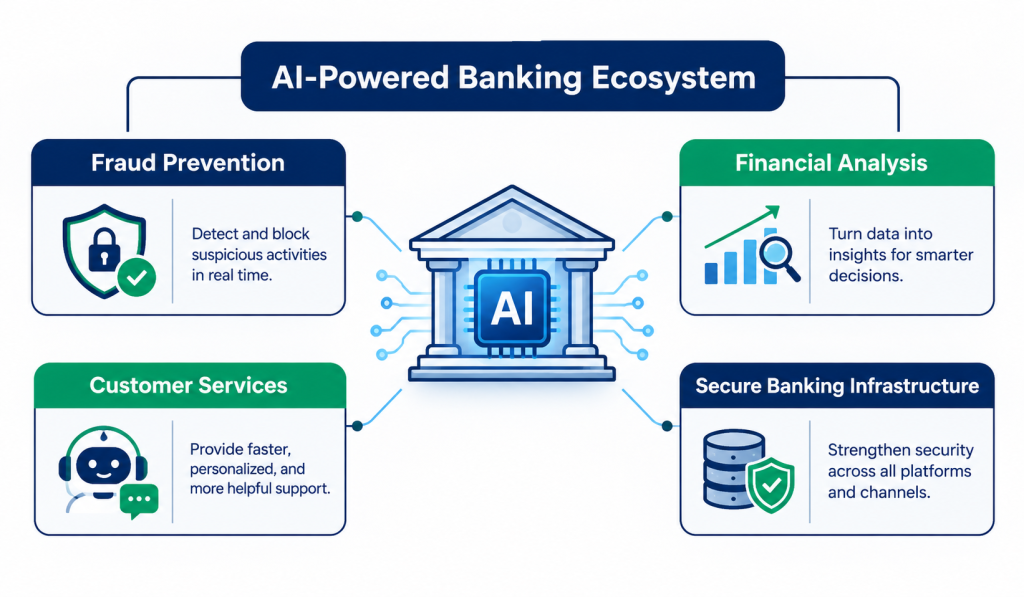
AI is expanding beyond digital payments into customer service, credit assessment, risk management and daily banking operations. Financial institutions use it to improve efficiency, support decisions and manage complex processes. Many nations are adopting and encouraging their banking sectors to follow international conventions on digital banking and the careful adoption of AI into their operations.
Visa’s investment in Singapore reflects this direction, with six global technology hubs focused on agentic AI and next-generation payments. Below are three roles where AI platforms are increasingly being used in banks worldwide:
- AI-Powered Customer Service and Virtual Assistants
Banks use AI assistants to answer routine enquiries, explain banking services, and guide customers through digital processes. Generative AI can also help employees retrieve information, summarise interactions, and prepare responses.
Complex or sensitive concerns, such as disputed transactions and account access issues, should still be escalated to human support.
- Credit Assessment and Risk Management
AI helps lenders analyse financial information, identify patterns, and assess credit risk. Predictive models can also detect changes in repayment behaviour and flag potential financial difficulties.
Since credit decisions affect customers’ financial opportunities, institutions must ensure their models are explainable, tested for bias, and compliant with lending regulations.
- Operational Automation and Back-Office Efficiency
AI and robotic process automation (RPA) can streamline repetitive banking tasks such as customer onboarding, document verification, reconciliation and reporting.
For example, AI can extract information from submitted documents, identify missing details, and flag inconsistencies before routing applications for review. This reduces manual work, improves consistency, and allows employees to focus on more complex tasks.
The Extent of AI Adoption in Modern Banking
AI adoption in banking is broadening, but it is not uniform across every institution or function. Larger banks and payment providers may have the resources to deploy AI across fraud monitoring, customer service, risk management, and operational automation. Smaller financial institutions may begin with more focused applications, such as customer support automation or transaction monitoring.
The extent of adoption also depends on the maturity of an institution’s data infrastructure, legacy systems, technical capabilities and governance arrangements.
The direction of adoption is towards broader integration. Rather than using AI as a standalone feature, financial institutions are increasingly considering how it can work across payment platforms, customer relationship management systems, core banking applications, and operational workflows. Below are some examples from global banks and nations:
DBS: moving from experiments to bank-wide capabilities. In its June 2025 account of responsible AI adoption, DBS described how early experiments evolved into institutional programmes supporting personalised customer engagement, fraud detection and decision-making. Its CSO Assistant helps customer service officers by transcribing conversations, retrieving information and assisting with documentation, while DBS GPT supports employee content generation and information retrieval. These examples illustrate a shift towards AI embedded in everyday customer service and internal workflows, supported by shared data platforms and governance.
JPMorganChase: building an employee AI hub. The bank launched LLM Suite in summer 2024 to give eligible employees secure access to large language models for tasks such as idea generation and content drafting. In June 2025, it described its next steps as connecting the platform to additional internal data sources and combining generative AI with workflows to create agents capable of completing a sequence of actions. This shows the direction from a standalone assistant towards connected, multi-step workflows; those next steps were stated development plans, not evidence that every process had already been automated. Read JPMorganChase’s LLM Suite update.
Singapore: supporting AI development through funding and collaboration. Public authorities are also helping financial institutions build these capabilities. In July 2024, the Monetary Authority of Singapore (MAS) announced enhanced AI and data support under its Financial Sector Technology and Innovation scheme. The measures support AI innovation centres covering model development, deployment, governance, testing and monitoring, alongside shared platforms for industry-wide applications. MAS identified scam and fraud detection as an initial pilot area involving banks, technology providers and public agencies, illustrating how public support can encourage collaboration beyond individual institutions.
United Kingdom: encouraging development through supervised testing. The Financial Conduct Authority (FCA) supports responsible AI adoption through its AI Lab. Its Supercharged Sandbox gives financial services firms access to computing resources, datasets and AI tools to develop and test early-stage ideas, while AI Live Testing supports more mature systems in real-world conditions with regulatory oversight. These initiatives illustrate a complementary approach to encouraging development in banking and wider financial services: providing technical resources and a route to test deployment readiness without removing the need for safeguards. Read about the FCA’s AI Lab.
Nevertheless, wider adoption does not mean every banking decision should be automated. The appropriate level of AI involvement depends on the financial impact, operational risk, regulatory requirements, and potential consequences for customers.
The Future of AI-Powered Finance
As AI capabilities develop, digital payments and banking are likely to become more connected, predictive and personalised. Future developments may move beyond individual automated tasks towards systems that coordinate multiple activities across financial platforms.
- Agentic AI and More Autonomous Financial Workflows
Agentic AI refers to systems that can interpret goals, plan steps and use connected tools to complete tasks with varying degrees of autonomy. In finance, potential applications include assisting with payment enquiries, coordinating internal workflows, and supporting financial operations.
For example, an AI agent could help a customer review recurring expenses, identify a subscription they may want to cancel and guide them through the relevant process. Within a bank, an agent could collect information from approved systems, prepare a case summary, and route it to an employee for a decision.
These capabilities require carefully defined permissions. An AI agent should not be given unrestricted authority to transfer funds, change account details, or make consequential financial decisions without appropriate authentication, safeguards, and approval mechanisms.
- More Intelligent and Context-Aware Payments
AI may make digital payments more responsive to context. Payment systems could use risk signals and customer preferences to support more appropriate authentication, identify unusual activity, and reduce unnecessary friction for legitimate transactions.
As digital wallets, account-to-account payments and other payment methods evolve, AI may also help financial institutions manage increasingly complex payment environments.
The priority will remain balancing convenience with security. Faster transactions are valuable only when customers can trust the systems processing them.
- Personalised Financial Guidance
AI-powered financial assistants may become more capable of helping customers understand their financial position. By analysing permitted account information, these tools could summarise spending, explain cash flow patterns, and provide budgeting suggestions based on individual circumstances.
Generative AI may make financial information easier to understand by translating complex statements or product details into clearer language.
However, there is an important distinction between financial education and regulated financial advice. Institutions must define what their AI tools are permitted to recommend, disclose their limitations, and ensure that customers can access qualified human support when needed.
- Stronger Collaboration Between AI and Human Expertise
The future of banking is unlikely to depend on AI operating without human involvement. Instead, AI will increasingly support employees by handling repetitive analysis, preparing information and highlighting potential risks.
Human specialists will remain important for complex investigations, customer complaints, sensitive financial decisions, and situations where context or judgement is required.
This combination can help financial institutions improve productivity without losing accountability or the personal support customers expect from their banks.
How Financial Institutions Can Leverage AI Effectively
Successful AI adoption requires more than choosing a model or purchasing a platform. Financial institutions need a clear implementation strategy that connects technology decisions to customer needs, operational priorities, and risk management.
- Start With Clearly-Defined Business Outcomes
Banks should identify the problems they want AI to solve before selecting a technology. Potential objectives include reducing payment fraud, improving customer response times, accelerating onboarding, lowering manual processing effort, or strengthening compliance monitoring.
Each initiative should have measurable outcomes. For example, a fraud detection project could track detection accuracy, false-positive rates, investigation time, and confirmed fraud losses.
Starting with business outcomes helps prevent institutions from investing in AI simply because the technology is available.
- Build a Reliable and Connected Data Foundation
AI systems depend on relevant, accurate and accessible data. In banking, information may be spread across core banking platforms, payment gateways, customer systems, fraud monitoring tools, and external data sources.
Institutions should assess data quality, consistency, accessibility, and ownership before deploying AI. They should also establish secure integration between systems and ensure that sensitive customer information is handled according to applicable privacy and security requirements.
Poor data quality can undermine model performance, produce unreliable recommendations, and create unnecessary operational risks.
- Choose the Right AI Technology for Each Use Case
Different banking problems require different capabilities. Machine learning may be suitable for transaction risk scoring, and predictive analysis. Natural language processing can support document review, and customer communications. Generative AI may assist with knowledge retrieval and summarisation, while RPA can automate structured, repetitive actions.
These technologies can also work together. For example, an AI model may identify a suspicious transaction, a workflow platform, may create an investigation case, and an employee may review the evidence before deciding what action to take.
Institutions should select technologies based on the process, available data, integration requirements, and level of risk rather than adopting a single solution for every use case.
- Establish Strong Governance and Human Oversight
Financial institutions must define who is responsible for AI systems, how models are approved and monitored, and when human intervention is required.
Governance should cover model validation, access controls, data privacy, explainability, bias testing, audit trails, and incident management. High-impact decisions should receive appropriate human review, particularly when they affect access to financial services or customer funds.
Institutions should also maintain clear escalation procedures for inaccurate outputs, suspicious activity, and system failures.
- Integrate AI With Existing Banking Infrastructure
AI delivers greater operational value when it can work with the systems employees and customers already use. Integration with core banking platforms, payment infrastructure, customer service tools, and compliance applications can reduce information silos and support end-to-end workflows.
However, integration should be planned carefully. Legacy systems may have limitations around APIs, data formats, security controls and processing capacity. Banks should assess these constraints and use secure, well-documented interfaces to connect AI capabilities with existing infrastructure.
- Pilot, Measure and Scale Gradually
A focused pilot allows institutions to test AI performance before expanding its use. A suitable starting point might be a document classification workflow, an internal customer service assistant or a specific fraud monitoring process.
During the pilot, teams should measure accuracy, processing time, exception rates, customer impact and operational costs. They should also test how the system behaves when information is incomplete, unusual or incorrect.
Once the pilot demonstrates measurable value and meets governance requirements, the institution can refine the solution and expand it to other processes.
- Prepare Employees for AI-Enabled Banking
AI adoption changes how different teams in banks work. Employees need to understand how AI tools operate, how to interpret their outputs and when to challenge or escalate automated recommendations.
Training should cover responsible AI use, data handling, security awareness and the limitations of automated systems. Involving employees during implementation can also help identify practical problems and improve adoption.
The goal is to make AI a useful operational capability, supported by people who understand both its benefits and its risks.
Challenges and Risks of AI in Digital Payments and Banking
Despite its potential, AI introduces challenges that financial institutions must address before deploying it at scale.
Data privacy and cybersecurity: Sensitive banking data and connected AI systems face risks such as unauthorised access, data poisoning and prompt injection. Encryption, access controls, secure integration and appropriate retention policies help protect them.
Bias and limited explainability: AI can reproduce unfair patterns in historical data or generate outputs that are difficult to explain. Regular testing, monitoring and sufficient transparency support fairer decisions and accountability.
Integration and overreliance on automation: Legacy platforms may need data restructuring, API development and infrastructure upgrades to support AI. Since AI can misinterpret information or produce inaccurate recommendations, testing, human oversight and clear escalation procedures remain essential.
Addressing these risks from the beginning helps institutions build AI systems that are secure, reliable and aligned with customer expectations.
Measuring the Success of AI in Banking
Financial institutions should evaluate AI initiatives using a combination of operational, financial, customer and risk-related measures.
Useful performance indicators include:
- Fraud detection: Detection rates, confirmed fraud losses and false-positive rates.
- Payment performance: Transaction processing time, payment success rates and exception volumes.
- Operational efficiency: Manual processing hours, cost per transaction and workflow completion time.
- Customer experience: Customer satisfaction, service response time and resolution rates.
- Model performance: Accuracy, reliability, model drift and the frequency of human overrides.
- Risk and compliance: Investigation quality, audit findings, policy adherence and unresolved control issues.
These measures should be reviewed continuously. A system that reduces processing time but increases customer complaints or incorrect decisions may not deliver genuine business value.
Key Takeaways
- AI is transforming digital payments through fraud detection, transaction monitoring, payment risk assessment and personalised customer experiences.
- Modern banks use AI across customer service, credit assessment, compliance, risk management and back-office operations.
- The extent of AI adoption varies according to institutional readiness, data infrastructure, investment and governance maturity.
- Agentic AI and more autonomous workflows may expand the role of AI in future financial services but require strict permissions and human oversight.
- Effective AI implementation starts with clear business outcomes, reliable data, appropriate technology and secure system integration.
- Continuous monitoring, employee training and responsible governance are essential to maintaining customer trust and achieving sustainable value.
Conclusion
AI is reshaping digital payments and banking by making financial services more responsive, data-driven and efficient. From identifying suspicious transactions to supporting customer service and automating operational workflows, it offers financial institutions new ways to improve how they serve customers and manage risk.
The future of AI-powered finance will depend not only on more capable technology but also on how responsibly institutions apply it. Strong data foundations, secure integration, transparent governance and human oversight will be essential as AI becomes more deeply embedded in financial systems.
For banks and payment providers, the opportunity is to move beyond isolated AI experiments and build practical capabilities that improve customer experiences, strengthen operations and support better financial decision-making. Institutions that combine innovation with accountability will be better positioned to develop trusted, AI-enabled financial services.
Work With USER on AI and Digital Transformation
Exploring how AI can improve your organisation’s financial or business operations? User Experience Researchers (USER) helps organisations assess digital opportunities, modernise processes and implement technology solutions aligned with their operational needs. From intelligent automation and data analytics to bespoke digital solutions, the right approach begins with understanding your goals and identifying where technology can deliver measurable value.
Speak with USER by reaching them at user.com.sg to discuss your digital transformation objectives.
Frequently Asked Questions
AI is used in digital payments to detect suspicious transactions, assess payment risks, identify unusual spending patterns and support fraud prevention. It can also help payment providers improve transaction monitoring, manage exceptions and deliver more personalised payment experiences.
Banks use AI for fraud detection, customer service, credit assessment, risk management, anti-money laundering monitoring, document processing and operational automation. Some institutions also use generative AI to assist employees with information retrieval, summarisation and customer support.
AI can help detect and prevent certain types of digital payment fraud by identifying unusual patterns and suspicious activity. However, it cannot eliminate fraud entirely. Effective prevention requires AI models to work alongside authentication controls, cybersecurity measures, transaction monitoring and human investigation.
The future of AI in banking may involve more personalised financial services, intelligent payment systems, AI-powered assistants and agentic workflows that coordinate tasks across connected platforms. These developments will require strong governance, secure permissions and appropriate human oversight.
The main benefits include faster transaction monitoring, improved fraud detection, more efficient customer service, better risk analysis, reduced manual processing and more personalised financial services. The value depends on data quality, system integration and responsible implementation.
Key risks include data privacy breaches, cybersecurity threats, biased decisions, limited model explainability, inaccurate outputs and overreliance on automation. Financial institutions should address these risks through governance, testing, access controls, continuous monitoring and human oversight.
Banks should begin by identifying clear business objectives, assessing data readiness and selecting suitable AI technologies. They should integrate solutions securely, establish governance and human oversight, test through focused pilots, measure results and scale gradually when performance and risk controls are satisfactory.
AI is more likely to change banking roles than replace the need for human expertise entirely. It can automate repetitive tasks and support analysis, allowing employees to focus on complex decisions, customer relationships, investigations and activities requiring judgement and accountability.

