
Last Updated: 17 November 2026
Medium-sized enterprises and government offices increasingly depend on cloud-based platforms to manage communication, documentation, collaboration, and daily operations. Tools such as Microsoft’s Outlook and Teams, Slack, and other enterprise applications have become essential to how employees work and how organisations deliver services.
However, relying too heavily on a single technology provider can create operational risks. Such a scenario was highlighted when Outlook had an outage recently, causing a major disruption in global enterprise operations for many large organisations. When a major platform experiences an outage, employees may lose access to email, shared files, internal workflows, and important communication channels. Even a temporary disruption can delay approvals, interrupt services, and affect business productivity.
This is why business continuity should be a priority when organisations plan their technology infrastructure. Rather than depending entirely on third-party platforms, organisations can invest in custom enterprise solutions, such as bespoke internal portals, independent communication channels, and alternative workflow systems. These solutions provide additional ways to access essential information and coordinate work when primary platforms become unavailable.
This guide explains the risks of single-vendor dependency, how custom enterprise solutions support business continuity, which systems organisations should consider, and how to develop a practical strategy for maintaining operations during technology disruptions.
What Business Continuity Means for Modern Organisations
Business continuity refers to an organisation’s ability to maintain or restore essential operations when unexpected disruptions occur. These disruptions may include technology outages, cybersecurity incidents, network failures, system maintenance, supplier problems, or other events that affect normal business activities.
For organisations that rely heavily on cloud platforms, business continuity involves more than having an alternative application available. It requires a clear understanding of which services are essential, how employees will access information, how work will continue, and how systems can be restored.
A strong approach considers technology, people, processes, and communication together. Custom enterprise solutions can strengthen this approach by providing additional systems that are designed around the organisation’s specific operational requirements.
Business Continuity Guide Summary
| Element | Detail |
| Topic | Business Continuity and Custom Enterprise Solutions |
| Covered here | The risks of single-vendor dependency; Why organisations need alternative systems; How custom portals and backup communication support operations; Enterprise solution use cases; Implementation considerations and best practices |
| Who is this for | Medium-sized enterprises, government agencies, large organisations, IT leaders, operations managers, business executives and digital transformation teams |
The Risks of Relying on a Single-Vendor Ecosystem
Many organisations use a combination of cloud-based productivity, communication, and business applications. These platforms provide convenience, scalability, and centralised management. However, when too many essential processes depend on one provider, an outage can affect multiple areas of the organisation simultaneously.
Consider an organisation that uses Outlook for email, Teams for internal communication, SharePoint for document access, and Microsoft-based workflows for approvals. If a service disruption affects several connected applications, employees may struggle to contact colleagues, retrieve documents, or complete routine tasks.
The impact can extend beyond inconvenience. In large organisations, it can lead to major disruptions that can cause heavy losses in the long run.
- Communication Disruptions
Email and messaging platforms are often the primary channels for internal and external communication. When these services become unavailable, employees may be unable to receive instructions, coordinate activities, or respond to customers and stakeholders.
- Interrupted Workflows
Approvals, document submissions, requests, and reporting processes may depend on a specific cloud platform. If the platform becomes inaccessible, pending tasks can accumulate and operational deadlines may be missed.
- Limited Access to Business Information
Organisations may store important documents, procedures, and operational records within a single ecosystem. A service disruption can prevent employees from retrieving the information they need, even when the data itself has not been lost.
- Reduced Operational Resilience
When there are no alternative systems or documented procedures, organisations may have limited options during an outage. Employees may resort to personal email accounts, informal messaging applications, or manual processes, creating security and coordination risks.
The issue is not that cloud platforms are inherently unreliable. It is that an organisation should not allow one provider or application to become a single point of failure for every essential activity.
Why Custom Enterprise Solutions Matter
Custom enterprise solutions are applications and systems developed or configured` around an organisation’s specific requirements. Unlike standard off-the-shelf products, they can be designed to support particular workflows, internal processes, user roles, and operational priorities.
For business continuity, these solutions provide alternatives when primary third-party platforms are unavailable. They can help employees access essential resources, communicate with teams, and continue selected business activities without relying entirely on the main vendor ecosystem.
The objective is not necessarily to replace existing platforms. Instead, organisations can create complementary systems that reduce dependency and provide a practical fallback during disruptions.
- Bespoke Internal Portals
An internal portal can provide employees with a central location for accessing essential organisational information and services.
Depending on its design, it may include:
- Internal announcements and operational updates
- Department directories and contact information
- Standard operating procedures and policy documents
- Forms, requests and approval tracking
- Important reference documents and business notices
If the primary collaboration platform becomes unavailable, an independently hosted portal can provide access to selected information and resources.
For this to work during an outage, the portal must have an independent hosting and access strategy. Simply creating another application within the same affected ecosystem may not provide meaningful resilience.
- Backup Communication Systems
Organisations should have alternative communication channels for essential announcements, urgent coordination, and incident response.
A backup communication system may include an independent messaging platform, emergency notification service, SMS gateway, or dedicated incident communication channel.
For example, if the email platform becomes unavailable, department heads could use an approved alternative channel to share urgent instructions and coordinate critical activities.
These channels should have clear access controls, user lists, and communication procedures. Employees must also know when and how to use them.
- Independent Workflow and Request Management
Some business processes should continue even when a primary cloud application is unavailable.
Custom workflow applications can support essential activities such as service requests, internal approvals, incident reporting, and task assignments.
For example, a government office may require a system for recording urgent service requests, while a medium-sized enterprise may need to continue processing purchase approvals or operational reports. Larger organisations may need even more functionalities continuing despite service outages.
A well-designed alternative workflow system can preserve critical records and allow work to resume without waiting for the primary platform to recover.
- Alternative Document and Knowledge Access
Access to important documents should not depend entirely on one application or storage service.
Organisations can establish secure alternative repositories for critical policies, emergency procedures, contact lists, templates, and operational records.
These repositories should have appropriate backup schedules, access permissions, encryption, and version controls. They should also be tested to confirm that employees can retrieve the information when needed.
Where Custom Enterprise Solutions Deliver Value
Different organisations have different operational requirements. A useful enterprise solution should reflect the processes, responsibilities, and services that must remain available during disruptions.
- Medium to LargeEnterprises
Businesses of scale often depend on cloud applications for finance, human resources, sales, procurement, and daily communication.
A custom internal portal can provide access to operational notices, department contacts, procedures, and essential documents. Alternative request and approval workflows can also help teams continue selected activities during a service disruption.
This approach supports business continuity without requiring the organisation to replace every existing platform.
- Government Offices and Public Agencies
Government offices manage public services, internal coordination, records and administrative processes that may need to continue during technology disruptions.
Custom enterprise solutions can provide alternative access to internal procedures, service information, department directories, and emergency announcements.
For example, an agency could maintain an independent internal portal for critical operational information and an approved backup channel for urgent coordination. Such systems should follow government security, privacy, accessibility, and records-management requirements.
- Logistics and Supply Chain Organisations
Logistics operations depend on timely communication between warehouses, transport teams, suppliers, and customers.
If a primary platform becomes unavailable, alternative communication and workflow systems can help coordinate deliveries, report incidents, and share essential operational updates.
A custom portal may also provide access to emergency contact information, delivery procedures, and contingency instructions.
- Human Resources and Administrative Teams
HR departments rely on communication and workflow systems for employee requests, onboarding, policy distribution, and internal announcements.
A backup portal can provide access to essential HR policies, forms, employee contacts, and instructions during a disruption. Alternative request channels can help maintain selected administrative processes until normal systems are restored.
How to Develop a Business Continuity Strategy with Custom Enterprise Solutions
Developing an effective continuity strategy requires more than building an alternative application. Organisations must identify their critical operations, understand their technology dependencies, and determine which services need to remain available during an outage.
A practical approach involves the following stages:
- Identify Critical Business Operations
Begin by identifying the processes that must continue during a technology disruption. These may include customer support, internal communication, public service delivery, finance approvals, logistics coordination, and access to important records.
Consultants and IT teams should work with department heads to understand which activities are time-sensitive and which systems support them.
- Assess Vendor Dependencies and Risks
Review the organisation’s existing technology ecosystem. Identify which applications depend on the same provider, infrastructure, identity service, network, or data repository.
This assessment helps reveal potential single points of failure and determines where alternative solutions may be needed.
- Design the Appropriate Enterprise Solutions
Once critical requirements are established, organisations can determine which custom solutions will provide the greatest value.
These may include an independently hosted internal portal, alternative communication channels, backup document repositories, or standalone workflow applications.
The design should prioritise essential functions rather than attempting to duplicate every feature of the primary platform.
- Establish Security and Access Controls
Alternative systems must maintain appropriate security standards. Organisations should define user permissions, authentication requirements, data encryption, logging, and administrative responsibilities.
Backup access should not create an easier route for unauthorised users to access sensitive information.
- Test and Validate the Systems
A backup solution is only useful if it works when needed. Organisations should conduct planned exercises to test whether employees can access the alternative portal, retrieve documents, communicate, and complete critical tasks.
Testing should also cover system availability, recovery procedures, and the process of returning to normal operations.
- Monitor and Improve
Business requirements and technology environments change over time. Organisations should regularly review their continuity arrangements, update contact lists, test backup systems, and address weaknesses identified during exercises.
This ensures that business continuity remains part of ongoing technology management rather than a one-time project.
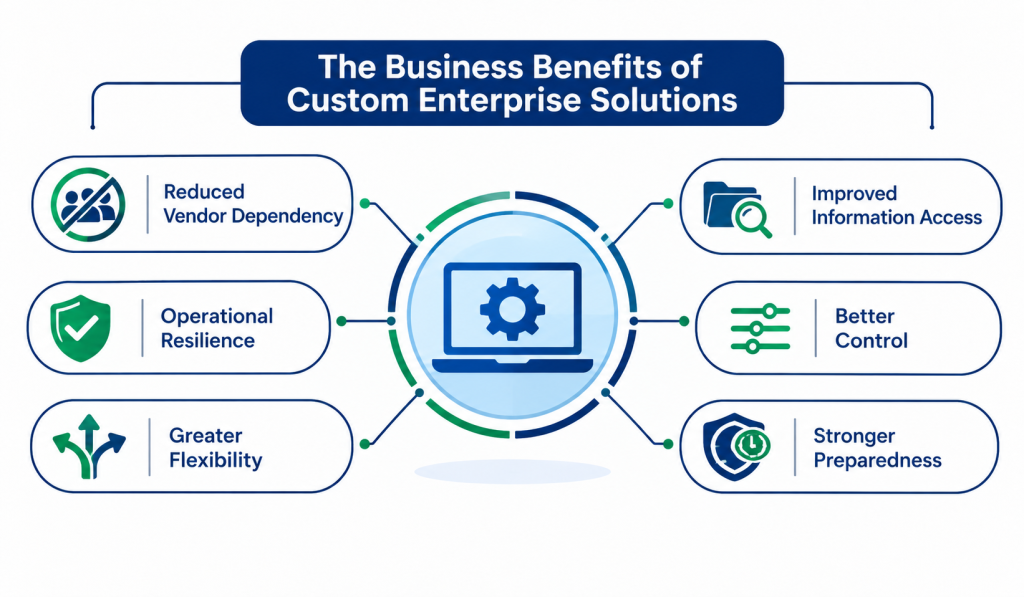
The Business Benefits of Custom Enterprise Solutions
Investing in custom enterprise solutions can provide operational benefits beyond responding to outages. When designed around clear requirements, these systems can improve how organisations manage information, coordinate employees, and support essential processes.
The key benefits include:
- Reduced vendor dependency: Provides alternative ways to access selected services and information.
- Operational resilience: Helps maintain essential activities when primary platforms become unavailable.
- Greater flexibility: Allows systems to reflect specific organisational workflows and requirements.
- Improved information access: Keeps important procedures, contacts, and documents accessible through approved alternatives.
- Better control: Gives organisations greater influence over system design, access permissions, and integration requirements.
- Stronger preparedness: Establishes clear procedures and tools for responding to technology disruptions.
The value of these solutions is not measured only by how often they are used. Their importance lies in giving organisations a reliable option when their primary systems cannot support normal operations.
Implementation Challenges and How to Overcome Them
Although custom enterprise solutions can strengthen business continuity, their development and maintenance require careful planning.
Cost and Development Resources
Custom systems require investment in design, development, hosting, testing, and ongoing support. Organisations should prioritise essential functions and begin with a clearly scoped solution rather than attempting to build a complete replacement for an existing enterprise ecosystem.
Integration Complexity
Alternative systems may need to exchange information with existing applications. Poorly planned integrations can create duplicate records or inconsistent data. Organisations should define integration requirements and establish clear data ownership.
Integration becomes harder when backup solutions must connect with legacy or incompatible systems that use outdated protocols, proprietary data formats, or limited interfaces. In these cases, organisations may need middleware, custom connectors, or manual data transfers, which add cost and create more points of potential failure. Assessing system compatibility early helps teams choose realistic integration options before development begins.
Security and Data Protection
A backup application must not become a weaker entry point into the organisation. Strong authentication, encryption, access controls, and security monitoring should be incorporated from the beginning.
User Adoption
Employees may be unfamiliar with alternative systems and procedures. Organisations should provide clear instructions, practical training, and regular exercises so that employees know what to do during an outage.
Maintenance and System Reliability
A backup system that is outdated or untested may fail when required. Organisations should assign clear ownership, schedule maintenance, and conduct regular recovery exercises.
Best Practices for Stronger Business Continuity
The most effective continuity strategies are built around essential business requirements rather than technology duplication.
Organisations should focus on the following practices:
- Prioritise critical services: Identify the operations, information, and communication channels that must remain available.
- Reduce single points of failure: Avoid depending on one provider, platform, or infrastructure component for every essential activity.
- Build only what is necessary: Develop custom enterprise solutions around specific continuity requirements and critical workflows.
- Separate critical dependencies: Where practical, ensure that backup systems do not rely on the same infrastructure or services that may cause the primary outage.
- Protect sensitive information: Apply appropriate authentication, encryption, permissions, and monitoring.
- Document recovery procedures: Define who activates backup systems, how employees access them, and how normal operations resume.
- Test regularly: Conduct realistic exercises to confirm that systems and employees are prepared.
- Review and improve: Update the strategy as technology, business processes, and organisational requirements change.
- A strong strategy combines technology, governance, and employee preparedness. Custom systems provide the tools, while clear procedures ensure that people know how to use them.
Measuring the Success and ROI of Business Continuity
Organisations should assess continuity investments based on their ability to reduce disruption and maintain essential operations.
Useful measures include:
| Area | Example Metrics |
| System availability | Availability of primary and backup systems |
| Recovery performance | Recovery Time Objective (RTO), Recovery Point Objective (RPO) |
| Operational continuity | Percentage of critical processes maintained during an outage |
| Communication | Time required to activate backup communication channels |
| Employee readiness | Training completion and recovery exercise results |
| Data protection | Backup success rate and recovery test results |
| Business impact | Downtime avoided, service delays, and estimated disruption costs
|
The Recovery Time Objective (RTO) defines how quickly a system or process should be restored after disruption. The Recovery Point Objective (RPO) defines the maximum acceptable amount of data loss measured in time.
These targets should reflect the importance of each business process. Not every application requires the same recovery speed or level of data protection.
Measuring these indicators helps organisations determine whether their investments are improving resilience and where further improvements are necessary.
Business Continuity and the Future of Enterprise Technology
As organisations adopt more cloud-based services, the need for flexible and resilient technology environments will continue to grow. Cloud platforms provide valuable capabilities, but organisations must understand the dependencies that come with using interconnected services.
The cost of having no fallback is visible in real incidents. According to the Cybersecurity and Infrastructure Security Agency (CISA), a contractor accidentally cut a fiber line in Gunnison and Hinsdale counties, Colorado, in November 2020, taking cell, internet and 911 services offline for about 10 hours. Responders coped only because handheld radios and public radio stations served as informal backups. Afterwards, local officials built a purpose-designed communications setup with over-the-air TV and radio alerts, analog phone lines and satellite phones. The lesson applies to medium and large organisations alike: depending on a single piece of infrastructure, without tested redundancies and emergency protocols, turns one failure into a service-wide outage. Future-ready enterprise technology is not about abandoning major vendors, but about designing tailored systems that work alongside them and reduce dependency.
Custom enterprise solutions, independent communication channels, secure data repositories, and alternative workflows can form part of a more resilient technology architecture. Combined with effective backup strategies, disaster recovery planning, and clear governance, these capabilities help organisations prepare for a wider range of disruptions.
Organisations that treat business continuity as part of their technology strategy will be better positioned to maintain services, protect information, and respond to unexpected events.
What to Get Right with Business Continuity — and the Common Mistakes to Avoid
Avoid these:
- Depending entirely on one cloud provider for all essential operations.
- Assuming that a backup application will work without regular testing.
- Building a duplicate system with the same infrastructure dependencies as the primary platform.
- Overlooking security and access controls for alternative systems.
- Failing to train employees on backup communication and recovery procedures.
- Treating continuity planning as a one-time IT project rather than an ongoing organisational responsibility.
Key Takeaways
- Business continuity helps organisations maintain essential operations during technology disruptions.
- Heavy reliance on a single-vendor ecosystem can create operational risks when connected services become unavailable.
- Custom enterprise solutions, such as internal portals and backup communication systems, provide alternative ways to access information and coordinate work.
- Medium-sized enterprises and government offices can benefit from systems designed around their critical processes.
- Backup solutions must have appropriate security, independent dependencies and clear recovery procedures.
- Regular testing, employee training, and continuous improvement are essential for effective continuity planning.
Conclusion
Organisations increasingly depend on cloud platforms to manage communication, information, and daily operations. While these services offer convenience and scalability, relying too heavily on a single-vendor ecosystem can leave essential processes vulnerable to disruption.
Custom enterprise solutions provide a practical way to reduce this dependency. Bespoke internal portals, backup communication systems, alternative workflows, and secure document repositories can help employees maintain access to essential resources when primary platforms become unavailable.
However, developing these solutions requires more than technical implementation. Organisations must identify critical operations, assess system dependencies, establish security controls, and test recovery procedures regularly. A well-planned business continuity strategy combines reliable technology with clear processes and employee readiness.
For medium-sized enterprises and government offices, the goal is not to replace every third-party platform. It is to build a more resilient technology environment where essential operations can continue, even when individual services fail. Agencies such as User Experience Researchers (USER, website: user.com.sg) can help organisations assess their requirements and explore custom enterprise solutions that support operational resilience and long-term business needs.
Work with USER on Custom Enterprise Solutions
If your organisation relies heavily on third-party cloud platforms, now is the time to review what happens when those services become unavailable.
User Experience Researchers (USER website: user.com.sg) can help organisations explore custom enterprise solutions, including bespoke internal portals, alternative communication systems, and tailored business applications. By understanding your operational requirements and technology dependencies, the right solution can help strengthen resilience and keep essential work moving during unexpected disruptions.
Frequently Asked Questions
Business continuity in IT refers to an organisation’s ability to maintain or restore essential technology-supported operations during disruptions. It involves backup systems, alternative communication channels, data protection, recovery procedures, and employee readiness.
Relying on one provider can create a single point of failure. If an outage affects its services, organisations may lose access to email, collaboration tools, documents, and workflows simultaneously. Alternative systems can reduce the operational impact.
Custom enterprise solutions are applications and systems designed or configured around an organisation’s specific needs. Examples include internal portals, workflow applications, document repositories, and communication systems.
An independently hosted internal portal can provide access to essential announcements, contact directories, procedures, forms, and reference documents when primary collaboration platforms are unavailable. Its infrastructure and access arrangements must be designed to remain independent of the affected services.
A backup communication system is an alternative channel used to share important information and coordinate activities when the primary communication platform is unavailable. It may include an independent messaging service, SMS notifications, or an emergency communication platform.
Government offices can assess critical public services, identify technology dependencies, establish alternative communication channels, and develop secure internal portals for essential information. Their plans should also meet applicable government security, privacy, and records-management requirements.
Testing frequency should depend on the criticality of the systems, organisational risk and recovery requirements. Critical systems and communication procedures should be tested regularly, with results documented and weaknesses addressed.
Not necessarily. Custom enterprise solutions can complement existing platforms by providing alternative access to essential information and selected workflows. The objective is to reduce dependency and improve resilience, not automatically replace existing technology.
Start by identifying critical operations and reviewing which third-party systems support them. Assess potential single points of failure, define recovery requirements and prioritise suitable backup solutions. Test the arrangements regularly to confirm that employees can use them when needed.

