
Last Updated: 25 November 2026
Healthcare providers are under constant pressure to deliver accessible, timely, and effective services while managing administrative demands, and limited resources. For clinicians and support teams, everyday tasks such as updating patient records, coordinating referrals, managing appointments, and responding to enquiries can take valuable time away from direct patient care.
Human-Centred AI in the healthcare sector offers a practical way to address these challenges. A growing subset of the industry, it focuses on developing solutions around the people who use healthcare services and the workflows they already follow. When designed around real operational needs, tailored AI tools can help clinicians reduce repetitive work, support administrative teams, and make healthcare services easier for patients to access.
For government healthcare agencies, primary care providers, and community healthcare organisations, the opportunity is not simply to adopt more AI. It is to identify where daily processes can be improved without creating additional technical complexity.
What Human-Centred AI Means in Healthcare
Human-centred AI is an approach to designing and implementing artificial intelligence around people’s needs, responsibilities, and experiences. In healthcare, this means considering how healthcare professionals deliver care, how administrative teams manage operations, and how patients interact with healthcare services.
Instead of expecting healthcare professionals to adapt to complicated new systems, AI solutions aim to fit into existing processes wherever possible. Its purpose is to support people with relevant information, reduce repetitive tasks, and make routine interactions more manageable.
For example, a primary care clinic may use an AI-assisted tool to prepare draft consultation notes based on authenticated interactions with the patient and other patients with relevant interaction histories, and as authorised by a strict data governance and privacy protection system. The clinician can review and correct the information before it becomes part of the patient’s record. This reduces manual documentation while keeping clinical responsibility with the healthcare professional.
Another example can be the application of AI-assisted workflows in critical health monitoring machines. This can allow them to respond to the patient immediately using pre-approved response algorithms, log condition reports, and alert human healthcare providers as needed. This can reduce the workload for nurses and doctors in busy healthcare centres or emergency rooms.
The approach is not about allowing AI to make independent clinical decisions. It is about using technology to support the people responsible for delivering and coordinating care.
Human-Centred AI in Healthcare Guide Summary
Measuring results
| Element | Detail |
| Topics covered | Everyday healthcare bottlenecks, tailored AI solutions, primary and community healthcare, workflow integration, responsible implementation, and measuring results. |
| Covered in this guide | Key healthcare challenges, practical AI applications, workflow integration, responsible implementation and measurable outcomes. |
| Who is this for? | Healthcare institution owners, managers, and operations heads; clinicians and administrative staff; government healthcare providers; IT and digital transformation teams; healthcare leaders and decision-makers. |
Everyday Workflow Bottlenecks in Primary and Community Healthcare
Healthcare teams experience operational challenges that may appear small individually but can create significant pressure when repeated throughout the day. Identifying these problems is the first step towards implementing useful AI solutions.
- Repetitive Clinical Documentation
Clinicians need to document consultations, update patient information, and prepare follow-up notes. These responsibilities are essential, but completing them manually can extend working hours and reduce the time available for patient interactions.
An AI-assisted documentation tool can help prepare draft notes from approved consultation information. The clinician reviews the draft, makes corrections, and confirms the final record. This allows documentation to become more manageable without removing professional oversight.
- Appointment Management and Patient Flow
Primary care clinics often handle appointment requests, cancellations, rescheduling, and patient reminders across different communication channels. When these processes depend heavily on manual coordination, staff may spend considerable time managing routine requests.
Tailored AI tools can assist with appointment enquiries, identify incomplete booking information and support reminders based on clinic-approved rules. Staff can then concentrate on exceptions, urgent requests, and situations requiring personal assistance.
- Routine Patient Enquiries
Administrative teams regularly respond to questions about clinic hours, appointment preparation, available services, documentation requirements, and follow-up procedures.
A healthcare-approved AI assistant can provide consistent responses to routine questions using verified information. More complex, sensitive, or urgent enquiries should be directed to the appropriate healthcare professional or staff member.
- AI-Enabled Clinical Machines and Diagnostic Support
Hospitals already rely on machines such as CT scanners, X-ray systems, and digital pathology platforms, and many include some AI functions built into their software. For example, a CT scanner in an emergency department can run an AI triage tool that reviews each scan as it is completed. If it detects a suspected finding, such as a brain bleed or a blocked vessel linked to a stroke, it flags the study and alerts the care team so that the case is reviewed sooner.
The same pattern is emerging in laboratory work. In digital pathology, AI software can help pathologists examine digitised tissue slides by highlighting areas that deserve a closer look, such as in prostate biopsy reviews. In each case, the machine prioritises, flags, and organises information, while the radiologist, pathologist, or doctor reviews the full result and makes the diagnosis. Clinical responsibility stays with the professional, and the tools remain subject to regulatory clearance, access controls, and existing data governance requirements.
- Referral and Care Coordination Delays
Primary and community healthcare often involve coordination between clinics, specialists, care teams and external service providers. Missing information, incomplete forms and manual follow-ups can delay the next step in a patient’s care journey.
AI can assist by checking referral documents for required information, organising incoming requests and flagging items that need staff attention. Final decisions about referral priority and clinical suitability remain with authorised professionals.
Practical Human-Centred AI Solutions for Healthcare Providers
The most useful AI applications are those that address clearly defined problems. Rather than introducing a large platform with unnecessary features, healthcare organisations can prioritise targeted tools that support specific tasks.
AI-Assisted Clinical Documentation
AI can help clinicians prepare draft consultation summaries, structure notes and organise information from approved sources.
For example, a community clinic may use a documentation assistant to prepare a draft after a consultation. The clinician checks the content, corrects any inaccuracies and approves the record before it is saved.
An example of this approach is the randomised trial at UCLA Health, where 238 physicians across 14 specialties used AI scribe tools (Microsoft DAX and Nabla) that record patient conversations and generate draft clinical notes for physicians to review and edit, covering about 72,000 patient encounters. Physicians using Nabla reduced their time spent writing each note by about 10% compared with usual care, and both tools showed modest improvements in burnout and cognitive workload scores. Fewer than 10% of patients declined its use. The study also found that the notes occasionally contained clinically significant inaccuracies, such as omissions and pronoun errors, so physicians had to stay actively involved in reviewing every draft (UCLA Health, 2025).
This type of human-Centred AI application can reduce repetitive typing while preserving the clinician’s control over patient documentation.
Intelligent Appointment and Administrative Support
AI-powered administrative assistants can support routine scheduling enquiries, appointment reminders, and request classification.
A primary care provider could use an assistant connected to its approved appointment information to answer common questions. Requests involving unusual circumstances, urgent needs, or changes requiring staff approval can be transferred to the relevant team.
The objective is to reduce repetitive interactions so they can focus on tasks that require judgement and personal assistance, not to remove administrative staff.
Patient Communication and Information Access
Patients may need help understanding service availability, appointment requirements and general care instructions. Delays in receiving basic information can create unnecessary calls and additional work for clinic staff.
A tailored AI assistant can make approved information easier to access through a website, patient portal or existing communication channel. Responses should use clear language, support accessibility needs, and provide a route to a human representative when necessary.
A similar case is the use of AI-drafted replies in patient portals. In a pilot at Penn Medicine, 80 physicians, nurses, nurse practitioners and medical assistants across seven clinics used Epic’s Augmented Response Technology, which presents clinicians with draft replies to patient messages built on a large language model, within the existing portal workflow. Two-thirds of survey respondents (66%) agreed the drafts were useful, and about 40% of replies needed little to no editing (Crowley et al., Applied Clinical Informatics, 2026). Clinicians still reviewed and sent every reply, and some drafts contained incorrect or inappropriate content, which shows why review is essential. Patients interviewed in a separate Duke-led study also said they accepted AI-drafted portal messages only if a clinician reviewed them, and they wanted AI use to be disclosed (Owens et al., JAMA Network Open, 2026).
AI assistants should not be treated as substitutes for medical advice, diagnosis or emergency services.
Referral Processing and Care Coordination
AI can support administrative teams by extracting relevant information from referral documents, checking whether required fields are present, and organising requests for review.
For example, a community healthcare network receiving referrals from several clinics could use AI to identify incomplete submissions and route them to the appropriate administrative team. Staff can review the flagged information and follow established referral procedures.
This can help reduce avoidable back-and-forth communication while keeping decisions under human control.
Operational Reporting and Resource Planning
Healthcare managers need reliable information to understand service demand, appointment activity, staffing requirements, and operational performance.
AI-assisted reporting can help consolidate approved operational data, identify recurring patterns, and prepare summaries for management review. These insights can support planning discussions, but decisions about staffing, budgets, and service delivery should remain with accountable managers.
Where Human-Centred AI Can Make a Difference
The requirements of healthcare organisations vary according to their size, services, and patient populations. A tailored approach allows AI applications to address the needs of different healthcare environments.
Government Healthcare Agencies
Government healthcare agencies may coordinate services across multiple facilities, departments, and community programmes. AI can assist with administrative reporting, information requests, and the organisation of service-related documents.
A practical starting point could be an internal assistant that helps authorised staff retrieve approved policy information and operational guidance. This can make information easier to locate without requiring employees to search through multiple documents manually.
Primary Healthcare Providers
Primary care clinics manage consultations, appointments, patient records, and follow-up activities. AI can support documentation, routine enquiries and appointment administration.
The priority should be to improve the patient journey and reduce administrative pressure without interrupting established clinical processes.
Community Healthcare Organisations
Community healthcare teams often coordinate home-based services, follow-up visits, and communication between patients, caregivers and healthcare professionals.
AI-supported scheduling and task coordination can help teams organise routine activities, identify outstanding administrative actions, and prepare relevant information before a visit. Staff should retain control over care decisions and any changes to patient support arrangements.
Enterprise Healthcare Networks
Larger healthcare networks may operate across several facilities with different teams and operational requirements. Tailored AI tools can help standardise selected administrative processes, improve access to approved information, and support reporting across departments.
A connected approach can improve consistency, provided that systems follow appropriate access controls and data governance policies.
How to Introduce AI Without Adding Technical Friction
Successful adoption depends on more than choosing the right AI technology. Healthcare organisations must ensure that solutions are practical for the people expected to use them.
A human-centred implementation approach can follow these stages:
- Identify the Actual Workflow Problem
Start by speaking with clinicians, administrative staff, patients, and operational managers. Identify tasks that create delays, repeated work, or unnecessary communication.
The goal is to understand the problem before selecting a technology.
- Prioritise a Specific Use Case
Choose one workflow where improvement can be measured. Examples include preparing draft consultation notes, managing routine appointment enquiries, or checking referral documents for missing information.
Avoid introducing multiple AI tools before the organisation understands the value of the first application.
- Work with Existing Systems
Where possible, integrate the solution with approved healthcare platforms and established processes. Staff should not have to repeatedly enter the same information or switch between unnecessary applications.
This is where tailored human-Centred AI solutions can be valuable: they can be designed around an organisation’s actual workflows rather than forcing teams into a generic process.
- Establish Human Oversight and Data Controls
Define which tasks AI can assist with, which outputs require review and who is accountable for approving actions.
Healthcare organisations should also establish appropriate data access, retention, security, and privacy controls before implementation.
- Test with Various Groups of Genuine Users
Pilot the solution with the different groups who will use it daily, such as clinicians, administrative staff and patients. Observe whether it reduces workload, fits existing routines and produces information that users can understand and verify. Include users with different roles, levels of digital confidence and accessibility needs so that issues are not overlooked. Gather feedback from each group before deciding on any changes.
- Improve Before Expanding
Use pilot results to correct usability issues, refine workflows and improve system performance. Expand the solution only when it demonstrates practical value and meets the organisation’s requirements.
Benefits of a Human-Centred Approach to Healthcare AI
When AI is designed around real healthcare needs, its value can extend beyond automation.
- More time for patient care: Reducing repetitive administrative work can help clinicians and support teams focus on direct patient interactions.
- Simpler daily workflows: Targeted tools can make documentation, scheduling and information retrieval easier to manage.
- More consistent communication: AI assistants can provide routine information using approved content and established guidelines.
- Better coordination: Organised information and administrative routing can help teams manage referrals and follow-up tasks.
- Improved staff experience: Tools designed around existing responsibilities are more likely to be useful and manageable.
- More accessible services: Clearer digital communication and alternative support channels can help patients access relevant information.
These benefits depend on implementation quality, workflow suitability and ongoing evaluation. AI does not automatically improve healthcare outcomes simply because it has been introduced.
Challenges to Consider Before Implementation
Healthcare organisations must address several considerations to ensure that AI tools are safe, reliable, and practical.
Patient Privacy and Data Security
AI applications may process sensitive patient or operational information. Organisations must establish appropriate access controls, security safeguards, data handling procedures, and compliance requirements before using these tools.
Accuracy and Clinical Accountability
AI-generated summaries and responses may contain errors or omit important contexts. Outputs used in clinical or patient-facing workflows must be checked according to the level of risk. Clinical decisions must remain with appropriately qualified professionals.
Integration with Existing Workflows
A solution that operates separately from established systems may create additional work. Integration should be assessed carefully, including compatibility, permissions, data quality and operational dependencies.
Staff Adoption and Usability
Healthcare professionals may be reluctant to use tools that interrupt consultations or require complicated processes. Training should be practical and role-specific, while interfaces should be clear and easy to navigate.
Accessibility and Patient Inclusion
Not all patients have the same digital skills, language abilities, or access to devices. AI-enabled services should offer accessible content and alternative ways to receive assistance, including human support.
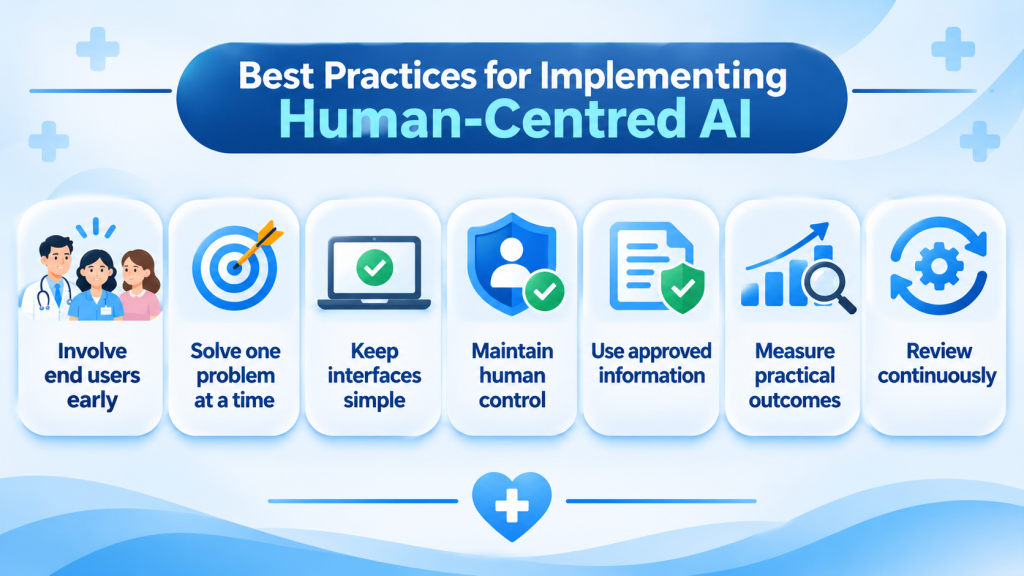
Best Practices for Implementing Human-Centred AI
To make healthcare AI useful in daily operations, organisations should follow several practical principles:
- Involve end users early: Consult clinicians, administrative staff and patients when identifying requirements and evaluating solutions.
- Solve one problem at a time: Begin with a specific workflow bottleneck instead of introducing technology across every department.
- Keep interfaces simple: Minimise additional logins, duplicate data entry and unnecessary steps.
- Maintain human control: Define approval processes and clear accountability for AI-assisted outputs.
- Use approved information: Ensure that patient-facing assistants and internal tools rely on verified, appropriately maintained content.
- Measure practical outcomes: Evaluate time saved, error rates, staff feedback, patient experience and workflow completion.
- Review continuously: Monitor performance, address errors and update the solution as service requirements change.
Measuring the Value of Healthcare AI
Healthcare providers should evaluate AI solutions based on improvements to real workflows, not simply the number of automated tasks.
| Area | Suggested measurement | What it indicates |
| Clinical documentation | Time spent preparing and completing notes | Whether documentation work becomes more manageable |
| Appointment management | Staff time spent handling routine requests | Whether administrative coordination improves |
| Patient communication | Response time and enquiry resolution rate | Whether patients can access information more easily |
| Referral processing | Incomplete submissions and processing time | Whether administrative delays are reduced |
| Staff experience | User feedback and adoption rates | Whether the solution fits daily responsibilities |
| Patient experience | Feedback and accessibility measures | Whether digital support is useful and inclusive |
Organisations should establish baseline measurements before implementation and compare results after the pilot. This helps decision-makers understand whether the solution is delivering meaningful operational improvements.
The Future of Human-Centred AI in Primary and Community Healthcare
The future of healthcare AI will not be defined only by more advanced models or greater automation. Its value will increasingly depend on how effectively technology supports the people delivering and receiving care.
Primary care providers may explore more integrated administrative assistants, while community healthcare organisations may use AI to support coordination across visits, referrals and follow-up activities. Government agencies and larger healthcare networks may also develop tailored tools to improve access to operational information and support service planning.
However, successful adoption will require continued attention to privacy, accessibility, system integration, and human oversight. Healthcare providers must ensure that technology remains understandable, accountable, and appropriate for the task it supports.
The strongest applications of human-centred AI in the healthcare sector will be those that fit naturally into workflows, reduce avoidable effort, and allow professionals to spend more time on the responsibilities that require human judgement and care.
What Healthcare Organisations Should Get Right
Before introducing AI into primary or community healthcare, decision-makers should avoid several common mistakes:
- Choosing technology before identifying the problem: Start with the workflow challenge, not the product.
- Over-automating sensitive processes: Keep qualified professionals involved in clinical decisions and high-risk interactions.
- Adding disconnected tools: Consider how each application will work with existing systems and responsibilities.
- Ignoring the patient experience: Ensure that digital services remain understandable and accessible.
- Treating implementation as a one-time project: Continue reviewing accuracy, usability, security and user feedback.
A successful approach balances operational improvement with the needs and responsibilities of the people involved.
Key Takeaways
- Human-Centred AI focuses on solving practical healthcare workflow problems rather than introducing technology for its own sake.
- Clinicians can benefit from support with documentation and information retrieval, while administrative teams can use AI to manage routine requests and coordination.
- Primary and community healthcare providers can apply tailored tools to appointment management, patient communication, and referral processing.
- AI should fit into existing systems and workflows without creating unnecessary technical steps.
- Privacy, accessibility, accuracy, and human oversight are essential to responsible implementation.
- Pilot testing and measurable outcomes help healthcare organisations determine whether an AI solution delivers genuine value.
Conclusion
Healthcare organisations do not need more complicated technology. They need solutions that make common tasks easier for clinicians, administrative teams, and patients.
Human-centred AI in healthcare provides a practical approach to achieving this by addressing specific workflow bottlenecks through tailored, accessible and responsibly implemented tools. From reducing documentation demands to improving appointment coordination and patient communication, AI can support healthcare teams when it is designed around their actual needs.
For government agencies, primary care providers and community healthcare organisations, the next step is to identify where unnecessary effort occurs and determine how the right solution can improve the process without disrupting existing services.
At User Experience Researchers (USER, website: user.com.sg), we help organisations explore tailored digital solutions that align with their operational needs. By understanding existing workflows and user requirements, we can help develop practical AI-enabled applications that support more efficient and connected healthcare services.
Frequently Asked Questions
Human-Centred AI is an approach to designing artificial intelligence around the needs of healthcare professionals, administrative teams and patients. It focuses on making everyday processes easier while keeping people involved in important decisions.
AI can support primary healthcare providers with tasks such as draft clinical documentation, appointment enquiries, patient reminders and administrative information retrieval. These applications can reduce repetitive work when integrated appropriately into existing workflows.
AI can assist community healthcare teams with scheduling, referral administration, follow-up coordination and access to approved service information. These tools can help organise routine activities while leaving care decisions to qualified professionals.
Yes. AI can assist with repetitive activities such as preparing draft notes, sorting enquiries and checking documents for missing information. Human review remains important, particularly when outputs affect patient records or care processes.
No. Its purpose is to support healthcare professionals and staff, not replace their expertise. AI can help manage repetitive tasks, but clinical judgement, patient interaction and accountable decision-making remain human responsibilities.
Organisations should begin by identifying a specific workflow problem, then select a suitable application that can work with approved systems and processes. Pilot testing, user feedback and careful integration can help minimise disruption.
Key considerations include patient data privacy, cybersecurity, inaccurate outputs, algorithmic bias, accessibility and system integration. Healthcare organisations should establish appropriate safeguards, testing procedures and human oversight before implementation.
Providers can measure documentation time, administrative processing time, referral completion, response times, staff adoption and patient feedback. Comparing these measures against pre-implementation baselines helps determine whether the solution is delivering practical value.

