
Last updated: 21 October 2026
Intelligent Process Automation (IPA) has quickly become one of the most important capabilities for organisations that want to operate faster, more accurately, and at lower cost. Where earlier waves of automation could only handle rigid, rule-based tasks, IPA combines robotic process automation (RPA) with artificial intelligence (AI) so that software can interpret unstructured information, make context-aware decisions, and improve over time. The result is automation that can handle the messy, judgement-heavy work that makes up most real business processes.
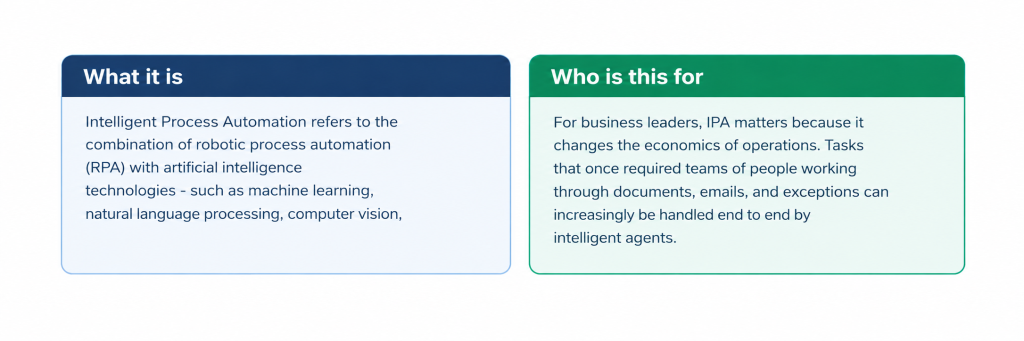
For business leaders, IPA matters because it changes the economics of operations. Tasks that once required teams of people working through documents, emails, and exceptions can increasingly be handled end to end by intelligent software, freeing employees to focus on higher-value work. Done well, IPA improves throughput and quality at the same time, rather than forcing a trade-off between the two.
This guide explains what Intelligent Process Automation is, how it differs from traditional automation, the technologies that power it, how a typical IPA programme works, where it delivers the most value, and how to implement it successfully. Whether you are exploring automation for the first time or scaling an existing programme, the goal is to give you a clear, practical understanding you can act on.
What Intelligent Process Automation means
Intelligent Process Automation refers to the combination of robotic process automation (RPA) with AI technologies — such as machine learning, natural language processing, computer vision, and intelligent document processing — to automate complex, end-to-end business processes that involve unstructured data and decision-making, not just simple rule-based tasks.
Intelligent Process Automation Guide Summary
| Element | Detail |
| Topic | Intelligent Process Automation |
| Covered here | What IPA is and how it differs from RPA; The core technologies that power IPA; How an IPA programme works end to end; The business benefits and ROI of IPA; Use cases across functions and industries; Implementation best practices and pitfalls |
| Who is this for | Business/Organisation leaders, Project managers, Operations, CTOs |
Intelligent Process Automation: what it is, and why it matters for your organisation.
What Intelligent Process Automation Means for Business
Intelligent Process Automation is best understood as the next stage in the evolution of business automation. Traditional automation excels at repetitive, deterministic tasks: if a process always follows the same steps with structured data, a script or a software robot can execute it reliably. The problem is that very few real processes are sufficiently ‘clean’. Most involve documents in different formats, free-text emails, judgement calls, and exceptions that rules alone cannot anticipate, and so therefore still require a huge amount of human supervision.
IPA closes that gap by layering artificial intelligence on top of automation for specific processes. Machine learning models can recognise patterns; natural language processing can read and interpret text; computer vision can extract information from images and scanned documents. Combined with the execution power of RPA and the coordination of workflow tools with each other, IPA enables handling of processes that span systems, formats, and decisions — much closer to how a skilled employee would work.
The word ‘intelligent’ is important but should not be overstated. IPA does not replace human reasoning across the board; it automates well-defined cognitive tasks within a process, such as classifying a document, extracting key fields, predicting the right routing, or flagging an anomaly. The strongest implementations pair machine capability with human oversight, so that the system handles the routine majority while people focus on genuine exceptions and strategic decisions.
How IPA Differs from Traditional RPA
Robotic process automation is a foundational building block of IPA, but it is not the same thing. RPA uses software robots to mimic the actions a person would take in a user interface — logging into systems, copying data between applications, filling in forms, and moving files. It is fast, accurate, and cost-effective, but it is fundamentally rule-based: it follows the exact steps it is given and struggles when inputs vary or decisions are required.
IPA extends RPA with the ability to handle ambiguity. Where RPA needs structured, predictable inputs, IPA can ingest unstructured content such as invoices, contracts, and customer messages, interpret them, and decide what to do next. Where RPA breaks when a process deviates from the script, IPA can learn from data, accommodate variation, and improve its accuracy over time.
In practice, organisations rarely choose one over the other. A mature automation programme uses RPA for the high-volume, deterministic steps, and AI for the parts that require interpretation or judgement, orchestrated together into a single end-to-end flow. Thinking of RPA as the ‘hands’ and AI as the ‘brain’ of automation is a useful way to understand how the two combine inside IPA.
The Core Technologies Behind IPA
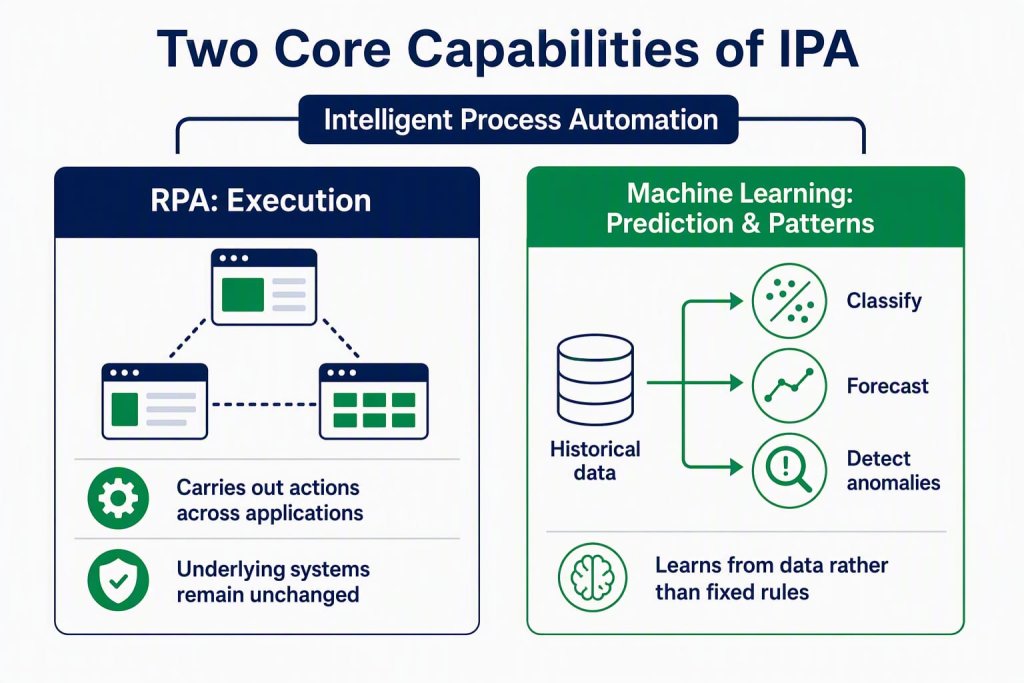
Several technologies come together to make Intelligent Process Automation possible. RPA provides the execution layer, carrying out actions across applications without changing the underlying systems. Machine learning provides the predictive and pattern-recognition capability, allowing the system to classify, forecast, and detect anomalies based on historical data rather than fixed rules.
Natural language processing enables software to read, interpret, and even generate human language, which is essential for processing emails, chat messages, contracts, and other text-heavy inputs. Intelligent document processing combines optical character recognition with machine learning to turn documents — including scanned materials and PDFs — into structured, usable data. Computer vision extends this to images and on-screen elements that lack clean digital data.
Around these core capabilities sit supporting technologies that make automation manageable at scale. Process and task mining help organisations discover how work actually flows and where automation will pay off. Business process management and orchestration tools coordinate robots, AI services, and human steps into coherent workflows. Together, these technologies form the toolkit that an IPA programme draws on, selected, and combined according to the specific process being automated.
How Intelligent Process Automation Works
A successful IPA initiative follows a clear lifecycle rather than a single deployment. The flow usually looks like this:
- Discovery
- Design
- Development
- Monitoring and improvement
During the discovery stage, the focus points are: understanding which processes are candidates for automation, how they currently work, where the bottlenecks and exceptions lie, and what business outcome automation should improve. Process and task mining can make this stage far more objective by revealing the real flow of work rather than the idealised version in a procedure document.
Next comes design and development. Here the process is mapped end-to-end, decisions are made about which steps should be handled by RPA, which by AI models, and which should remain with people. Models are trained or configured, robots are developed, and the workflow is assembled and tested against real data. This stage is where the discipline of treating automation as a product — with proper testing, version control, and documentation — pays dividends.
Once deployed, the automation must be monitored and continuously improved. Intelligent systems can drift as data and conditions change, so ongoing measurement is essential: tracking accuracy, exception rates, processing time, and business impact. The best programmes treat go-live as the beginning rather than the end, using performance data to retrain models, refine rules, and expand automation to adjacent processes over time.
The Business Benefits of Intelligent Process Automation
IPA gives businesses immense benefits to operations, mostly:
- Efficiency
- Speed
- Quality
- Consistency
- Improved employee and customer experiences
The most visible benefit of IPA is efficiency. By automating high-volume, time-consuming work, organisations can dramatically reduce processing times and free employees from repetitive tasks. Work that once took hours or days can often be completed in minutes, and capacity can scale up or down without the lead time and cost of hiring.
Quality and consistency improve alongside speed. Automated processes execute the same way every time, reducing the errors and variation that creep into manual work, especially under pressure. When combined with AI that can validate data and detect anomalies, IPA can actually raise accuracy above manual baselines, which is particularly valuable in regulated or high-risk processes where mistakes are costly.
Beyond cost and accuracy, IPA improves both employee and customer experience. Employees are relieved of tedious, low-value tasks and can focus on work that uses their judgement and creativity, which supports engagement and retention. Customers benefit from faster responses, fewer errors, and round-the-clock processing. These softer benefits are often what make automation programmes sustainable, because they create advocates rather than resistance inside the organisation.
Where IPA Delivers Value: Use Cases
IPA is applicable across almost every function, because every function has document-heavy, repetitive, decision-laden work.
In specific fields such as finance and accounting, IPA can automate invoice processing, accounts payable and receivable, reconciliations, and reporting, handling the unstructured documents and exceptions that defeat simple automation. In human resources, it can streamline onboarding, payroll, and employee queries.
In customer operations, IPA powers faster case handling by classifying and routing requests, extracting information from messages, and drafting responses for agents to review. In supply chain and procurement, it automates order processing, supplier communications, and inventory updates. These functional use cases share a common shape: a mix of structured actions and unstructured interpretation that IPA is uniquely suited to handle end to end.
Industry-specific applications add further depth. Banks use IPA for customer onboarding, fraud detection, and loan processing; insurers for claims intake and adjudication; healthcare providers for patient administration and billing; and manufacturers for quality and compliance reporting. The common thread is that IPA delivers the most value where processes are high-volume, rules are complex, data is unstructured, and accuracy genuinely matters.
Implementation Challenges and How to Overcome Them
Despite its promise, IPA can fail to deliver when it is approached as a technology project rather than a business one. A frequent mistake is automating a broken or poorly understood process; automation then simply makes a bad process run faster. The remedy is to understand and, where necessary, redesign the process before automating it, using discovery and mining to ground decisions in reality.
Data quality and integration present another common challenge. AI models are only as good as the data they learn from, and IPA often has to connect systems that were never designed to work together. Investing early in data quality, clear interfaces, and realistic expectations about model accuracy prevents disappointment later. It is far better to start with a well-scoped process and prove value than to attempt an over-ambitious, fragile automation.
Finally, governance and change management determine whether automation scales. Without oversight, organisations accumulate unmanaged robots and models that become risky and hard to maintain. Without bringing people along, automation meets resistance and adoption stalls. The organisations that succeed put governance, monitoring, and clear ownership in place, and they involve and reskill the people whose work is changing, so that automation is seen as support rather than threat.
Best Practices for a Successful IPA Programme
The most successful IPA programmes start from business outcomes, not technology. They identify the results that matter — faster cycle times, lower cost, higher accuracy, better customer experience — and select processes to automate based on their contribution to those outcomes. This keeps the programme focused on value and makes its impact measurable and defensible.
They also start small, prove value, and then scale. A focused pilot on a well-understood, high-volume process builds confidence, surfaces practical lessons, and creates a template for expansion. From there, a centre of excellence or shared capability can spread automation across the organisation in a controlled way, with reusable components, standards, and governance that prevent fragmentation.
Underlying it all, the best programmes build in security, governance, and human oversight from the start, and they treat people as partners. Automations are documented, monitored, and owned; sensitive data is protected; and employees are trained and involved so adoption is genuine. This is exactly the disciplined, outcome-led approach that user.com.sg helps organisations apply when planning and scaling Intelligent Process Automation.
Measuring the Success and ROI of Intelligent Process Automation
Like any investment, Intelligent Process Automation should be measured against the outcomes it is meant to deliver. The most useful metrics combine operational and financial measures: processing time and throughput, error and exception rates, straight-through processing percentage, cost per transaction, and the proportion of work handled without human intervention. Tracking these before and after automation makes the impact concrete and defensible.
Return on investment comes from several sources that should be measured together. Direct savings come from reduced manual effort and lower cost per transaction. Indirect value comes from faster cycle times, improved accuracy, better compliance, and the redeployment of staff to higher-value work. Capturing both the hard and soft benefits gives a fair picture of the programme’s worth and helps prioritise where to automate next.
It is also important to measure quality and risk, not just speed and cost. Monitoring model accuracy, the rate at which the system escalates cases correctly, and the outcomes of automated decisions ensures that efficiency does not come at the expense of reliability. A well-instrumented IPA programme treats measurement as a continuous discipline, using performance data to justify investment, target improvements, and demonstrate value to stakeholders.
Intelligent Process Automation and the Future of Work
Intelligent Process Automation is part of a broader shift often described as hyperautomation — the coordinated use of automation, AI, and process intelligence to automate as much suitable work as possible across an organisation. As these technologies mature, automation is moving from isolated tasks towards orchestrated, end-to-end processes that span departments and systems, with AI making more of the decisions along the way.
The emergence of more autonomous, agentic AI is accelerating this trend. Rather than executing fixed steps, increasingly capable systems can plan, take actions, and adapt to achieve a goal, with human oversight. For IPA, this means automation that can handle more variation and complexity, extending its reach into work that previously required constant human involvement. The direction of travel is towards software that does not just follow processes but actively helps run them.
For employees, this future is less about replacement than redefinition. As routine cognitive work is automated, human roles shift towards judgement, exceptions, relationships, and the design and supervision of automated systems. Organisations that prepare for this — by reskilling their people and designing thoughtful human-machine collaboration — will be best placed to benefit. The future of work is not humans or machines, but humans and machines working together, and IPA is a central part of building that capability.
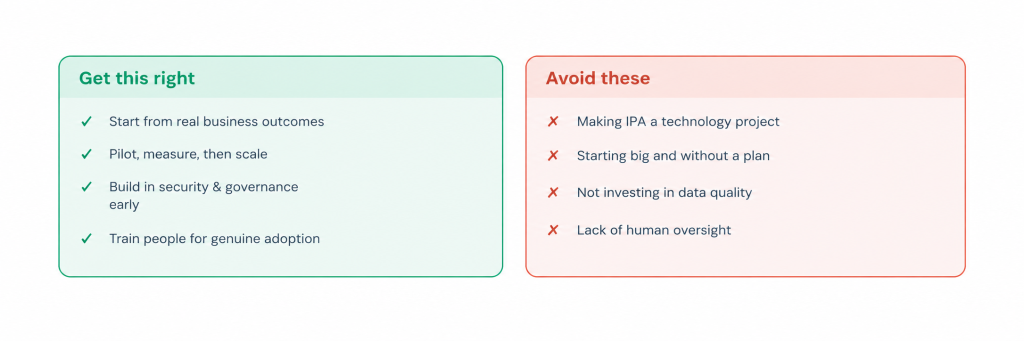
What to get right with Intelligent Process Automation — and the common mistakes to avoid.
Key takeaways
- Intelligent Process Automation is best approached around clear business outcomes, not tools or hype.
- IPA is an evolution, a next step from RPA.
- The core technologies that power IPA are RPA, machine learning, and NLP.
- IPA starts with planning and updated continuously through monitoring and improvement.
- The business benefits and ROI of IPA are speed, efficiency, quality, consistency, and better experiences..
- Pilot, measure, and then scale — with security, governance, and adoption built in.
Conclusion
Intelligent Process Automation represents a genuine step change in how organisations operate. By combining the execution power of RPA with the interpretive and decision-making capability of artificial intelligence, IPA can automate the complex, end-to-end processes that earlier automation could not touch — improving speed, accuracy, scalability, and experience at the same time. It is not a silver bullet, and it does not remove the need for human judgement, but applied well it changes the economics and quality of work in a way few other technologies can.
The organisations that benefit most are those that approach IPA strategically: starting from clear business outcomes, understanding their processes before automating them, building in security and governance, piloting before scaling, and bringing their people along. For any organisation serious about operating faster and more accurately, the question is no longer whether to adopt IA, but how to do it well — and that is where a focused, experienced partner makes the difference. Agencies such as User Experience Researchers (USER, website: user.com.sg) provide in-depth expertise on setting up IPA tailored to your organisations’ workflows and policies, enabling you to upgrade your team’s performance quickly and cost-effectively.
Work with USER on Intelligent Process Automation
If you are exploring Intelligent Process Automation for your organisation, the most valuable next step is a focused conversation about your goals, current state, and the outcomes that matter most. The USER (user.com.sg) team can recommend the right discovery, planning, or implementation pathway for your context.
Frequently Asked Questions
Intelligent Process Automation is the use of software that combines robotic process automation with artificial intelligence to handle complex business processes from start to finish. It can read documents, interpret information, make decisions, and carry out actions across systems, automating work that simple rule-based automation cannot.
RPA automates rule-based, repetitive tasks using structured data, while IPA adds artificial intelligence so it can also interpret unstructured information, make context-aware decisions, and improve over time. In practice, IPA uses RPA as its execution layer and AI for the parts that require judgement.
IPA typically combines robotic process automation, machine learning, natural language processing, intelligent document processing, and computer vision, supported by process mining and workflow orchestration tools. The specific mix depends on the process being automated.
The main benefits are faster processing, lower cost, higher accuracy and consistency, the ability to scale capacity quickly, and improved employee and customer experience. Done well, IPA improves throughput and quality at the same time rather than trading one for the other.
IPA delivers the most value on high-volume processes that involve unstructured data, complex rules, and decisions — such as invoice and claims processing, customer case handling, onboarding, and compliance reporting. Processes that are well understood and measurable make the best starting points.
The biggest risks are automating a poorly understood or broken process, relying on poor-quality data, and neglecting governance and change management. These are avoided by understanding processes first, investing in data quality, and putting oversight and people-focused adoption in place.
IPA automates well-defined tasks within a process rather than replacing people wholesale. It typically handles the routine majority of work while employees focus on exceptions, judgement, and higher-value activities. Most successful programmes redeploy and reskill staff rather than simply reducing headcount.
Start by identifying the business outcomes you want to improve, then use process discovery to find high-value candidate processes. Pilot automation on a well-scoped process, measure the results, and scale gradually with reusable components and governance. Working with an experienced partner accelerates this and helps avoid common pitfalls.

