

Last updated: 13 October 2026
Legal work is a document-intensive and knowledge-heavy industry. As most of legal work revolves around written information, it is a natural fit for a new generation of AI agents built specifically for the legal domain. ‘Legal agents’ are AI systems that can read, analyse, and act on legal information — reviewing contracts, conducting research, drafting documents, and supporting legal processes — with a degree of autonomy that goes well beyond simple search or templates.
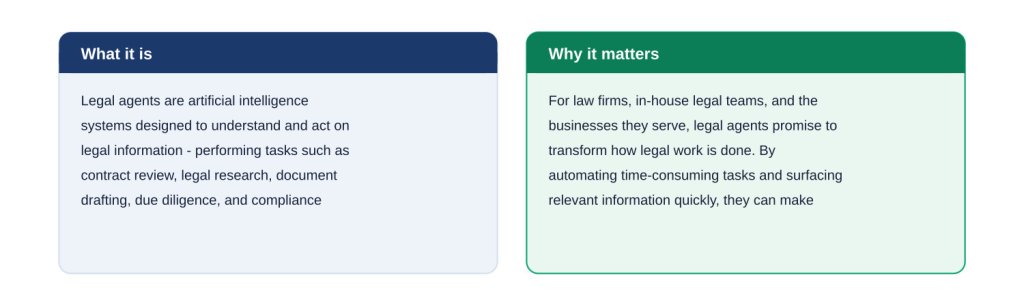
For law firms, in-house legal teams, and the businesses they serve, legal agents promise to transform how legal work is done. By automating time-consuming tasks and surfacing relevant information quickly, they can make legal services faster, more affordable, and more accessible, while freeing legal professionals to focus on judgement, strategy, and client relationships. But they also raise important questions about accuracy, ethics, and the irreplaceable role of human lawyers.
This guide explains what legal agents are, the problems they address, how they work, what they can do, who benefits, and the limitations and responsibilities involved. Whether you work in law, lead a business that relies on legal services, or simply want to understand this development, the goal is a clear and balanced view.
What are Legal Agents
‘Legal agents’ are artificial intelligence agentic systems designed to understand and act on legal information. These include performing tasks such as contract review, legal research, document drafting, due diligence, and compliance support, often with the ability to reason about a goal and take multiple steps, while operating under the oversight of qualified legal professionals.
Legal Agents Guide Summary
| Topic | Legal Agents |
| Best for | Law firm owners, legal division heads, IT/operations teams,& digital strategists |
| Covered here | What legal agents are and how they work; The problems they solve in legal work; Key capabilities: review, research, drafting; Who benefits: firms, in-house teams, businesses; Limitations, risks, and ethical considerations; Responsible use and the role of human lawyers |
Legal Agents: what it is, and why it matters for your organisation.
What Are Legal Agents?
Legal agents are AI systems built to understand and work with law-related information. Rather than simply retrieving documents or filling in templates, they can read and interpret legal text, reason about a task, and carry out multi-step work such as reviewing a contract, researching a question, or drafting a document. They apply the capabilities of modern AI specifically to the language, structure, and demands of legal work.
What distinguishes a legal agent from a general AI tool is its focus and capability within the legal domain. Legal language is precise, technical, and consequential, and legal tasks often require retrieving information from multiple verified sources and applying it to a specific situation. Legal agents are designed to handle this, combining language understanding with the ability to take actions and work through legal tasks systematically.
Importantly, legal agents are tools that support legal professionals rather than replace them. They handle the time-consuming, routine parts of legal work, understanding the core of this partnership between human lawyers and legal agents is central to understanding what they are and how they should be used.
The Problems Legal Agents Solve
Legal work has long faced a fundamental tension: it is essential, but it is also slow, expensive, and labour-intensive. Reviewing contracts, researching case law, conducting due diligence, and drafting documents consume enormous amounts of skilled time. This makes legal services costly and creates bottlenecks, and it means highly trained lawyers spend much of their time on repetitive, document-heavy tasks rather than higher-value work.
These costs and bottlenecks create consequences for many businesses. They face delays and often, overhead expenses in getting legal work done, and smaller organisations and individuals often cannot afford the legal support they need. Many legal teams also often struggle keeping up with growing volumes of contracts, regulation, and information. The result is that legal services are frequently a constraint on the activities they are meant to support.
Legal agents address these problems directly by automating the most time-consuming tasks. By reviewing documents, analysing information from reputable resources, and drafting at speed and scale, they reduce the time and cost of legal work, relieve bottlenecks, and make legal support more accessible. This does not remove the need for lawyers, but it changes the economics of legal work and lets legal professionals focus their expertise where it matters most.
How Legal Agents Work
Legal agents are typically built around large language models capable of understanding and generating legal language, combined with the components that make AI agents effective: memory, planning, and access to legal information and tools. The language model provides the ability to interpret legal text and reason about it, while the surrounding system lets the agent work through multi-step tasks and draw on relevant sources.
A crucial element is access to reliable legal information. Effective legal agents are connected to authoritative sources — such as legislation, case law, and the organisation’s own documents — so that their work is grounded in accurate, relevant material rather than generated in isolation. Techniques that retrieve and reference source material help ensure that the agent’s outputs are based on real legal information and can be checked.
The agent then works through legal tasks systematically. Here are some examples:
- For a contract review, it might identify key clauses, assess them against criteria, flag risks, and summarise findings;
- For research, it might gather relevant authorities, synthesise them, and produce an answer with references.
The tailored setup emphasises transparency and the ability for a lawyer to review, verify, and rely on the work, keeping a qualified professional firmly in control.
Key Capability: Contract Review and Analysis
One of the most valuable capabilities of legal agents is contract review and analysis. Reviewing contracts is essential but time-consuming, requiring careful reading to identify key terms, assess risks, and ensure consistency with requirements and standards. Legal agents can perform this review rapidly, extracting key clauses, flagging unusual or risky terms, and comparing contracts against playbooks or standards.
This dramatically accelerates a task that traditionally consumes large amounts of lawyer time. An agent can review a contract in a fraction of the time a manual review would take, highlighting the points that need attention and producing a structured summary. This is especially valuable when dealing with high volumes of contracts, where manual review is a serious bottleneck.
Crucially, contract review by an agent is designed to support rather than replace a lawyer’s judgement. The agent surfaces the issues and provides analysis, but the lawyer makes the decisions about acceptability, negotiation, and risk. This division — the agent handling the heavy lifting of review and the lawyer providing judgement — captures the benefits of speed and scale while preserving the professional oversight that contracts require.
Key Capability: Legal Research
Legal research is another area where legal agents deliver substantial value. Finding relevant legislation, case law, and commentary, and synthesising it to answer a legal question, is a core but demanding part of legal work. Legal agents can search authoritative sources, identify relevant material, and synthesise it into an answer far faster than manual research, with references that allow the work to be verified.
This extensive capability helps legal professionals get to relevant authority quickly and comprehensively, reducing the risk of missing important material and accelerating the research process. For complex questions that span many sources, an agent’s ability to gather and synthesise information at scale is particularly valuable, providing a strong starting point that a lawyer can then refine and rely upon.
As with other capabilities, the key to legal agents’ success on research is on grounding and verification. Effective legal research agents reference the sources they rely on, so that their conclusions can be checked against the underlying authority rather than taken on trust. This transparency is essential in a field where accuracy is paramount, and it ensures that the agent accelerates research without compromising the rigour that legal work demands.
Key Capability: Document Drafting
Drafting legal documents is a further task that legal agents can accelerate. Much of legal drafting involves applying established structures and language to a specific situation, such as in writing contracts, letters, or document filing.This relieves lawyers of the time-consuming work of producing initial drafts from scratch.
By producing a solid first draft rapidly, an agent lets the lawyer focus on reviewing, refining, and tailoring the document rather than building it from the ground up. This can significantly speed up the production of routine documents and free time for the judgement-intensive parts of drafting, such as bespoke terms and negotiation strategy.
In this stage, human review is essential. A drafted document must be checked and adapted by a qualified professional before being passed to the next viewer to be relied upon, because legal documents have real consequences and require accuracy and judgement. The agent provides a powerful starting point and accelerates the process, but the lawyer remains responsible for the final document, ensuring quality and accountability are maintained.
Due Diligence and Compliance Support
Beyond review, research, and drafting, legal agents support broader tasks such as due diligence and compliance. Due diligence often involves examining large volumes of documents to identify risks, obligations, and issues — a task that is both critical and extremely labour-intensive. Legal agents can process these documents at scale, extracting relevant information and flagging matters that require attention, accelerating a traditionally slow process.
In compliance, legal agents can help organisations keep track of obligations and assess documents or activities against requirements. By monitoring for relevant changes and analysing materials against rules, they support the ongoing work of staying compliant, which has become increasingly demanding as regulation grows in volume and complexity.
These applications share the same pattern as other specialised agent capabilities: the agent handles the heavy lifting of processing and analysis at scale, while qualified professionals provide judgement and make decisions. By taking on the tedious parts of due diligence and compliance, legal agents help organisations manage risk and obligations more efficiently, without removing the essential role of expert oversight.
Who Benefits from Legal Agents
Law firms are among the clearest beneficiaries of legal agents. With legal agents, firms can deliver work faster and more efficiently, handle greater volumes, and free their law professionals to focus on higher-value, judgement-intensive work and client relationships. This can improve both profitability and the quality of service while helping firms manage the pressure of rising volumes.
In-house legal teams benefit similarly. Corporate legal departments are often stretched, handling large volumes of contracts, queries, and compliance work with limited resources. Legal agents help them do more with the resources they have, accelerating routine work and allowing in-house lawyers to focus on strategic matters and supporting the business effectively.
On a broader spectrum, legal agents can help improve access to legal support, such as for public sector use. By reducing the cost and time of legal work, such as for public attorney offices, they can make legal services more affordable and accessible to smaller businesses and individuals who might otherwise struggle to obtain them. While professional advice remains essential, the efficiency that legal agents bring has the potential to widen access to legal help, which is a significant societal benefit.
Limitations, Risks, and Ethical Considerations
Legal agents are powerful, but they have important limitations that must be recognised. Despite being specialised for legal use, they are still AI models, and can make mistakes, misinterpret information, or produce outputs that appear plausible but are incorrect. In a field where accuracy is critical and errors can have serious consequences this means their work must always be reviewed and verified by qualified professionals.
There are also significant ethical and professional considerations. Legal work involves duties of competence, confidentiality, and accountability that rest with qualified lawyers, and these cannot be delegated to an AI system. Issues of confidentiality and data security are especially important given the sensitivity of legal information, and the use of legal agents must respect professional obligations and protect client information. Organisations using legal agents must be careful to ensure their teams are sufficiently ready for adopting such automated generative systems.
Trust, transparency, and accountability are therefore central. Legal agents should be used in ways that are transparent about their role, that ground their work in verifiable sources, and that keep qualified professionals firmly responsible for outcomes. Recognising these limitations and responsibilities is not a barrier to using legal agents, but the foundation for using them properly — as tools that support lawyers rather than substitutes for professional judgement.
Responsible Use and the Role of Human Lawyers
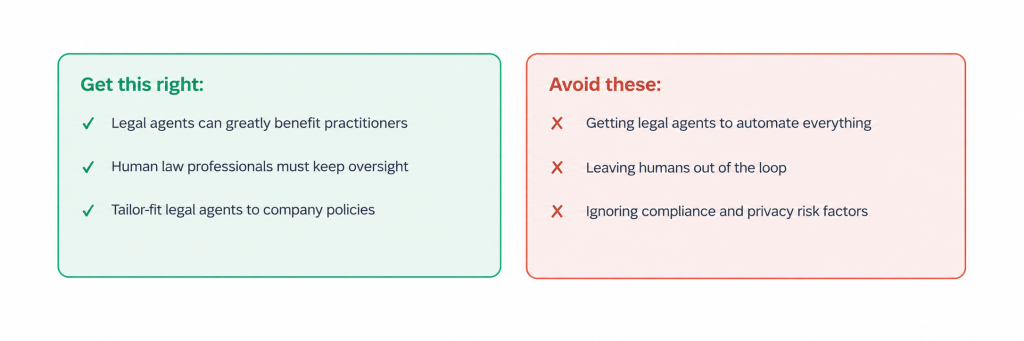
The responsible use of legal agents rests on a clear principle: they augment qualified legal professionals rather than replace them. The agent handles the document-heavy, time-consuming tasks at speed and scale, while the lawyer provides judgement, applies expertise to the specific situation, takes accountability, and makes the decisions that matter. This human-in-the-loop model captures the benefits while preserving the standards legal work requires.
Using legal agents well means putting the right safeguards in place: verifying outputs, grounding work in authoritative sources, protecting confidential information, and being clear about where professional judgement is required. It also means choosing the right tasks for automation — those where speed and scale add value and where review is straightforward — while keeping inherently judgement-intensive work firmly with lawyers.
Approached this way, legal agents become a genuine asset to legal practice and to the businesses that rely on it. They make legal work faster, more efficient, and more accessible, while the expertise and accountability of human lawyers remain at the centre. For organisations looking to adopt this technology responsibly and effectively, the key is thoughtful implementation that recognises the irreplaceable role of professional judgement. To ensure legal agents are tailored to an organisation’s policies and know inside out how its legal department or legal work ‘works’, a reliable technology partner such as User Experience Researchers (USER – user.com.sg) could be the key to make it work perfectly..
What to get right with Legal Agents — and the common mistakes to avoid.
Key takeaways
- Legal Agents are beneficial for law organisations and legal departments
- Legal agents are capable of reviewing, analysing, researching, drafting, and due diligence workThe problems they solve in legal work: Routine text-heavy tasks, retrieving information, organising thoughts and ideas
- Who benefits the most: firms, in-house teams, businesses
- A reliable technology provider such as USER can help you plan, implement, and optimise Legal Agents for your context.
Conclusion
Legal agents represent a significant advance in applying artificial intelligence to one of the most document-intensive and knowledge-heavy of professions. By reading, analysing, and acting on legal information — reviewing contracts, conducting research, drafting documents, and supporting due diligence and compliance — they address the cost, speed, and accessibility challenges that have long constrained legal work. The result is the potential for legal services that are faster, more efficient, and more widely available.
Yet the value of legal agents depends entirely on how they are used. They are powerful tools, but they are not substitutes for the judgement, accountability, and ethical responsibilities of qualified lawyers. Used responsibly — grounding work in authoritative sources, verifying outputs, protecting confidential information, and keeping professionals firmly in control — legal agents can transform legal work for the better. The future of legal practice is not AI instead of lawyers, but lawyers empowered by AI, and legal agents are a central part of building that future.
Work with USER on Legal Agents
If you are exploring implementing legal agents for your organisation, consider having a reliable technology partner that understands your needs, such as USER.
User Experience Researchers Pte. Ltd (USER) is a leading business transformation company committed to revolutionising work through AI innovation, experience design, digital transformation, and workforce solutions.
Contact us through project@user.com.sg
Frequently Asked Questions
A legal agent is an AI system designed to understand and act on legal information, performing tasks such as contract review, legal research, document drafting, due diligence, and compliance support. It can reason about a task and take multiple steps, working under the oversight of qualified legal professionals.
Legal agents can review and analyse contracts, conduct legal research, draft documents, support due diligence by processing large volumes of material, and assist with compliance. They handle time-consuming, document-heavy tasks at speed and scale, while lawyers provide judgement and make decisions
Legal agents are typically built around large language models that understand legal language, combined with memory, planning, and access to authoritative legal sources. They work through legal tasks systematically, grounding their outputs in real legal material and producing results that lawyers can review and verify.
No. Legal agents augment lawyers rather than replace them, handling document-heavy and time-consuming tasks while qualified professionals provide judgement, expertise, and accountability. Legal work involves duties and decisions that must remain with human lawyers, with agents supporting their work.
Law firms benefit by working more efficiently and handling greater volumes, in-house legal teams by doing more with limited resources, and businesses and individuals by gaining faster, more affordable access to legal support. The efficiency legal agents bring can widen access to legal help.
Legal agents are powerful but not infallible; like all AI systems they can make mistakes or produce plausible but incorrect outputs. Because accuracy is critical in legal work, their outputs must always be reviewed and verified by qualified professionals and grounded in authoritative sources.
The main risks are errors in their outputs, confidentiality and data security concerns given the sensitivity of legal information, and the need to respect professional duties. These are managed by verifying outputs, protecting client data, grounding work in reliable sources, and keeping lawyers accountable.
Use legal agents to augment qualified professionals, verify their outputs, groundwork in authoritative sources, protect confidential information, and choose appropriate tasks for automation while keeping judgement-intensive work with lawyers. Thoughtful implementation that respects professional standards is essential.

