
Last updated: 24 August 2026
Artificial intelligence offers enormous benefits, but it also introduces new security risks that organisations and individuals must understand. As AI becomes embedded in critical systems and everyday tools, it creates fresh vulnerabilities, enables new kinds of attacks, and raises difficult questions about data, reliability, and trust. Understanding these risks is essential to using AI safely and responsibly.
These security risks are distinct from the ways AI helps defend against cyber threats. Here the focus is on the dangers that AI itself brings — the vulnerabilities of AI systems, the misuse of AI by malicious actors, and the broader risks to privacy, safety, and trust. As AI adoption accelerates, these concerns are becoming more pressing for everyone who builds, deploys, or relies on AI.
This guide examines the main security risks of artificial intelligence, from data and privacy concerns and attacks on AI systems to AI-powered cyberattacks, misuse, and reliability issues, along with how these risks can be managed. The aim is a clear, balanced understanding that supports the safe and responsible use of AI rather than fear or complacency.
What Security Risks of Artificial Intelligence means
The security risks of artificial intelligence are the threats and vulnerabilities that AI may introduce or amplify — including risks to data and privacy, attacks that manipulate or exploit AI systems, the use of AI to enhance cyberattacks, the misuse of AI for malicious purposes, and risks arising from AI’s reliability, bias, and lack of transparency — all of which must be managed to use AI safely.
Security Risks of Artificial Intelligence — Summary
|
Topic |
Security Risks of Artificial Intelligence |
|
Best for |
Business leaders, IT/operations teams, product owners & digital strategists |
|
Covered here |
How AI introduces new security risks; Data privacy and confidentiality risks; Attacks that target AI systems; AI-powered cyberattacks and misuse; Reliability, bias, and transparency risks; How to manage and mitigate AI risks |
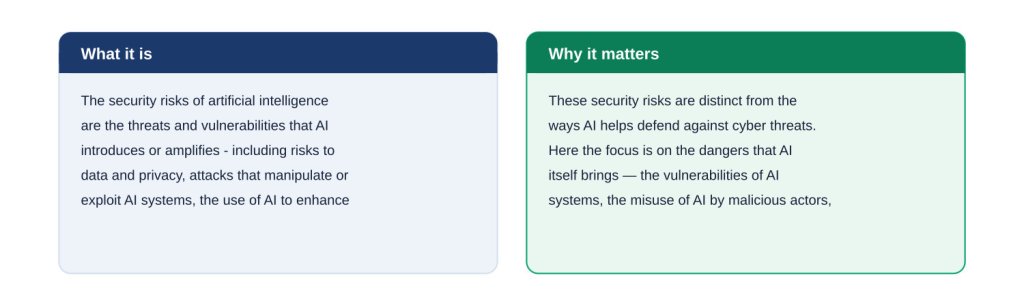
Security Risks of Artificial Intelligence: what it is, and why it matters for your organisation.
“If you are evaluating Security Risks of Artificial Intelligence, focus on the core concepts, real-world use cases, and trade-offs first — so any decisions, investments, or implementations are aligned to real outcomes.”
How AI Introduces New Security Risks
Artificial intelligence introduces security risks in several distinct ways. First, AI systems themselves can be vulnerable. Just like human-made systems, they can be attacked, manipulated, or exploited, creating new targets and attack surfaces. Second, AI can be misused by malicious actors to enhance their attacks or pursue harmful goals. Third, AI’s reliance on data, its potential for error, and its opacity may creater risks for privacy, safety, and trust.
These risks are growing in significance as AI becomes more widely adopted and more deeply embedded in important systems. As organisations integrate AI into critical processes and people rely on it in daily life, the potential consequences of AI security failures increase. What might once have been a theoretical concern is becoming a practical one that demands attention.
Understanding these risks is not a reason to avoid AI security platforms and associated AI-enhanced methodologies, which offer genuine and substantial benefits. Rather, it is the foundation for using AI safely and responsibly. By recognising where the risks lie — in the systems themselves, in their misuse, and in their inherent characteristics — organisations and individuals can take steps to manage them and capture AI’s benefits while limiting its dangers.
Data Privacy and Confidentiality Risks
One of the most significant security risks of AI relates to data and privacy. AI systems are typically trained to process large amounts of data, often including personal or sensitive information. This raises important questions about how that data is collected, used, stored, and protected, and creates risks if it is mishandled, exposed, or misused.
There are particular concerns around the information people share with AI tools. When users provide data to AI systems — questions, documents, or personal details — that information may be processed and potentially retained, and it is important to understand how it is handled. Sensitive information shared with AI tools could be exposed or used in ways the person did not intend if appropriate protections are not in place.
Organisations deploying AI face heightened data risks because they may be processing customer or proprietary information through AI systems. Ensuring that data is handled securely, that privacy is protected, and that regulatory requirements are met is essential. These data and privacy risks are among the most important security considerations of AI, requiring careful attention to how information flows through AI systems and how it is safeguarded.
Attacks that Target AI Systems
AI systems can themselves become a target of attacks designed to manipulate or exploit them. Adversarial attacks involve crafting inputs specifically designed to fool an AI model into making mistakes.An example is when an AI attack can cause it to misclassify something or behave incorrectly. As AI is used in important decisions and security functions, such attacks can have serious consequences.
Another category of attack targets the data and models that AI depends on. Data poisoning involves corrupting the data used to train a model so that it learns incorrect or harmful behaviour. Attacks may also attempt to extract sensitive information from models or to steal the models themselves. These attacks exploit the way AI systems are built and trained, creating risks that traditional security did not have to consider.
As AI becomes more embedded in systems and decision-making, securing the AI platform itself becomes an important part of security. This means understanding how AI systems can be attacked, designing them to be more robust, monitoring for manipulation, and protecting the data and models they rely on. Recognising that AI systems are themselves potential targets is essential to defending them and the processes that depend on them.

How user.com.sg moves from discovery to measurable, scalable value.
AI-Powered Cyberattacks
Beyond attacks on AI, a major risk is the use of AI to enhance cyberattacks. Malicious actors can use AI to make their attacks more effective, scalable, and difficult to detect. AI can help craft more convincing phishing and social-engineering attacks, generate malicious content, and automate aspects of attacks, lowering the barrier to sophisticated wrongdoing.
A particular concern is the use of AI to create highly convincing deceptive content. AI can generate phishing messages free of the errors that once made them detectable, produce realistic fake content, and create “deepfakes” (fabricated audio or video)for deception and fraud. This makes social engineering attacks more convincing and harder to spot, increasing the risk to organisations and individuals.
The implication is that AI is raising the capabilities of attackers, and defenders must respond accordingly. As attacks become more convincing and scalable, technical defences, vigilance, and awareness all become more important. Organisations must assume that adversaries are using AI to enhance their attacks and strengthen their defences and their people’s awareness to match this evolving threat.
Misuse and Malicious Use of AI
AI can be misused for a range of harmful purposes beyond cyberattacks. Its capabilities can be turned to generating misinformation and disinformation at scale, creating deceptive or harmful content, enabling fraud and manipulation, and supporting other malicious activities. The same power that makes AI useful can be exploited for harm when used with malicious intent.
The scale and accessibility of AI amplify these misuse risks. Because AI tools are powerful and increasingly available, the potential for misuse is significant, and harmful applications can be carried out more easily and at greater scale than before. This raises challenges for individuals, organisations, and society in guarding against the malicious use of AI.
Addressing misuse risks requires a combination of responsible development, safeguards, awareness, and broader measures. Those who build and provide AI have a role in designing safeguards against misuse, while organisations and individuals must be aware of these risks and how to protect themselves. Recognising the potential for misuse is important to using AI responsibly and to defending against those who would use it for harm.
Reliability and Accuracy Risks
A different but important category of risk arises from the reliability and accuracy of AI. AI systems can make mistakes, produce incorrect outputs, or generate content that appears plausible but is wrong. When AI is relied upon for important decisions or information, these errors can have real consequences, particularly if they go unnoticed or unchecked.
This risk is heightened by the tendency to over-trust AI outputs. Because AI can be confident and articulate, people may accept its outputs uncritically, even when they are incorrect. Relying on AI without verification, especially for important matters, can lead to errors propagating into decisions and actions. Maintaining appropriate scepticism and verifying important AI outputs is essential to managing this risk.
For organisations, the reliability of AI used in processes and decisions is a genuine security and operational concern. Ensuring that AI is accurate enough for its purpose, that its outputs are validated where it matters, and that human oversight is maintained for consequential decisions all help manage this risk. Treating AI as a powerful but fallible tool, rather than an infallible authority, is key to using it safely.
Bias, Fairness, and Discrimination Risks
AI systems can reflect and amplify biases present in their training data, leading to unfair or discriminatory outcomes. When AI is used in decisions that affect people, biased behaviour can cause real harm and raise ethical and legal concerns. This makes bias an important risk associated with AI, particularly in sensitive applications.
Bias risks arise because AI learns patterns from data, and if that data reflects existing biases or is unrepresentative, the AI may learn and perpetuate those biases. The results can be unfair treatment of certain groups or skewed outcomes that are difficult to detect, especially given the opacity of many AI systems. This can undermine fairness and trust and expose organisations to harm.
Managing bias risks requires attention throughout the development and use of AI — examining data and outcomes for bias, testing for fairness, and maintaining oversight. While bias is a complex challenge, recognising it as a risk and taking steps to detect and mitigate it is essential to using AI fairly and responsibly. For organisations, addressing bias is both an ethical obligation and a way to manage real reputational and legal risk.
Transparency and Accountability Challenges
Many AI systems operate as ‘black boxes’ whose internal workings are difficult to understand or explain. This lack of transparency creates challenges for security, trust, and accountability, because it can be hard to know why an AI system produced a particular output or to detect when something has gone wrong. Opaque systems are harder to verify, audit, and trust.
The transparency challenge has practical consequences. When AI is used in important decisions, the inability to explain its reasoning can make it difficult to identify errors, bias, or manipulation, and to hold the right parties accountable. This is a particular concern in high-stakes applications, where understanding and justifying decisions matters greatly.
Addressing transparency and accountability involves striving for AI that is more explainable, maintaining human oversight, and establishing clear responsibility for AI systems and their outcomes. While full transparency is not always achievable, taking steps to understand, monitor, and account for AI behaviour is important to using it responsibly. Clear accountability — knowing who is responsible for an AI system and its decisions — is essential to managing its risks.
How to Manage and Mitigate AI Risks
Managing the security risks of AI begins with awareness and a clear-eyed assessment of where the risks lie. Understanding the specific risks relevant to how AI is being used — data, attacks, misuse, reliability, bias, and transparency — allows organisations to focus their efforts where they matter. This risk-based approach is the foundation of effective management.
Practical measures span the lifecycle of AI use. Protecting data and privacy, securing AI systems against attack, validating AI outputs, maintaining human oversight for consequential decisions, testing for bias and reliability, and establishing clear accountability all help mitigate the risks. Choosing trustworthy tools and providers, and ensuring appropriate governance, further strengthen an organisation’s position.
Above all, the safe use of AI rests on keeping people, oversight, and good practice at the centre. AI should augment human judgement rather than replace it, its outputs should be verified where they matter, and its use should be governed thoughtfully. Combining awareness of the risks with sound practices and human oversight is what allows organisations to capture AI’s benefits while managing its dangers — exactly the balanced, responsible approach user.com.sg helps organisations adopt.
Ultimately, having an AI expert check on your security systems based on user behaviour and AI readiness can help your organisation catch up with AI-related security upgrades. Partnering with AI transformation companies such as User Experience Researchers (website: user.com.sg) can help you find the sweet spot in implementing AI security in the most effective way for your organisation’s needs.
Using AI Safely and Responsibly
Using AI safely and responsibly is ultimately about balance — capturing the substantial benefits of AI while managing its real risks. This means neither avoiding AI out of fear nor adopting it uncritically, but engaging with it thoughtfully, aware of both its potential and its dangers. A balanced, informed approach is the key to using AI well.
For organisations, this involves embedding responsible practices into how AI is developed and used: protecting data, securing systems, ensuring oversight and accountability, and governing AI thoughtfully. For individuals, it involves understanding the risks, being mindful about the information shared with AI, and maintaining appropriate scepticism about its outputs. Both have a role in using AI safely.
As AI continues to advance and become more pervasive, the importance of using it responsibly will only grow. By understanding the security risks, taking steps to manage them, and keeping human judgement and good practice at the centre, organisations and individuals can benefit from AI while protecting themselves and others. The goal is not to fear AI but to use it wisely — harnessing its power while safeguarding against its risks.
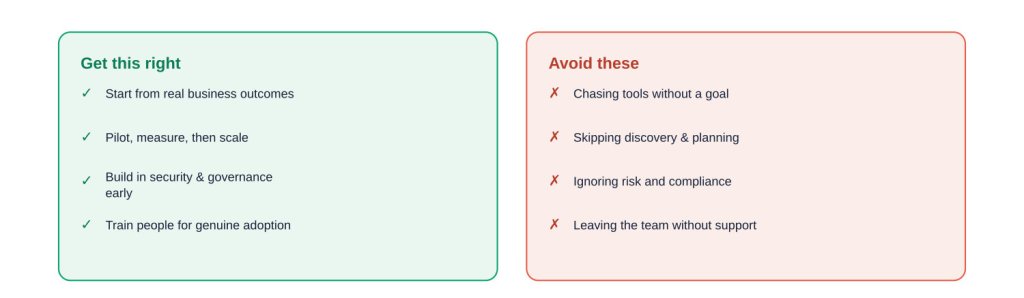
What to get right with Security Risks of Artificial Intelligence — and the common mistakes to avoid.
Key takeaways
- Security Risks of Artificial Intelligence is best approached around clear business outcomes, not tools or hype.
- The continuous development of AI may introduce new security risks to organisations.
- Data privacy and confidentiality risks are real and should be monitored.
- Attacks may also target AI systems.
- AI-powered cyberattacks and misuse are also being carried out by malicious entities.
- Pilot, measure, and then scale — with security, governance, and adoption built in.
- Partners such as User Experience Researchers (user.com.sg) can help you plan, implement, and optimise Security Risks of Artificial Intelligence for your context.
Conclusion
Artificial intelligence brings significant security risks alongside its substantial benefits. These risks span data and privacy concerns, attacks that target AI systems, the use of AI to enhance cyberattacks, the misuse of AI for harmful purposes, and risks arising from AI’s reliability, bias, and lack of transparency. As AI becomes more deeply embedded in systems and daily life, understanding and managing these risks becomes increasingly important for organisations and individuals alike.
The path forward is not to avoid AI but to use it safely and responsibly. By understanding where the risks lie, taking practical steps to manage them — protecting data, securing systems, validating outputs, addressing bias, maintaining oversight, and establishing accountability — and keeping human judgement and good practice at the centre, it is possible to capture AI’s benefits while limiting its dangers. A balanced, informed, and responsible approach is the key to harnessing the power of artificial intelligence while safeguarding against the genuine risks it brings.
Work with USER on Security Risks of Artificial Intelligence
If you are exploring Security Risks of Artificial Intelligence for your organisation, the most valuable next step is a focused conversation about your goals, current state of data security, and the outcomes you wish to achieve. The User Experience Researchers (USER) team can recommend the right discovery, planning, or implementation pathway for your context. Visit user.com.sg for more information or send an email to project@user.com.sg to book a discovery call.
Frequently asked questions
The main security risks of AI include data and privacy risks, attacks that manipulate or exploit AI systems, the use of AI to enhance cyberattacks, the misuse of AI for harmful purposes, and risks arising from AI’s reliability, bias, and lack of transparency. These must be managed to use AI safely.
AI systems process large amounts of data, often including sensitive information, raising concerns about how it is collected, used, stored, and protected. Information shared with AI tools may be retained or exposed, and organisations processing customer data through AI face heightened privacy and security risks.
Yes. AI systems can be targeted by adversarial attacks that craft inputs to fool a model, by data poisoning that corrupts training data, and by attempts to extract information from or steal models. As AI is used in important decisions, securing the AI itself has become an important part of security.
Malicious actors use AI to make attacks more effective and scalable — crafting convincing phishing and social-engineering messages, generating malicious content, automating attacks, and creating deepfakes for deception. This raises attackers’ capabilities, so defences and awareness must strengthen in response.
AI can make mistakes or produce plausible but incorrect outputs, and people may over-trust these outputs. Relying on AI without verification, especially for important matters, can lead to errors propagating into decisions. Maintaining scepticism, verifying important outputs, and keeping human oversight are essential.
AI can reflect and amplify biases in its training data, leading to unfair or discriminatory outcomes that cause harm and raise ethical and legal concerns. Because AI is often opaque, such bias can be hard to detect. Examining data and outcomes for bias and testing for fairness help manage this risk.
Organisations can manage AI risks by assessing where the risks lie, protecting data and privacy, securing AI systems, validating outputs, maintaining human oversight, testing for bias and reliability, establishing accountability, and choosing trustworthy tools and governance. A risk-based, responsible approach is key.
Using AI safely means balancing its benefits with its risks — engaging with it thoughtfully rather than avoiding it or adopting it uncritically. This involves protecting data, securing systems, ensuring oversight and accountability, verifying outputs, and keeping human judgement at the centre, for both organisations and individuals.

