

Agentic AI in Contact Centres: What It Means for Operational Efficiency & Customer Trust
Agentic AI is emerging as one of the most significant shifts in how contact centres operate. Unlike traditional automation or static chatbots, agentic AI refers to systems that act autonomously, take multi-step actions based on goals, learn from context, and manage workflows with minimal human supervision. Its role in customer service is growing rapidly, as organisations seek both to reduce costs and deliver faster, more personalised service.
Here’s a striking statistic: Cisco predicts that by 2028, 68% of customer service and support interactions with technology vendors will be handled by agentic AI. This suggests that what feels innovative today will soon be standard practice.
For contact centre operators, managers, and customers, the benefits are clear: lower operating costs, quicker response times, fewer errors, improved customer satisfaction, and more consistent service delivery. But how exactly does agentic AI look inside a contact centre, and what does it mean in practice?
What Agentic AI Looks Like in Contact Centres
Agentic AI is not simply a more advanced chatbot. It is a class of artificial intelligence that can take initiative, set and pursue goals, and adapt its actions based on outcomes. Within a contact centre environment, this translates into a system that doesn’t just answer questions but can orchestrate entire workflows.
Core Characteristics
Autonomy and proactivity
Agentic AI can detect customer intent, anticipate potential issues, and even initiate conversations. For instance, if a customer’s order is delayed, the system might proactively reach out with an apology and updated delivery information.
Goal-oriented behaviour
Instead of delivering isolated responses, agentic AI works toward outcomes. A goal might be to resolve a billing enquiry, ensure a refund is processed correctly, or restore service quickly. The system may break this goal into smaller steps and execute them without constant human oversight.
Contextual understanding
Modern customer service demands continuity. Agentic AI remembers a customer’s history, preferences, and sentiment, enabling consistent and tailored support. If a customer has called before about the same issue, the AI recalls this, reducing frustration and saving time.
Integration across systems
Agentic AI doesn’t operate in isolation. It connects to CRMs, ticketing systems, analytics tools, and communication channels. This integration allows it to pull data, take action, and close the loop across the customer service ecosystem.
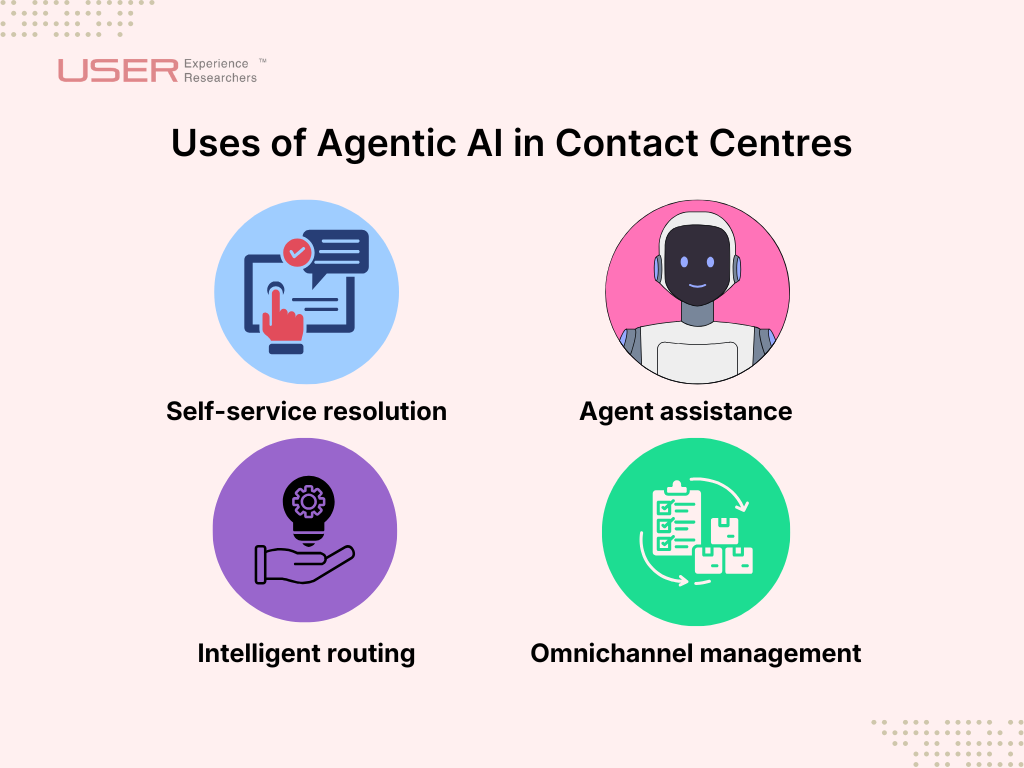
Applications in Contact Centres
Self-service resolution
Customers often prefer to solve issues without waiting for a human agent. Agentic AI can resolve straightforward queries such as account resets, subscription cancellations, or delivery tracking in real time.
Agent assistance
Instead of replacing humans, agentic AI often works alongside them. It provides real-time suggestions, pulls up relevant knowledge base articles, summarises customer history, and even monitors sentiment so that the agent knows when to adjust tone.
Intelligent routing
By analysing the nature and urgency of a query, the system can assign it to the most appropriate agent or escalate it automatically. This reduces bottlenecks and ensures critical issues are handled quickly.
Omnichannel management
Contact centres are no longer limited to phone calls. Customers reach out through email, live chat, social media, and messaging apps. Agentic AI coordinates responses across all channels, ensuring consistency in tone, information, and service quality.
These capabilities are more than just technical novelties. They have a direct and measurable impact on efficiency, cost, and customer relationships.
Benefits for Operational Efficiency & Customer Trust
The adoption of agentic AI brings both operational and experiential advantages. These benefits extend to the business, the workforce, and the customer base.
Faster Resolution Times
Agentic AI reduces average handling times by managing routine tasks and guiding conversations more effectively. A customer enquiring about their billing cycle, for example, could be served in seconds without waiting in a queue. For more complex issues, AI speeds up the agent’s work by pre-filling forms, summarising customer data, or drafting responses.
This speed not only saves costs but also improves customer satisfaction. In today’s competitive markets, a customer who receives a swift resolution is less likely to switch providers.
Lower Operational Costs
Labour is the single biggest cost in most contact centres. By allowing AI to handle repetitive tasks, organisations can optimise staffing levels and reallocate human resources to areas where empathy and complex reasoning are essential. This doesn’t necessarily mean reducing headcount; rather, it enables staff to deliver higher-value work, such as handling escalations or nurturing high-priority clients.
In addition, AI reduces errors caused by fatigue or inexperience. Every mistake avoided is time and money saved.
Improved Customer Trust and Satisfaction
Trust is built on consistency, accuracy, and transparency. Customers often become frustrated when they have to repeat themselves, receive conflicting information, or wait endlessly for a resolution. Agentic AI addresses these issues by:
- Remembering past interactions.
- Providing accurate, up-to-date information.
- Offering proactive updates and reassurance.
When customers feel heard and valued, their trust in the brand increases. Over time, this can translate into stronger loyalty and higher lifetime value.
Scalability and Flexibility
Demand in contact centres fluctuates — seasonal spikes, unexpected crises, or promotional campaigns can cause call volumes to surge. Agentic AI scales effortlessly, maintaining consistent service even when human staff cannot.
For global businesses, AI can also provide multi-language support and 24/7 availability. This level of scalability is hard to achieve with human agents alone, making AI a cost-effective way to meet growing expectations.
Enhanced Employee Experience
Agentic AI doesn’t only benefit customers. By offloading tedious tasks, it improves job satisfaction for human agents. Instead of dealing with repetitive enquiries, agents can focus on problem-solving, empathy, and customer relationship management.
Moreover, AI can act as a coach, providing feedback, suggesting phrasing, or flagging compliance issues in real time. This creates a more supportive working environment and helps staff develop professionally.
The benefits are clear. But what comes next as this technology matures?
Reimagining the Contact Centre of Tomorrow
Tomorrow’s contact centres will look very different from todays, and agentic AI will be at the core of that transformation. The question is not whether AI will be used, but how it will redefine interactions, reshape roles, and reset customer expectations. Several developments are likely to dominate this reimagining.
-
Hyper-Personalised Customer Journeys
Instead of simply recognising a customer’s name, AI will craft experiences tailored to each individual’s history, behaviour, and preferences. A broadband customer might be offered proactive compensation for repeated outages before lodging a complaint, while a retail shopper could receive a personalised promotion based on browsing habits and sentiment analysis.
-
Deeper Human-AI Collaboration
Agents will increasingly become specialists in empathy, judgement, and escalation, while AI takes on the routine, structured work. Co-pilot tools will become standard, guiding agents through conversations, flagging compliance risks, and generating instant summaries. The partnership will allow agents to spend more time connecting emotionally with customers.
-
Emotion and Voice Recognition
Future AI will interpret tone, pace, and even pauses in speech to detect frustration or satisfaction. It could switch responses dynamically — offering a calmer tone when a customer is upset, or escalating quickly when emotions run high. This emotional intelligence will make AI feel less mechanical and more responsive.
-
Multilingual and Culturally Aware Service
With built-in translation and cultural context, agentic AI will provide seamless service across languages and regions. This will allow companies to expand globally without massive increases in multilingual staff.
-
Predictive and Preventative Support
Contact centres will shift from reactive problem-solving to proactive prevention. AI could detect early signals of product failure, contract dissatisfaction, or delivery delays and intervene before the customer complains. This will transform customer support into customer assurance.
-
Ethical AI and Transparent Governance
As reliance on AI grows, so will expectations for transparency. Customers will want to know when they are interacting with AI and how decisions are made. Companies that prioritise fairness, explainability, and accountability will gain trust and competitive advantage.
-
Integration Beyond the Contact Centre
The contact centre will no longer be a silo. AI-driven insights will flow to sales, product design, and marketing. A recurring support issue might inform product upgrades, while sentiment analysis could guide campaign strategies. The contact centre will evolve from a cost centre into a strategic nerve centre for the entire business.
Conclusion
Agentic AI is poised to transform contact centres, not just by making them more efficient but by redefining what customer service means. Its ability to work autonomously, adapt to context, and scale across systems already delivers faster resolutions, lower costs, and stronger relationships.
The next phase will be even more transformative: hyper-personalised service, predictive interactions, emotion recognition, multilingual communication, and deeper human-AI collaboration. Far from replacing humans, agentic AI will empower them, freeing up time for empathy and complex problem-solving.
For organisations, the opportunity is clear. Those that invest wisely in agentic AI — while maintaining transparency, ethics, and customer-first values — will not only streamline operations but also build lasting trust. The contact centre of tomorrow will be less about answering calls and more about anticipating needs, strengthening loyalty, and creating competitive advantage.
About USER Experience Researchers Pte. Ltd.
USER is a leading UX-focused company specialising in digital transformation consultancy, agile development, and workforce solutions. We have a steadfast commitment to innovating the best of today’s technology to promote sustainable growth for businesses and industries.
For more information, contact USER through project@user.com.sg

