
Last updated: 6 May 2026

In today’s fast-paced business landscape, efficiency is paramount. Companies are constantly looking for innovative ways to streamline operations, enhance productivity, and drive growth. One of the most effective ways to achieve this is by leveraging AI automation tools. These tools, powered by artificial intelligence, are revolutionizing how businesses operate by automating repetitive tasks, improving decision-making processes, and enabling data-driven insights. This article will explore the key AI automation tools that can transform business efficiency, discuss their features and benefits, and provide a roadmap for successful implementation.
AI Automation Tools Expert — At a Glance
What this guide helps you do
This guide is built for decision-makers, practitioners, and teams who need a practical, implementation-focused understanding of AI Automation Tools Expert. It outlines key concepts, real-world applications, and considerations to help you evaluate, plan, or adopt this topic with confidence.
Why this guide matters
As AI Automation Tools Expert continues to shape how modern organisations operate, understanding the core principles, benefits, and limitations is essential. This article brings together the structure, examples, and frameworks you need to make informed, business-aligned decisions.
Quick facts
- Topic: AI Automation Tools Expert
- Last updated: 6 May 2026
- Best for: Business leaders, IT/operations teams, product owners, and digital strategists evaluating this area
- Covered in this guide: Understanding AI Automation Tools; Key Features of AI Automation Tools; Benefits of AI Automation for Businesses; Top AI Automation Tools for Business: An Expert’s Guide; Best Practices for Implementing AI Automation Tools in Business
- Format: Definitions, frameworks, comparison tables, FAQs, and a clear next step
AI Automation Tools Expert refers to the practical applications, principles, and frameworks described throughout this guide—covering core concepts, benefits, considerations, and adoption pathways.
“If you are evaluating AI Automation Tools Expert, focus on understanding the core concepts, real-world use cases, and trade-offs first—so any decisions, investments, or implementations are aligned to actual outcomes.”
“AI Automation Tools Expert — Scope & Considerations”
| Scope area | What to consider | Why it matters |
| Core concepts | Definitions, terminology, and underlying principles | Establishes a shared baseline for stakeholders |
| Use cases & applications | Where the topic delivers measurable value | Helps prioritise where to invest effort first |
| Benefits | Efficiency, quality, cost, risk, and experience gains | Quantifies business impact and ROI potential |
| Limitations & risks | Trade-offs, dependencies, and known constraints | Reduces surprises during planning and execution |
| Implementation steps | Discovery, design, pilot, scale, and optimisation | Provides a repeatable, lower-risk delivery path |
| Success metrics | Adoption, outcomes, ROI, and quality indicators | Confirms whether the initiative is delivering value |
Understanding AI Automation Tools
What Are AI Automation Tools?
AI automation tools are software solutions that use artificial intelligence (AI) to automate business processes. These tools harness the power of machine learning (ML), natural language processing (NLP), and robotic process automation (RPA) to handle a wide range of tasks that would typically require human intervention. From automating repetitive administrative tasks to processing vast amounts of data, AI automation tools help businesses improve efficiency, reduce errors, and save valuable time.
Core Technologies Behind AI Automation Tools
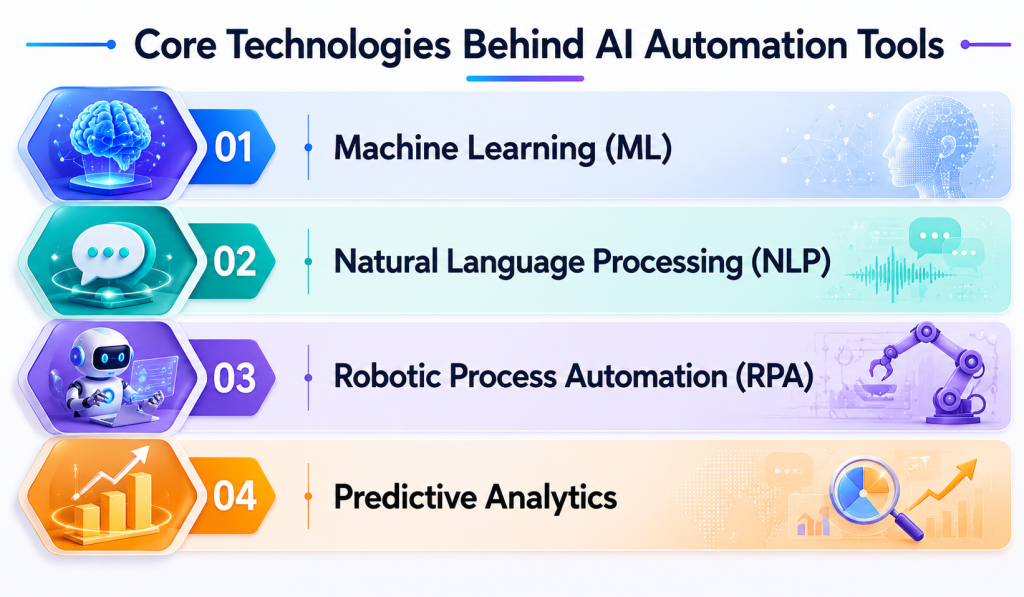
The effectiveness of AI automation tools lies in the advanced technologies they employ:
- Machine Learning (ML): AI systems use ML algorithms to learn from data, identify patterns, and improve over time without human intervention.
- Natural Language Processing (NLP): NLP enables AI to understand, interpret, and generate human language, allowing tools to automate tasks like customer support and content generation.
- Robotic Process Automation (RPA): RPA automates rule-based tasks, mimicking human actions to complete repetitive tasks such as data entry, processing transactions, and responding to queries.
- Predictive Analytics: AI-driven predictive analytics can forecast future trends, customer behaviour, and market conditions, helping businesses make proactive decisions.
Key Features of AI Automation Tools
AI automation tools are designed to enhance business efficiency through several core features:
Task Automation
Task automation is one of the primary benefits of AI automation tools. By automating manual and repetitive tasks, businesses can free up time for employees to focus on more strategic activities.
Workflow Optimisation
AI tools optimise workflows by streamlining processes, ensuring that tasks are completed in the most efficient order and that resources are used optimally.
Data Processing
AI tools can process large volumes of data quickly, extracting valuable insights from structured and unstructured data sources. This enhances decision-making and improves overall business intelligence.
Machine Learning Integration
AI tools with ML capabilities continuously learn from new data, improving task performance and predicting future outcomes. This makes AI automation tools adaptable and future-proof.
Reporting Capabilities
AI-powered tools can generate detailed reports, offering businesses insights into their operations. These reports can be used to monitor key performance indicators (KPIs) and track the effectiveness of automation initiatives.
Implementation readiness means an organisation has the people, processes, data, and systems needed to adopt AI Automation Tools Expert in a way that delivers measurable, sustainable value.
“The strongest results come from teams that pair clear business outcomes with disciplined execution—not from chasing the latest buzzwords or tools.”
Benefits of AI Automation for Businesses
Implementing AI automation tools can provide numerous advantages for businesses across industries. Here are some of the key benefits:
1. Cost Reduction
AI automation reduces the need for manual labor, cutting operational costs by automating time-consuming tasks. For instance, automating customer support with AI chatbots eliminates the need for large customer service teams.
2. Enhanced Productivity
AI tools improve productivity by handling routine tasks, allowing employees to focus on higher-value activities. This leads to faster delivery times and increased throughput.
3. Reduced Human Error
AI systems are less prone to errors than humans, particularly when performing repetitive tasks. This minimizes mistakes, ensuring that operations run smoothly and efficiently.
4. Scalability
AI automation tools can easily scale to meet growing business needs. Whether a business is expanding its customer base or increasing its product offerings, AI tools can handle the increased workload without the need for additional staff.
5. Faster Decision-Making
AI tools can analyse data and generate insights in real-time, enabling businesses to make informed decisions faster. Predictive analytics, for example, can help businesses anticipate trends and adjust strategies accordingly.
Top AI Automation Tools for Business: An Expert’s Guide
There is a wide variety of AI automation tools available, each with unique features and applications. Here’s an expert’s guide to some of the most powerful AI automation tools for businesses:
UiPath: The Leading Robotic Process Automation (RPA) Tool
UiPath is a leader in the RPA space, offering powerful tools to automate business processes. With UiPath, businesses can automate repetitive tasks like data entry, invoice processing, and customer onboarding. The tool’s user-friendly interface, scalability, and integration capabilities make it a favourite among companies in industries such as finance, healthcare, and logistics.
- Pricing: Offers both enterprise and community editions, with flexible pricing based on usage.
- Key Applications: Automating administrative tasks, customer support, data processing, and IT management.
Automation Anywhere: AI-Powered Business Process Automation
Automation Anywhere combines RPA with AI to automate complex workflows. The tool integrates with enterprise software, enabling businesses to create end-to-end automation solutions. With its focus on intelligent automation, it helps businesses streamline operations across multiple departments, including HR, finance, and supply chain management.
- Pricing: Offers a subscription-based model with various tiers based on the scale of automation.
- Key Applications: Workflow automation, intelligent document processing, and customer service automation.
Appian: Low-Code Automation for Streamlined Business Operations
Appian’s low-code platform allows businesses to develop and deploy AI automation solutions with minimal coding knowledge. This makes it ideal for companies that want to automate their workflows without extensive IT resources. Appian’s platform is highly customisable and can be tailored to suit the specific needs of businesses across industries.
- Pricing: Flexible pricing based on the number of users and usage.
- Key Applications: Business process automation, workflow management, and custom application development.
Expert.ai: Advanced AI Automation for Data Processing and Analysis
Expert.ai specializes in natural language processing and machine learning, offering businesses the ability to automate data-driven decision-making. The tool is particularly useful for industries that rely heavily on unstructured data, such as legal, finance, and healthcare.
- Pricing: Custom pricing based on business needs.
- Key Applications: Data analysis, document processing, and knowledge management.
Make (formerly Integromat): Customisable Workflow Automation
Make is a visual automation platform that allows businesses to automate workflows without writing code. It integrates with over 1000 applications and is perfect for automating tasks across different business systems. Make is highly customisable and suitable for businesses of all sizes.
- Pricing: Offers free and paid plans based on the number of integrations and workflows.
- Key Applications: Task automation, workflow optimisation, and data synchronization.
Best Practices for Implementing AI Automation Tools in Business
Implementing AI automation tools requires careful planning and execution. Here are some best practices for businesses looking to adopt AI automation solutions:
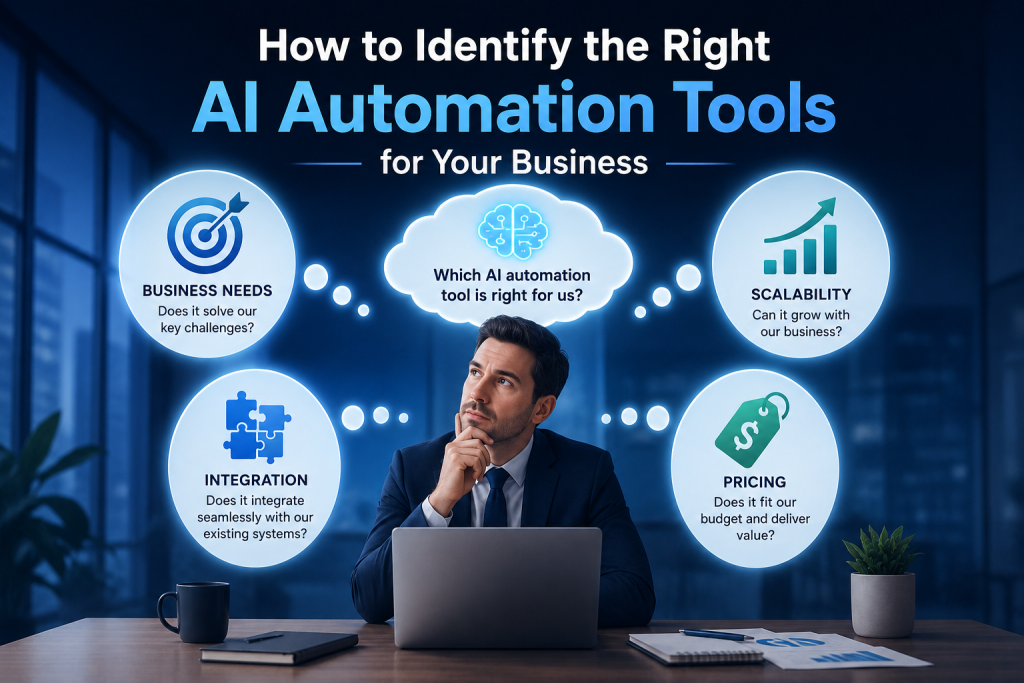
How to Identify the Right AI Automation Tools for Your Business
To select the best AI automation tools for your business, you need to evaluate several factors:
- Business Needs: Identify which processes can be automated and select a tool that aligns with those needs.
- Scalability: Choose tools that can scale with your business growth.
- Integration: Ensure that the AI tool integrates seamlessly with your existing business systems.
- Pricing: Consider the cost of the tool, factoring in both initial investment and ongoing maintenance.
Overcoming Challenges in AI Automation Adoption
While AI automation can provide substantial benefits, there are challenges businesses need to overcome:
- Data Quality: AI tools rely on high-quality data. Ensure that your data is clean, accurate, and well-structured.
- Integration with Legacy Systems: Some businesses may face challenges integrating new AI tools with legacy systems. Work with experts to ensure a smooth integration.
- Employee Resistance: Employees may fear job displacement due to automation. It’s important to communicate the benefits of automation and provide training to help employees adapt.
Measuring the Success of AI Automation Tools
To measure the success of AI automation tools, businesses should track several key performance indicators (KPIs), including:
- Time Saved: Measure how much time has been saved by automating repetitive tasks.
- Cost Savings: Track reductions in operational costs due to automation.
- Productivity Improvements: Measure the increase in output after implementing automation tools.
Key Metrics to Track AI Automation ROI
- Time Savings: Evaluate how much faster tasks are completed.
- Error Reduction: Track the decrease in human errors.
- Efficiency Gains: Measure the increase in overall business efficiency.
Case Studies of Successful AI Automation Implementations
Real-life examples of businesses successfully implementing AI automation tools provide valuable insights into their benefits. For instance, a financial institution may use UiPath to automate invoice processing, leading to a significant reduction in manual labor and error rates, ultimately improving operational efficiency.
The Future of AI Automation Tools
The future of AI automation tools looks bright, with innovations on the horizon that will further enhance business efficiency. Emerging trends include the rise of generative AI, which can create content and provide insights from complex data sets, and predictive analytics, which will allow businesses to anticipate customer needs and market trends with even greater accuracy.
Trends Shaping the Future of AI Automation in Business
- Generative AI: AI tools will increasingly be used to generate content, design products, and create personalized experiences for customers.
- Predictive Analytics: AI will continue to enhance decision-making by predicting market trends and customer behaviours.
- Cloud Integration: AI tools will become more integrated with cloud-based systems, making them more accessible and scalable for businesses of all sizes.
Enquire about a tailored discovery or consultation session with User Experience Researchers Pte Ltd (USER) to identify the right AI automation opportunities for your organisation.
Frequently Asked Questions (FAQ)
AI automation tools use artificial intelligence to automate business tasks, improving efficiency and reducing human error. These tools utilize machine learning, natural language processing, and robotic process automation.
AI tools handle repetitive tasks, freeing up employees to focus on more strategic and creative work, leading to increased productivity.
Industries like finance, healthcare, logistics, customer service, and marketing can all benefit from AI automation tools.
Top tools for small businesses include UiPath, Appian, and Make, which offer scalability and ease of use.
Consider your business needs, the tool’s scalability, integration capabilities, and cost when selecting the best AI automation tool.
RPA automates repetitive tasks, saving time, reducing errors, and improving efficiency.
Challenges include data quality issues, integration with legacy systems, and employee resistance to change.
Businesses measure ROI by tracking metrics like time savings, cost reductions, and productivity improvements.
Yes, many AI tools are designed to integrate with existing business software for seamless operations.
The future of AI automation includes the rise of generative AI, predictive analytics, and deeper integration with cloud-based systems. By implementing AI automation tools, businesses can unlock a wealth of opportunities to increase efficiency, save time, and enhance decision-making. Whether you’re looking to automate repetitive tasks or enhance data analysis, there is an AI tool designed to meet your needs.

