
If you’re searching for a focus group discussion in Singapore that’s actually usable for decision-making (not just “nice quotes”), this page lays out the practical details: what you get, how recruiting works, how sessions are moderated, what deliverables look like, and how we document consent and data handling in a way that supports internal governance under Singapore’s Personal Data Protection Act (PDPA).
Unlike generic market-research pages, we’ll be specific about how the work is run: group size, session length, discussion guide structure, stimulus testing, analysis approach, and the evidence pack stakeholders typically need to trust and reuse the findings.
Focus Group Discussion in Singapore at-a-Glance
What is a focus group discussion?
A focus group discussion is a controlled group interview facilitated by a moderator to explore perceptions, beliefs, and reactions to a topic, concept, product, or service.
When an FGD is the right method
FGDs are strong when you need:
- Language: how people naturally talk about a problem, brand, or offer
- Reactions: what resonates, confuses, triggers trust, or creates friction
- Idea generation: new angles and unmet needs that don’t show up in surveys
- Concept testing: initial “directional” feedback before deeper validation
Quick Facts
- Session length: often 60–120 minutes (many projects keep it tighter to maintain engagement).
- Group size: commonly ~6–9 for classic focus groups, but smaller groups can be used depending on the topic and the depth required.
- Format: online or in-person; single segment or multi-segment; single-city (Singapore) or regional.
How we beat generic competitors
Competitors often stop at “we do focus groups.” This is what you should spell out:
- how recruiting is screened,
- how the guide is structured,
- how bias is managed (dominant voices, groupthink),
- what you actually receive at the end (not just “insights”).
2) Availability, Timelines & Cost Drivers
What you should commit to
Don’t publish “next available dates” unless they’re live-bookable. Instead, plan around:
- your decision deadline (launch / campaign / roadmap)
- recruitment complexity (B2B vs consumer, niche profiles, incidence rate)
- number of groups and segments
- whether stimulus needs preparation (concept boards, prototypes, scripts)
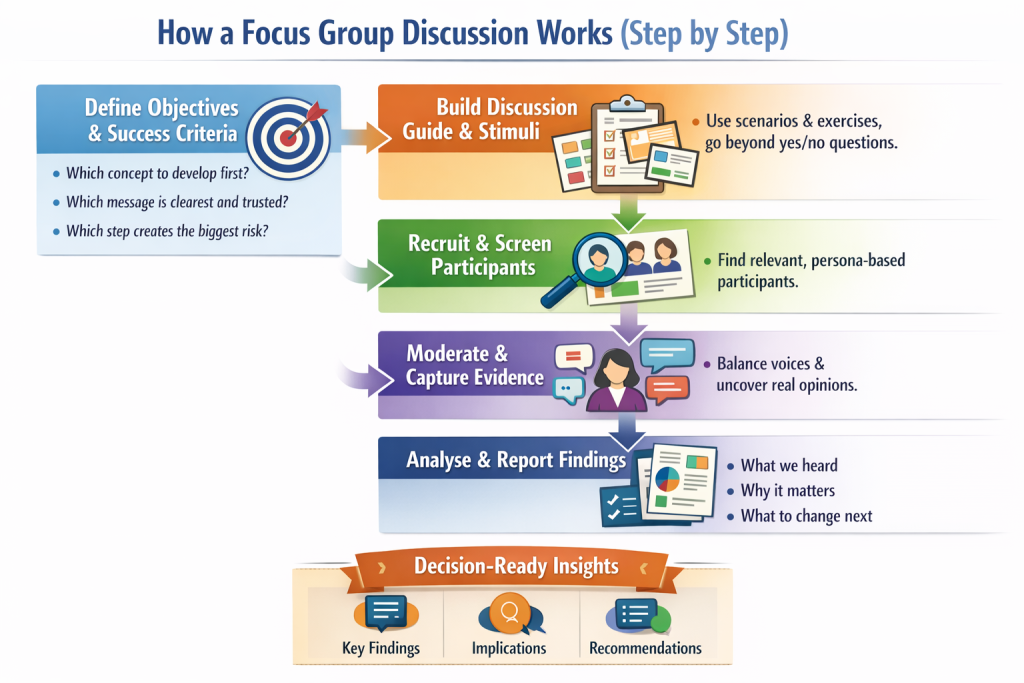
Typical engagement timeline
| Phase | What happens | Typical output |
| 1) Scoping | objectives, segments, risk/bias checks | research plan + proposed segments |
| 2) Screener + recruitment | define must-haves/exclusions, outreach, scheduling | screener + participant grid |
| 3) Discussion guide | topics, probes, stimulus flow | moderator guide + stimulus checklist |
| 4) Fieldwork | moderated sessions (online or in-person) | recordings/notes (as agreed) |
| 5) Analysis | coding, theming, triangulation | findings + implications |
| 6) Reporting | exec summary + evidence | report + highlight clips (optional) |
Why this matters: A focus group is only as good as the recruitment and the moderation structure—that’s where most “cheap” FGDs fail. Learn where and how to apply the right structure and recruitment strategy.
Cost drivers
- Recruitment: incidence rate, seniority, language needs, B2B vs consumer
- Incentives: whether incentives are needed and at what level (varies by profile)
- Segments: number of distinct cohorts (e.g., new vs returning, SME vs enterprise)
- Fieldwork mode: online vs in-person, venue needs, recording needs
- Outputs: topline readout vs full report vs clips + workshop
“The biggest drivers of focus group discussion cost in Singapore are recruitment difficulty, number of segments/groups, and the level of reporting required—from a fast readout to a full evidence-backed report.”
3) What You’ll Get from a Focus Group Discussion
What a well-run FGD delivers
By the end of an FGD engagement, teams typically get:
- Top themes (what matters most, and why)
- Decision-ready implications (what to change, what to keep, what to test next)
- Language and messaging (phrases people actually use)
- Barrier analysis (what blocks adoption, trust, purchase, or usage)
- Segment differences (how priorities shift across cohorts)
The most common failure modes
The importance of avoiding leading questions and enabling open discussion creates balanced, yet detailed exchanges.
You should also design around classic focus group risks:
- Dominant participants → structured turn-taking, directed prompts
- Groupthink → independent reflection moments before discussion
- Social desirability bias → neutral phrasing, scenario framing
- “Idea pile” without decisions → decision-focused questions and prioritisation
Mini table: scenarios and what we extract
| Scenario | What is tested | What you get |
| New concept / positioning | comprehension, appeal, trust, objections | messaging do/don’t + hypothesis list |
| Customer journey friction | emotional peaks, confusion points, expectations | friction map + fix priorities |
| Feature prioritisation | perceived value, must-have vs nice-to-have | ranked feature drivers + rationale |
Definitions to include
- Discussion guide: a structured set of topics and probes that keeps the session consistent and comparable across groups.
- Groupthink: when participants converge on a view because of social pressure rather than independent judgement.
“A focus group discussion is most useful when you need to understand why people feel a certain way, what language they use, and what objections or trust signals shape their decisions.”
4) Reporting & Evidence Pack
What’s typically included in an evidence pack
Depending on what’s agreed, your pack may include:
- Research plan (objective, segments, method)
- Screener (questions + acceptance rules)
- Participant profile summary (aggregated; no unnecessary personal data)
- Session metadata (date/time, segment, moderator, mode)
- Findings report (themes → evidence → implications)
- Readout deck (leadership-ready)
- Clips/highlights (optional, if recording is enabled)
FGDs are controlled group interviews facilitated by researchers with careful attention given to participant reactions and interaction.
PDPA-ready documentation (practical, not legal advice)
Singapore’s PDPA sets baseline rules governing the collection, use, disclosure, and care of personal data.
In practice, internal governance typically wants clarity on:
- what you collected,
- why you collected it,
- how consent/notice was handled,
- how it’s protected,
- how long it’s retained.
PDPC outlines obligations such as notification, consent, purpose limitation, protection, and retention limitation (among others).
Table: “Evidence Pack” (what it is and why it matters)
| Item | Why stakeholders care |
| Screener + criteria | proves the right people were recruited |
| Consent/notice record | supports governance expectations under PDPA obligations |
| Session metadata | traceability for follow-up decisions |
| Theme-to-evidence links | prevents “it’s just opinions” pushback |
| Recommendations + next tests | converts insight into action |
“For governance and audit trails, a strong FGD pack includes the screener, participant profile summary, consent records, session metadata, and a Findings report that links claims to evidence.”
5) Who Should Book Focus Group Discussions
This service is ideal for:
- Product leaders validating direction early
- Marketing teams testing messaging, positioning, and campaign concepts
- CX teams exploring churn, trust, and service expectations
- Innovation teams evaluating new value propositions
- Public sector / regulated teams needing stronger documentation
Rule-of-thumb planning suggestion (not a regulation)
- Start with 2–4 groups for directional learning across key segments.
- Add groups when you see segment divergence or high-stakes decisions.
“If stakeholders disagree on what customers want, focus group discussions provide structured, moderated evidence to align teams on what matters and what to do next.”
6) Recruitment Options: Use Your Customer List vs Fresh Recruit
Option A: Recruit from your existing customer/user list
Best when:
- you have a quality list and permissions to invite
- you need feedback from known cohorts (e.g., active users, churned users)
Watch-outs:
- sample bias (only the reachable / engaged respond)
- privacy/consent workflow must be handled carefully
Option B: Fresh recruitment (panel / outreach)
Best when:
- you need non-customers or competitor users
- you need specific profiles not present in your database
Watch-outs:
- tighter screening is required
- recruitment timelines can vary by incidence
Decision table
| Need | Use your list | Fresh recruit |
| Fastest start | ✅ | Depends on profile |
| Competitor users | ⚠️ limited | ✅ |
| Niche B2B seniority | Depends on network | Depends on incidence |
| Cleaner representativeness | ⚠️ Depends on profile | ✅ (with good screening) |
| Governance clarity | ✅ (with workflow) | ✅ (with workflow) |
7) Choosing the Right Method: FGD vs Interviews vs Usability Testing vs Surveys
FGDs are time-efficient because they gather perspectives from multiple participants at once (often in a 1–2 hour session).
But they are still discussion-based—so they’re best for perceptions and language, not behavioural proof.
Comparison matrix
| Criteria | Focus group discussion | 1:1 interviews | Usability testing | Survey |
| Best for | perceptions, language, reactions | deep individual stories | observed behaviour | sizing prevalence |
| Typical sample size | small (group-based) | small | small–medium | medium–large |
| Output style | themes + consensus/divergence | depth + nuance | issues + success rates | stats + segments |
| Main risk | dominance/groupthink | interviewer bias | task realism | shallow “why” |
“Use focus group discussions to learn language, motivations, and objections; use usability testing to validate behaviour; use surveys to measure prevalence.”
8) Inclusivity, Language & Accessibility
Practical inclusivity measures:
- Use clear, non-leading language and culturally neutral prompts
- Offer language-appropriate moderation where needed
- Avoid assumptions; ask participants to define their own context
- Provide accessibility options (breaks, captions, device support for online)
Definition
- Inclusive research: research designed so participants can contribute safely and comfortably, without being pressured by language, status, or social dynamics.
“The best focus group discussions are structured and participant-centred: neutral prompts, balanced airtime, and analysis that reflects both consensus and disagreement.”
Frequently Asked Questions
A focus group discussion is a controlled group interview facilitated by a moderator to explore perceptions, beliefs, and reactions to a topic, concept, product, or service.
Many focus group sessions run about 60–120 minutes, depending on depth and stimulus complexity.
Classic focus groups commonly involve around 6–9 participants, but projects may use smaller groups depending on the topic and depth required.
Focus groups are great for perceptions and language, but they’re often paired with usability testing or interviews when you need behavioural validation.
Under Singapore’s PDPA, organisations should manage notice/consent, purpose limitation, reasonable security, and retention practices when handling personal data.
Note: This is practical guidance, not legal advice—your internal DPO/legal team should confirm requirements for your context.
Typical deliverables include a findings report, session metadata, and a structured evidence trail (e.g., screener and participant profile summary) so stakeholders can trust and reuse the insights.
Focus groups explore perceptions and beliefs in a moderated discussion, while usability testing evaluates whether users can successfully use a product through observed tasks.
Share your objective, target segments, number of groups, preferred mode (online/in-person), and timeline—then the scope can be priced accurately based on recruitment difficulty and reporting depth.

