

Focus group market research is a qualitative method where a small group of people from your target audience discuss a defined topic in a moderated session. The point is not to “vote” on an answer, but to uncover the reasoning, language, doubts, and trade-offs behind real decisions.
For teams in Singapore, that depth matters because decisions often carry a high cost of change—whether you’re designing customer journeys, validating product direction, or aligning stakeholders across regions. A well-run focus group reduces guesswork by making user thinking visible before you commit to build, launch, or scale.
This article will guide you on running focus groups as part of research-led UX/UI delivery that translates into clearer flows, stronger interfaces, and measurable adoption outcomes.
What Is Focus Group Market Research?
A focus group brings together a small set of participants who represent your intended audience. A moderator guides the discussion through carefully sequenced prompts—typically moving from warm-up questions to deeper probes—to surface attitudes, behaviours, perceptions, and decision triggers.
As a mature market, Singapore organisations rely on accurate information that takes local usage into consideration. Most users are knowledgeable on platforms, with many being familiar with digital interfaces, and are quick in deciding to pursue adoption or rejection of a technology. This can make or break the longevity or profitability of digital products in the country.
Typical group size (and why it matters)
Many focus groups are run with a small group (often around 6–10 participants), because the goal is to capture varied perspectives while still allowing every participant enough airtime. Too many people and the group becomes performative; too few and you lose diversity of viewpoints.
Focus groups vs surveys vs interviews
Focus groups are best when you need the why—the explanations, the emotional signals, the language people naturally use, and the group dynamics that shape opinions. Surveys are useful when you need breadth and measurement, while one-to-one interviews are often better for deeply personal topics or when group dynamics may suppress honest disclosure.
A simple way to choose:
- Need depth and discovery? Focus groups
- Need private, detailed narratives? 1:1 interviews
- Need measurement at scale? Surveys (often paired with qualitative work)
When to Use Focus Groups (and When Not To)
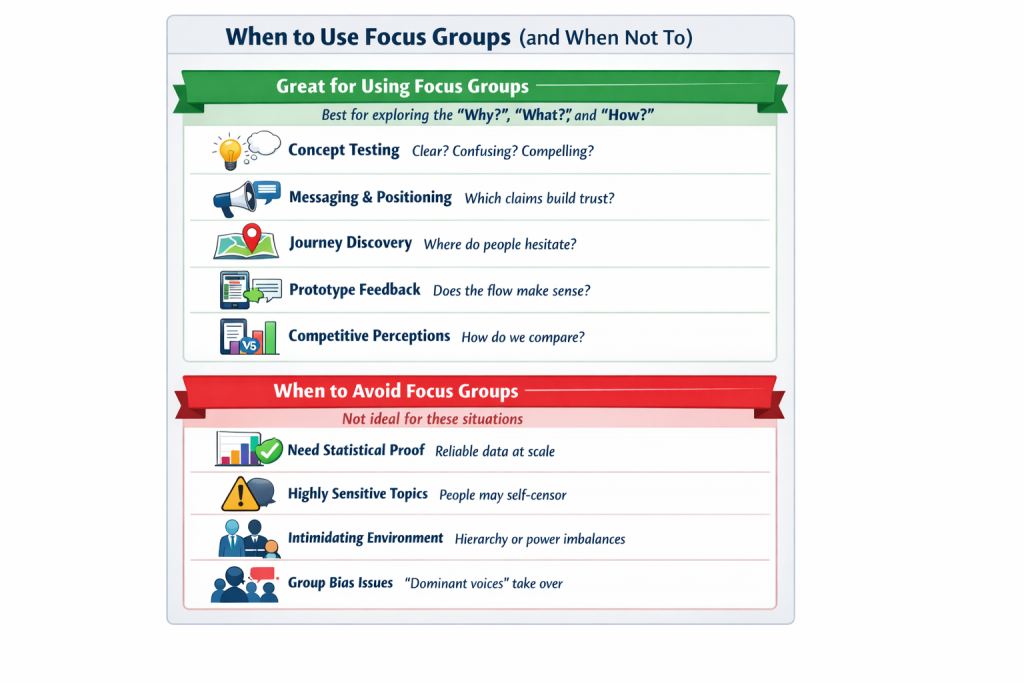
Focus groups deliver “qualitative depth” and are particularly useful when exploration and understanding are the primary objectives—especially the classic “why?”, “what?”, and “how?” questions.
Strong use cases for focus group market research
Focus groups are especially effective for:
- Concept testing: What feels clear, confusing, compelling, risky, or unnecessary?
- Messaging and positioning: Which claims sound credible? Which words build trust?
- Journey discovery: Where do people hesitate, drop off, or look for reassurance?
- Prototype feedback (early): Whether flows “make sense” before you polish UI
- Competitive perceptions: How buyers describe differences in their own words
When to NOT use focus groups
Focus groups can be the wrong tool when:
- You need statistically reliable measurement (e.g., “Which option will win?” at scale)
- The topic is highly sensitive, where people may self-censor
- The environment has hierarchy or intimidation effects (e.g., senior vs junior participants) that distort responses
- You’re vulnerable to classic biases like participants trying to please the moderator, or “dominant voices” steering the room
This doesn’t mean you should avoid focus groups—it means you should design around these risks (better recruitment, stronger moderation, and follow-up validation)
Types of Focus Groups You Can Run
The format you choose should match your constraints and objectives.
In-person focus groups
Best when you need:
- Higher emotional richness (body language, shared artefacts)
- Hands-on product handling or physical stimulus (packaging, devices)
- High-stakes stakeholder confidence (some teams simply trust in-person more)
Online (live video) focus groups
Online groups can be more practical when participants are distributed; schedules are tight, or travel is a barrier. Many research teams use online groups to increase reach and speed while preserving moderated discussion.
Asynchronous formats (discussion boards, diaries)
Use these when:
- You want reflection over time
- You need participants to test something in real life (then report back)
- Scheduling a live session is difficult
If you’re looking for examples of participant communities that support different participation modes (online, phone, in-person), you can review what Focus Groups offer.
How to Run Focus Group Market Research Step-by-Step
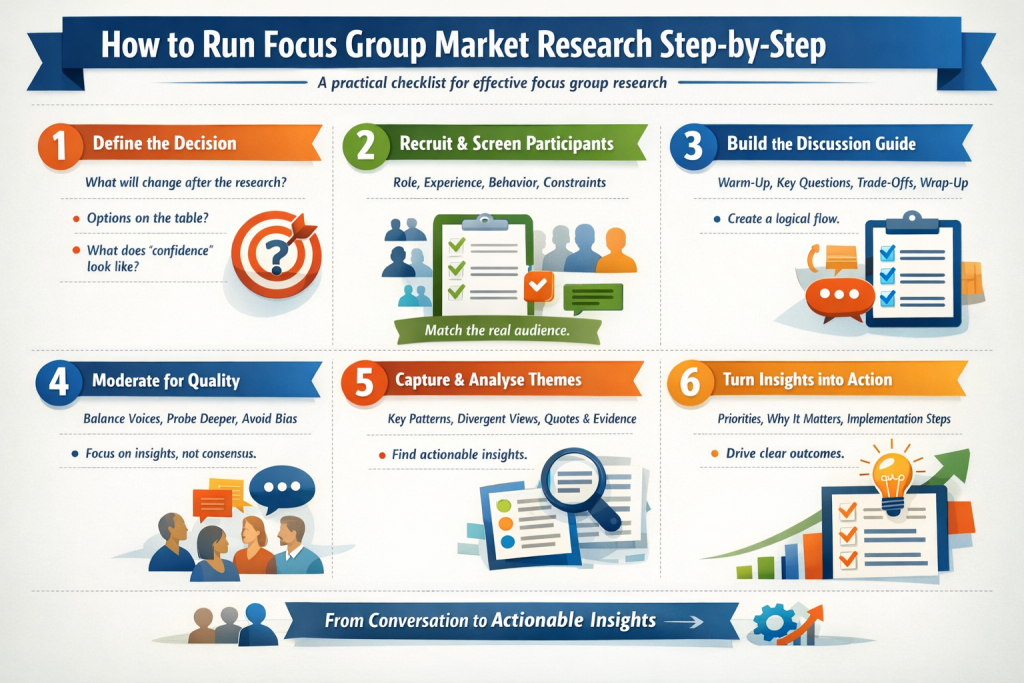
A strong focus group is built, not improvised. Here’s a practical workflow you can use internally or as a checklist when hiring a partner.
1) Define the decision you’re trying to improve
Start with the business decision, not the method:
- What will change after the research?
- What options are on the table?
- What would “confidence” look like?
This prevents the most common failure mode: great conversations that don’t translate into decisions.
2) Recruit and screen the right participants
Your screener should match the real audience:
- Role (buyer, user, influencer)
- Experience level (new vs expert)
- Behaviour (actual purchase/use patterns)
- Constraints (tools used, budget band, compliance context)
With respect to Singapore contexts, it’s often useful to test language preferences and terminology upfront—because the “right words” can vary by industry and audience segment.
3) Build a discussion guide that flows
A good topic guide typically starts with easy “getting comfortable” prompts, then progresses toward deeper probes and comparisons. The structure matters because it shapes the group’s psychological safety and willingness to share honestly.
A practical guide structure:
- Warm-up (context and behaviours)
- Current solutions (what works, what fails)
- Reaction to stimulus (concepts, messaging, prototypes)
- Trade-offs (what they’d give up, what’s non-negotiable)
- Wrap-up (summarise priorities; ask for “one thing to change”)
4) Moderate for quality (not consensus)
The goal is not agreement—it’s insight. Strong moderators:
- Balance airtime (prevent “dominant participant” effects)
- Probe for underlying reasons (“What makes you say that?”)
- Separate preference from behaviour (“What would you do in practice?”)
- Watch for social desirability and moderator influence
5) Capture and analyse themes
Your analysis should move beyond “notes” into:
- Key themes (patterns that repeat)
- Moments of divergence (where segments differ)
- Language mapping (what users call things)
- Opportunity areas (what to improve, simplify, clarify)
- Evidence (quotes and clips supporting recommendations)
6) Turn insights into action
A strong focus group output should make it easy to act:
- What to change first (prioritised)
- Why it matters (risk or upside)
- How to implement (UX/UI implications, messaging changes, journey improvements)
Case Examples (Illustrative Patterns)
1) Concept test for a new service offer
Challenge: Stakeholders disagreed on what customers would value most.
Approach: Two focus groups with target segments; tested value propositions, pricing anchors, and “deal-breaker” concerns.
Outcome: Clear prioritisation of benefits and language that improved message clarity and sales enablement.
2) High drop-off in a form-heavy journey
Challenge: Users abandoned mid-way due to uncertainty and perceived risk.
Approach: Focus groups reviewed the journey step-by-step; identified trust gaps, confusing field requirements, and missing confirmations.
Outcome: Simplified steps, better microcopy, stronger reassurance patterns, fewer support tickets.
3) Dashboard that looked good but didn’t support decisions
Challenge: Teams exported data to spreadsheets because the dashboard didn’t answer daily questions.
Approach: Focus groups explored decision routines (“what do you check first?”), interpretation problems, and alert expectations.
Outcome: Improved hierarchy, clearer comparisons, and “next action” cues aligned to how decisions are actually made.
What to Prepare Before You Hire a Focus Group Partner
If you want a research partner to move quickly and deliver useful outputs, prepare:
- Your objective: what decision the research supports
- Your audience definition: who “counts” and who doesn’t
- Stimulus materials: concept boards, prototypes, messaging, or journey screenshots
- Constraints: timeline, compliance expectations, technical realities
- Success metrics: adoption, conversion, task completion, trust, reduced support tickets
The clearer these are, the more your partner can spend time on insight quality—not admin.
How a Reliable Agency like USER Applies Focus Groups to UX/UI Design
Focus groups are particularly valuable when you’re designing or improving digital products because they reveal:
- Where mental models diverge from your internal assumptions
- Which terminology builds trust (or creates friction)
- What “confidence” looks like in a flow (confirmation, status, error recovery)
User Experience Researchers’ (USER’s) UI/UX design work is positioned around creating better digital experiences through a data-driven approach—making focus group insights useful not only for research readouts, but for design decisions that show up in production.
This is especially valuable in the context of Singapore businesses and organisations. Given the country’s push towards better digital experiences and initiatives towards sustainable growth through technology, it’s important to know how to fit products and services through detailed research of various Singapore user groups.
If your focus group is tied to a digital experience (portal, dashboard, onboarding, workflow), connect it directly to your UX/UI roadmap—so you can move from “insight” to “implementation” with fewer translation gaps.
About User Experience Researchers
User Experience Researchers Pte Ltd (USER) is a leading UX-focused company specialising in digital transformation consultancy, agile development, and workforce solutions. We have a steadfast commitment to innovating the best of today’s technology to promote sustainable growth for businesses and industries.
For more information, contact USER throughproject@user.com.sg
Common Questions About Focus Group Market Research
Costs depend on participant type (B2B is often harder to recruit), number of groups, stimulus complexity, whether you need multilingual moderation, and analysis depth. A good provider will scope deliverables clearly (discussion guide, session recordings, thematic analysis, recommendations).
A typical cycle includes planning, recruitment, sessions, and analysis. Timelines vary, but the main drivers are recruitment speed and stakeholder review cycles.
Many focus groups use small groups (often around 6–10 participants) to keep discussion manageable while capturing different viewpoints.
Online focus groups are a mainstream option for qualitative research, especially when speed, reach, or practicality matters. They can work extremely well when the moderator actively manages dynamics and the stimulus is designed for screen-sharing and discussion.
Often, the best approach is sequential:
- Focus groups to discover themes and language
- Surveys to measure how common those themes are at scale

