
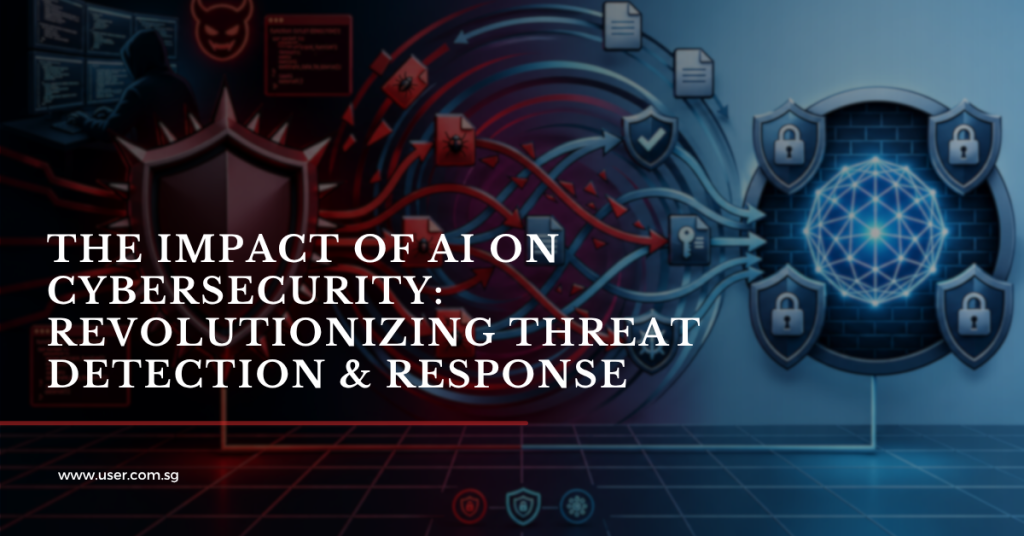
Artificial intelligence is fundamentally changing how organisations defend themselves against cyber threats. Traditional security approaches, built on fixed rules and human analysis, are struggling to keep pace with attacks that are growing in volume, speed, and sophistication. AI is transforming this picture by enabling security that can detect threats faster and more accurately, respond more quickly, and adapt as threats evolve — a genuine revolution in threat detection and response.
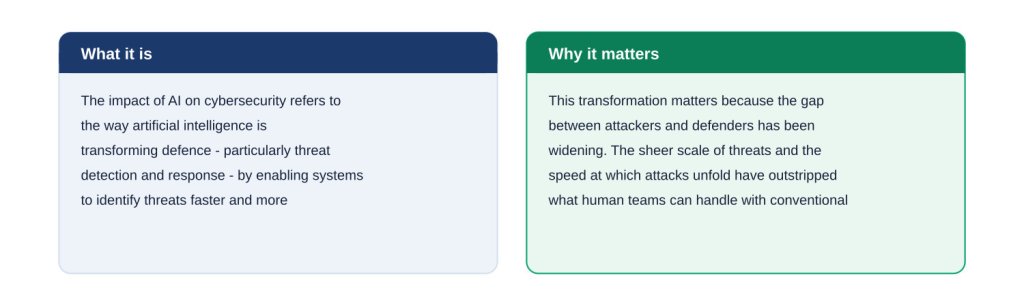
This transformation matters because the gap between attackers and defenders has been widening. The sheer scale of threats and the speed at which attacks unfold have outstripped what human teams can handle using conventional tools. AI is disrupting this rise in vulnerability, giving defenders the ability to process vast amounts of information, spot subtle signs of attack, and act at machine speed, shifting the balance back towards the defenders.
This guide examines the impact of AI on cybersecurity, focusing on how it is revolutionising threat detection and response. It explores the limitations of traditional approaches, how AI improves detection and response, the shift from reactive to proactive security, the augmentation of security teams, the challenges involved, and how to adopt AI-driven security effectively.
What AI in Threat Detection means
The impact of AI on cybersecurity refers to the way artificial intelligence is transforming defence — particularly threat detection and response — by enabling systems to identify threats faster and more accurately, respond at machine speed, anticipate attacks, and adapt over time, fundamentally improving how organisations protect their data and systems.
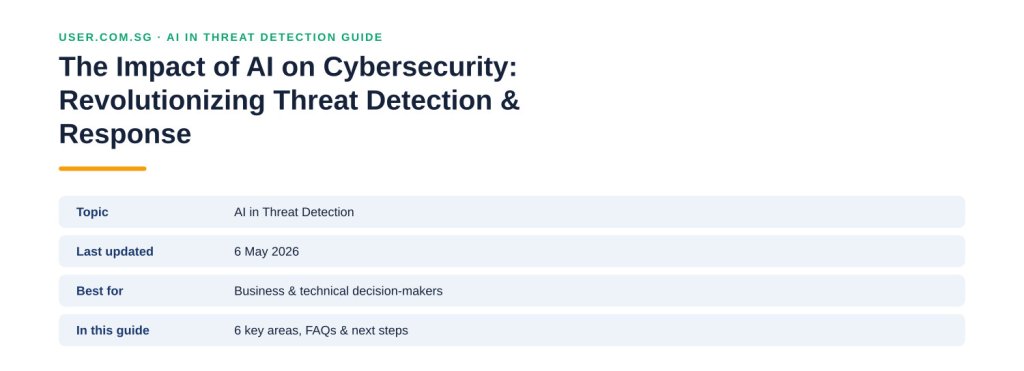
AI in Threat Detection — quick facts
| Element | Detail |
| Topic | AI in Threat Detection |
| Last updated | 6 May 2026 |
| Best for | Business leaders, IT/operations teams, product owners & digital strategists |
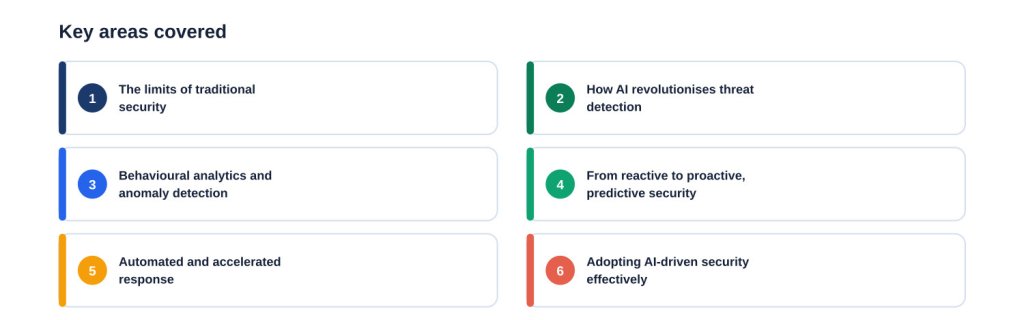
| Covered here | The limits of traditional security; How AI revolutionises threat detection; Behavioural analytics and anomaly detection; From reactive to proactive, predictive security; Automated and accelerated response; Adopting AI-driven security effectively |
The Limits of Traditional Security
To understand AI’s impact, it helps to recognise the limitations of traditional security approaches. Conventional tools rely heavily on signatures and rules — known patterns of malicious activity — which work well against known threats but struggle to detect new or disguised ones. As attackers constantly develop novel techniques, signature-based methods are always playing catch-up, leaving gaps that sophisticated threats exploit.
Traditional approaches also depend heavily on human analysts to investigate and respond, which does not scale to the volume of threats organisations now face. Security teams are overwhelmed by the number of alerts and events they must process, leading to fatigue, missed threats, and slow response. The manual nature of conventional security is a fundamental constraint in an environment of high-volume, fast-moving attacks.
These limitations leave organisations vulnerable to the modern threat landscape. Attacks are too numerous, too fast, and too sophisticated for rule-based tools and human analysis alone to handle effectively. This gap between the capabilities of traditional security and the demands of modern threats is precisely what AI addresses, which is why its impact on cybersecurity has been so significant.
How AI Revolutionises Threat Detection
The most significant impact of AI on cybersecurity is threat detection. Rather than relying solely on known signatures, AI uses machine learning to understand what normal activity looks like and to identify deviations that may indicate an attack. This enables it to detect novel threats, previously unseen malware, and subtle indicators that signature-based tools would miss entirely.
AI also transforms detection through its ability to process enormous volumes of data continuously and at speed. It can analyse network traffic, user behaviour, and system activity across an organisation, identifying suspicious events among vast amounts of normal activity. This capacity to find the needle in the haystack, in real time, is something human analysis simply cannot match at scale.
In a recent incident called “the Hugging Face incident,” it was discovered that even closed AI systems can even be compromised. Innovations in using open-source approaches helped contain the agent from “going rogue,” as NVidia Founder and CEO Jensen Huang says, “During the Hugging Face incident, closed AI blocked essential forensics. An open-weight frontier model helped contain the intrusion.” This shows how continuous improvement in AI-driven approaches can help threat detection against continuously evolving threats.
Furthermore, AI-driven detection improves over time as it learns from more data. It becomes better at distinguishing real threats from benign anomalies and reduces flagging false alarms. This addresses the problem that plagues traditional security: alert fatigue. It helps teams focus on the threats that matter. By detecting more threats, more accurately, and faster, AI has revolutionised the foundational task of identifying attacks, which is at the heart of its impact on cybersecurity.
Behavioural Analytics and Anomaly Detection
One way AI improves threat detection is through behavioural analytics. By establishing a baseline of normal behaviour for users, devices, and systems, AI can detect deviations that may signal compromise — even when no known attack signature is involved. A user accessing unusual systems, moving large amounts of data, or behaving atypically can be flagged as a potential threat.
This approach is particularly powerful against threats that evade old detection methods. Insider threats and compromised accounts, where attackers use legitimate credentials, are notoriously difficult to catch because they appear normal on the surface. Behavioural analytics detects them by identifying the subtle changes in behaviour that betray malicious activity, providing early warning of attacks that would otherwise go unnoticed.
Because it learns what is normal for a specific environment, behavioural analytics adapts to the organisation rather than relying on generic rules, improving both detection and accuracy. As work patterns and systems change, the baseline updates, keeping detection effective over time. This adaptive, context-aware capability is a clear example of how AI’s impact goes beyond speed to fundamentally improve the quality of threat detection.

How user.com.sg moves from discovery to measurable, scalable value.
From Reactive to Proactive Security
One of the most profound impacts of AI is the shift it enables from reactive to proactive security. Traditional security largely responds to threats after they appear, detecting and addressing attacks once they are underway. AI is changing this by enabling organisations to anticipate and prevent threats before they cause harm, moving from a defensive posture to a more proactive one.
AI supports this shift through its ability to identify risks and predict potential threats. By analysing patterns and trends, AI can highlight vulnerabilities, anticipate likely attack methods, and identify emerging risks, allowing organisations to address weaknesses before they are exploited. This predictive capability helps organisations stay ahead of threats rather than constantly reacting to them.
The move towards proactive, predictive security represents a significant change in how organisations defend themselves. Rather than waiting for attacks and responding to damage, they can anticipate and prevent, reducing the likelihood and impact of incidents. This shift, enabled by AI’s analytical capabilities, is one of the most valuable aspects of its impact on cybersecurity, fundamentally improving organisations’ security posture.
Automated and Accelerated Response
AI’s impact extends powerfully to response. Detecting threats quickly is only valuable if organisations can respond before damage is done, and AI dramatically accelerates response through automation. When a threat is detected, automated actions can be taken immediately — isolating affected systems, blocking malicious activity, or containing an attack — without waiting for manual intervention.
This speed is decisive against fast-moving attacks. The time it might take a human analyst to investigate and respond can be the difference between a contained incident and a major breach. By automating the initial response to threats, AI reduces the window attackers have to cause harm, often stopping attacks in their tracks before they can spread or escalate.
Automated response also relieves pressure on security teams, handling routine responses so that analysts can focus on complex incidents requiring judgement. Typically designed with appropriate oversight, automation handles high-confidence actions while escalating consequential decisions to people. This combination of speed and human oversight transforms response capabilities, making it a major part of AI’s impact on cybersecurity.
AI as a Force Multiplier for Security Teams
A crucial aspect of AI’s impact is how it augments rather than replaces security professionals. Security teams face a persistent shortage of skilled people and an overwhelming volume of work, and AI acts as a force multiplier that allows them to be far more effective. By handling scale, speed, and routine analysis, AI frees analysts to focus on the threats and decisions that genuinely require human expertise.
AI supports security teams in many ways. Here are some examples:
- Surfacing the most important threats from a flood of alerts
- Providing context and analysis to speed investigation
- Automating routine scan tasks
This reduces the burden on analysts, addresses alert fatigue, and helps teams operate more effectively despite limited resources. The result is security professionals empowered to do more and to focus where they add the most value.
This augmentation is especially valuable given the cybersecurity skills shortage. By handling much of the workload that would otherwise require more people, AI helps organisations defend effectively even with limited security staff. The partnership between AI and human experts, whereAI provides scale and speed and humans provide judgement and oversight is central to AI’s positive impact on cybersecurity.
The Other Side: AI in the Hands of Attackers
A complete picture of AI’s impact must acknowledge that it also empowers attackers. Just as AI strengthens defence, it gives adversaries new capabilities — crafting more convincing phishing and social-engineering attacks, generating malicious content, automating attacks, and creating deepfakes for deception. This makes attacks more convincing, scalable, and difficult to detect.
This dual-edge nature means AI is reshaping both sides of the security contest. As attackers use AI to enhance their methods, defenders must use AI to keep pace, creating an escalating dynamic in which AI capabilities on both sides continue to advance. Organisations must assume that adversaries are using AI and ensure their defences are equipped to counter AI-enhanced threats.
The implication is not that AI’s impact is negative, but that it raises the stakes and the importance of adopting AI-driven defence. As attacks become more sophisticated through AI, strong AI-enabled security, combined with vigilance and awareness, becomes essential. Understanding both sides of AI’s impact ensures organisations harness its defensive benefits while preparing for the more capable threats it enables.
Transforming Security Operations
Beyond individual capabilities, AI is transforming how security operations work as a whole. Security operations centres, where organisations monitor and respond to threats, are being reshaped by AI that automates detection, triage, and response, allowing them to handle far greater volumes and operate more efficiently. This transformation addresses the scale and speed challenges that overwhelm traditional operations.
A practical example is ASM, a global semiconductor manufacturer, which adopted Microsoft Security Copilot to strengthen its security operations. By using AI to assist with threat investigations and automate repetitive workflows, ASM reduced laptop compromise investigation times from around 25 minutes to 8 minutes (a 68% reduction), saved 337 hours per week on security investigations, and redeployed approximately 20% of its security operations staff to governance, risk, and compliance initiatives. This demonstrates how AI can improve both the speed and efficiency of security operations while allowing security teams to focus on higher-value work rather than routine analysis.
This transformation of security operations represents the cumulative impact of AI across detection, response, and analysis. By bringing these capabilities together, AI is changing not just individual security tasks but the overall practice of defending an organisation. The result is security operations that are faster, more capable, and more scalable, reflecting the deep and broad impact AI is having on cybersecurity.
Adopting AI-Driven Security Effectively
Realising the benefits of AI in cybersecurity requires adopting it thoughtfully. The starting point is clarity about the security outcomes an organisation wants to improve — better detection of unknown threats, faster response, reduced analyst workload — and choosing AI capabilities that serve those goals. This keeps adoption focused and its value measurable rather than pursuing AI for its own sake.
Effective adoption also depends on good data and integration. AI-driven security performs best with access to rich, high-quality data and when integrated into the broader security ecosystem so that detection and response work together. Investing in data quality and sensible integration is what turns promising AI tools into effective defence, avoiding isolated, underused capabilities.
Above all, the strongest security combines AI with skilled people and sound fundamentals. AI should augment security teams, handling scale and speed while humans provide judgement and oversight, and good security practices should remain in place. Combining AI’s capabilities with human expertise and disciplined implementation is what allows organisations to capture AI’s transformative impact reliably — exactly the balanced approach user.com.sg helps organisations adopt.
The Future of AI in Cyber Defence
AI’s impact on cybersecurity will continue to grow as both the technology and the threats evolve. Detection will become more accurate and predictive, response to threats done more autonomously, and security operations will be more automated, enabling organisations to defend against increasingly sophisticated, AI-driven attacks. The trajectory points towards security becoming smarter and adaptive.
More autonomous security systems are emerging that can detect, investigate, and respond to many threats with limited human intervention, escalating only the most complex decisions to people. This promises to address the chronic shortage of security talent by handling far more of the workload, allowing scarce experts to focus where they add the most value, and further improving organisations’ ability to defend themselves.
For organisations, the message is clear: building AI-driven security capability is an investment in resilience against the threats of the future. By adopting AI thoughtfully, maintaining strong fundamentals, and keeping skilled people in the loop, organisations can turn AI’s transformative impact into a lasting advantage in cyber defence. The future of cybersecurity is one of intelligent, adaptive protection, and AI is at its centre.
Measuring the Impact of AI on Security
To understand the value AI brings to cybersecurity, it helps to consider how its impact can be measured. Meaningful measures include improvements in the speed and accuracy of threat detection, reductions in the time taken to respond to and contain incidents, the proportion of threats handled automatically, and reductions in the workload and alert fatigue experienced by security teams.
These measures translate the abstract notion of AI’s impact into concrete benefits. Faster, more accurate detection means threats are caught earlier and more reliably; quicker response means less damage; greater automation means teams can handle more with the same resources. Tracking such measures before and after adopting AI-driven security makes its impact tangible and demonstrates the value of the investment.
Measuring impact also helps organisations refine their use of AI over time. By monitoring how AI-driven security performs and where it adds the most value, organisations can refine their efforts, tune their systems, and continue to improve their defences. This disciplined attention to results ensures that the transformative potential of AI in cybersecurity is realised in practice, not just in principle, delivering measurable improvements in protection.
Key takeaways
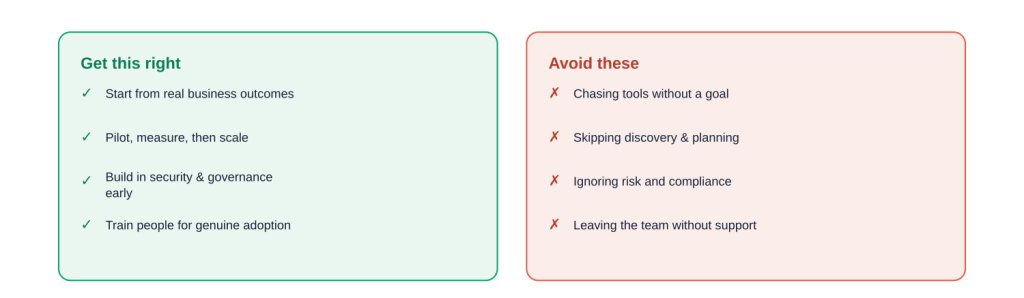
- AI in Threat Detection is best approached around clear business outcomes, not tools or hype.
- The limits of traditional security.
- How AI revolutionises threat detection.
- Behavioural analytics and anomaly detection.
- From reactive to proactive, predictive security.
- Pilot, measure, and then scale — with security, governance, and adoption built in.
- user.com.sg can help you plan, implement, and optimise AI in Threat Detection for your context.
Conclusion
Artificial intelligence is revolutionising cybersecurity, transforming how organisations detect and respond to threats. By moving beyond the limitations of signature-based tools and manual analysis, AI enables security that detects threats faster and more accurately, responds at machine speed, anticipates and prevents attacks, and adapts as threats evolve. It augments security teams as a force multiplier, transforms security operations, and shifts organisations from reactive to proactive defence — a genuine revolution in how cyber threats are met.
This impact comes with the reality that AI also empowers attackers, which raises the stakes and makes AI-driven defence increasingly essential. The organisations that benefit most adopt AI thoughtfully — focusing on clear outcomes, investing in data and integration, and combining AI with skilled people and sound fundamentals. Used this way, AI’s impact on cybersecurity is overwhelmingly positive, giving defenders the capabilities they need to protect data and systems in an increasingly hostile and fast-moving digital world.
Work with USER on AI in Threat Detection
If you are exploring the use of AI in Threat Detection for your organisation, the most valuable next step is a focused conversation about your goals, current state, and the outcomes that matter most. Contact the User Experience Researchers team can to recommend the right discovery, planning, or implementation pathway for your context.
Frequently asked questions
AI is transforming cybersecurity by enabling faster and more accurate threat detection, machine-speed response, predictive and proactive defence, and the augmentation of security teams. It addresses the limitations of traditional, rule-based, manual security in the face of growing and sophisticated threats.
AI improves threat detection by learning what normal activity looks like and identifying deviations, allowing it to detect novel threats that signature-based tools miss. It processes vast amounts of data in real time, finds subtle signs of attack, and reduces false alarms by learning over time.
Reactive security responds to threats after they appear, while proactive security, enabled by AI, anticipates and prevents threats before they cause harm. AI supports this by analysing patterns to identify vulnerabilities and predict attacks, helping organisations stay ahead of threats.
No. AI augments security analysts as a force multiplier, handling scale, speed, and routine analysis while humans provide judgement and oversight. This is especially valuable given the cybersecurity skills shortage, helping teams defend effectively despite limited resources.
AI speeds up response by automating immediate actions when threats are detected — isolating systems, blocking activity, or containing attacks — without waiting for manual intervention. This reduces the window attackers have to cause harm, often stopping attacks before they spread.
Yes. AI is dual-use: it gives attackers new capabilities such as more convincing phishing, generated malicious content, automation, and deepfakes. This makes AI-driven defence increasingly important, as organisations must use AI to counter AI-enhanced threats.
AI is reshaping security operations by automating detection, triage, and response, allowing teams to handle far greater volumes and operate more efficiently. AI-driven operations monitor continuously, detect threats in real time, prioritise issues, and respond rapidly at scale.
Organisations should adopt AI by identifying the security outcomes they want to improve, ensuring good data and integration, and combining AI with skilled people and strong fundamentals. A focused, outcome-led approach with human oversight ensures AI delivers its benefits reliably.

