
If you are comparing intelligent automation vs AI, you are probably not looking for a dictionary definition. You want to know which one best fits your business problem, what each delivers in practice, or whether you need both, and what a realistic first step looks like for your organisation.
Terms like artificial intelligence (AI) and intelligent automation (IA) are often used interchangeablycausing confusion at exactly the moment teams are trying to make budget and roadmap decisions. They share common building blocks, but they differ in scope, purpose, and application. Getting the distinction right is the difference between investing in an analytics capability, an end-to-end automated workflow, or a combination of the two.
User Experience Researchers (USER) helps Singapore and regional organisations turn this decision into a plan. As a pioneer UX and digital transformation company in Southeast Asia with 15+ years of enterprise IT experience, 100+ MNCs served, and an authorised partner ecosystem that includes IBM, Microsoft, and Snowflake, USER designs and builds AI and intelligent automation solutions that are tied to measurable outcomes, not buzzwords.
Why People Search for “Intelligent Automation vs AI”
Most decision-makers do not research this topic out of curiosity. They search because real business pressures — cost, capacity, accuracy, compliance, or growth — are pushing them toward technology, and they need clarity before committing a budget.
You may be comparing intelligent automation vs AI because:
| Situation | Why the distinction matters |
| You want to reduce manual, repetitive work | This usually points toward intelligent automation (RPA + orchestration), not AI alone |
| You need better predictions, insights, or classification | This is typically an AI problem — analytics, ML, or NLP |
| A vendor is pitching an “AI platform” | You need to tell genuine AI capability apart from basic rule-based automation (“AI washing”) |
| You are scoping an end-to-end process | End-to-end workflows usually need IA, with AI embedded at the decision points |
| Leadership has asked for an “AI strategy” | The real requirement is often a mix of AI and automation, not one or the other |
| You are budgeting for next financial year | Knowing the difference helps you prioritise spend on outcomes, not hype |
| You want to scale a process that already works | IA is built for consistent, scalable execution at volume |
If your priority is a single capability — for example, a forecasting model or a document classifier, you may need standalone AI.
If your priority is automating a multi-step process across systems, you are likely looking at intelligent automation. Most mature programmes end up using both.
What USER Offers in This Space
USER’s Data Analytics & AI Solutions, Enterprise Solutions, and broader Digital Transformation services cover the full spectrum from standalone AI to end-to-end intelligent automation.
The work typically spans AI and machine learning solutions, data analytics, custom and bespoke enterprise software, robotic process automation and workflow orchestration, and the user research and UX discipline that makes adoption stick. The goal is not to have a proof-of-concept that never ships; it is to help organisations move better as a system: automating reliably, deciding intelligently, and scaling with confidence.
Choose the Right Approach Fast
If you are unsure whether your problem calls for AI, IA, or a hybrid solution, use this guide:
| Need | Best starting point | Why it matters |
| Predictions, insights, classification, or perception | Standalone AI (Data Analytics & AI Solutions) | AI is purpose-built for analytical and cognitive tasks |
| Automating a repetitive, rule-based task | RPA within an intelligent automation approach | Robots handle high-volume, structured work consistently |
| End-to-end process across multiple systems | Intelligent Automation (Enterprise Solutions) | IA orchestrates AI, RPA, and workflow into one pipeline |
| Smarter decisions inside an automated process | Hybrid AI + IA | AI supplies the judgement; IA supplies the execution |
| Unsure where value actually sits | Discovery / consultation session | A structured assessment identifies the highest-ROI use cases first |
| Capability or talent gap to deliver | ICT Staffing / Professional Services | Augment your team with specialists for delivery and support |
Not sure what you need? Request a discovery session and USER will help route you to the right approach.
Contact USER
Defining Artificial Intelligence (AI)
At its core, AI refers to the ability of machines to perform tasks that typically require human intelligence — learning, reasoning, and perception. It encompasses a range of technologies designed to mimic human cognitive functions and improve over time based on data.
Types of AI: Narrow, Generative & AGI
| Type | What it is | Example |
| Artificial Narrow Intelligence (ANI) | Task-specific intelligence | Speech recognition, image classification |
| Generative AI | Creates new content from learned patterns | Large Language Models (LLMs) generating text, images, or code |
| Artificial General Intelligence (AGI) | Hypothetical human-level cognition across any task | A concept, not a current reality |
As of writing, AGI is still in development but is sort of a general goal among AI companies. Such a kind of intelligence can help in combining the advantages of both ANI and GenAI to produce output almost at the same level of cognition as humans.
AI’s Core Technologies
| Technology | Role |
| Machine Learning (ML) | Learns from data and improves over time |
| Neural Networks | Recognise patterns and support decisions, loosely modelled on the brain |
| Natural Language Processing (NLP) | Understands and generates human language |
| Computer Vision | Interprets and acts on visual data |
| AI Agents | Software that autonomously carries out tasks and makes decisions |
All technologies cater to different needs, and many solutions are based on combining a given number of core AI technologies to benefit target users.
Defining Intelligent Automation (IA)
Intelligent Automation integrates AI with robotic process automation (RPA), business process management (BPM), and related technologies to automate complex business processes end-to-end. IA combines AI’s decision-making and learning with RPA’s ability to execute repetitive tasks, producing smarter, more efficient workflows by itself over time.
Components of IA
| Component | What it contributes |
| RPA | Robots that handle repetitive, rule-based tasks |
| BPM | Software that orchestrates and manages workflows |
| AI | Cognitive capabilities — decision-making, pattern recognition, learning |
| NLP | Handles unstructured data such as text and speech |
| Process Mining | Analyses processes to find inefficiencies and automation opportunities |
How IA Leverages AI
AI gives IA dynamic decision-making, letting automated systems analyse data and adapt in real time. AI’s pattern recognition and learning improve the accuracy and efficiency of automated tasks so businesses can streamline operations continuously rather than once.
Comparison: IA vs AI — Key Differences & Overlap
| Dimension | Artificial Intelligence (AI) | Intelligent Automation (IA) |
| Purpose & scope | Build intelligent systems that reason, learn, and decide | Automate entire business processes using AI, RPA, and BPM |
| Typical use cases | Predictive analytics, classification, natural language understanding | Invoice processing, customer-service automation, document management |
| Outcomes | Insights, adaptability, intelligence, better decisions | Efficiency, consistency, scalability, reliable execution at scale |
| Relationship | A core technology | A framework that embeds AI inside automated workflows |
TL/DR: AI is the intelligence; IA is the system that puts that intelligence to work across a process.
Advantages & Benefits in Context
IA delivers benefits that go beyond traditional, rules-only automation.
| Benefit | What it means for your organisation |
| Efficiency, accuracy & compliance | Fewer human errors, consistent outcomes, and accurate records that support regulatory compliance |
| Intelligent decision automation | Tasks are routed, data is classified, and recommendations are made automatically |
| Scalability & flexibility | Processes can adapt to new systems, tools, and changing business needs as you grow |
When to Use AI vs IA
Use cases for standalone AI
Standalone AI is ideal where the requirement is analytics, insight, or perception.
Examples:
- Fraud detection
- Customer sentiment analysis
- Demand forecasting
- Personalised recommendations.
Use cases for IA platforms
IA platforms excel at automating enterprise workflows, especially when intelligence is needed across multiple steps, such as:
- Automated claims processing,
- Chatbots integrated into service workflows
- Supply-chain orchestration.
Platform & tool considerations
Several platforms combine AI, RPA, and BPM for intelligent automation — for example UiPath, Appian, and Blue Prism. The right choice depends on your processes, complexity, and integration needs. As an authorised UiPath partner, USER can advise on platform fit objectively rather than defaulting to a single tool.
Challenges & Misconceptions
| Challenge | What to watch for |
| AI washing & overhype | Some vendors brand basic automation as “AI”. Validate the actual capability before you buy |
| Skills & governance | IA needs people who can manage models, mitigate bias, and enforce governance frameworks |
| Integration & data quality | Legacy systems and messy data undermine results — data must be clean, structured, and model-ready |
Future Trends: Where AI & IA Are Heading
| Trend | What it looks like |
| Hybrid intelligence | Human expertise and machine intelligence working together to refine decisions |
| Generative AI in IA | LLMs used for document generation, content creation, and service chatbots inside automated flows |
| Expanding adoption | Finance, healthcare, and manufacturing are already transforming; more industries will follow as tools mature |
Do You Need to Replace Your Current Systems?
A common reason organisations delay is the assumption that IA means ripping out existing systems. In practice, IA is frequently layered on top of current applications — RPA can operate across legacy interfaces, and AI can be introduced at specific decision points without a full re-platforming.
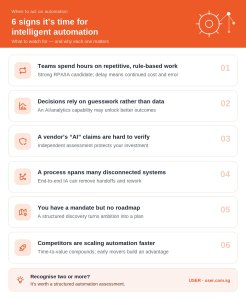
The realistic answer depends on your data quality, integration points, and process maturity. Before committing to anything, the safest step is a discovery session so USER can assess what can be automated now, what needs remediation first, and what genuinely requires new systems. See the illustration below to know if it’s the right time to switch to IA.
Engagement, Scoping & Cost Questions
Cost and scope vary with the use case, data readiness, integration complexity, and whether you need standalone AI, full IA, or a hybrid. Because every programme differs, it helps to confirm the essentials before you begin.
Before engaging, ask:
| Question | Why it matters |
| Is this an AI problem, an automation problem, or both? | Determines the right approach and the right budget envelope |
| Is our data clean and integration-ready? | Data quality is the single biggest predictor of success |
| Do we have the in-house skills to run this? | Identifies whether you need delivery or staffing support |
| What does a pilot cost vs a full rollout? | Helps you stage investment and prove value before scaling |
| How will we measure ROI? | Confirms the initiative is delivering, not just running |
| What governance is required? | Reduces risk around bias, compliance, and accountability |
This removes one of the biggest barriers to starting: uncertainty about scope, cost, and readiness.
What to Expect in a Discovery / Consultation Session
The fastest next step is simple: request a discovery or consultation session. A specialist can help confirm whether your problem calls for standalone AI, an intelligent automation platform, or a hybrid approach — and what the right starting point is for your context.
Your first session is usually a discovery conversation. The goal is to understand your objectives, current systems, data, and constraints — and what is preventing you from getting the outcome you want.
| Step | What happens |
| Goals & context | You discuss the business problem, current state, and the outcomes that matter most |
| Capability assessment | The team reviews relevant processes, data sources, and systems |
| Opportunity mapping | Candidate use cases are identified and prioritised by value and feasibility |
| Approach recommendation | You receive a view on whether AI, IA, or a hybrid fits — and which platform |
| Delivery path | A staged plan is outlined: discovery → design → pilot → scale → optimise |
| Next steps | You leave with a clear, lower-risk path forward |
Come prepared with a sense of your priority processes, any known data or integration constraints, and the outcomes you are accountable for. Existing documentation, process maps, or analytics are useful but not required.
Expertise & Credentials You Can Trust
USER’s work in AI and intelligent automation is backed by capability signals that matter for an enterprise programme:
- 15+ years of enterprise-level IT experience and 100+ MNCs served across the globe.
- ISO 9001:2015 (QMS) and ISO 27001:2022 (ISMS) certified — quality and information-security disciplines that matter for AI and data work.
- An authorised partner ecosystem spanning UiPath (RPA/IA), IBM, Microsoft, Snowflake, Adobe, and Qualtrics.
- A UX and user-research foundation, so automation and AI are designed around how people actually work — improving adoption, not just deployment.
- In-house experts such as Priya Gangikuntakaranm, who have spearheaded development of various custom models for enterprise use cases
Why Choose USER for AI & Intelligent Automation
| Differentiator | Benefit to you |
| Outcome-first approach | Solutions are tied to measurable business results, not buzzwords |
| Full spectrum capability | Standalone AI, RPA/IA, and hybrid — under one provider |
| Authorised platform partnerships | Objective platform advice (e.g. UiPath) rather than a one-tool default |
| UX and research heritage | Higher adoption because solutions fit real workflows |
| Enterprise track record | 15+ years and 100+ MNCs served, ISO-certified delivery |
| Singapore-based, regional reach | Local engagement with Southeast Asia delivery experience |
If you are unsure whether you need AI, intelligent automation, staffing support, or a combination, request a session and explain your main concern — the team will help route you appropriately.
When to Act
Do not wait for a manual or analytical bottleneck to get worse before acting. Consider a discovery session if:
| Sign | Why it matters |
| Teams spend hours on repetitive, rule-based work | Strong RPA/IA candidate; delay means continued cost and error |
| Decisions rely on guesswork rather than data | An AI/analytics capability may unlock better outcomes |
| A vendor’s “AI” claims are hard to verify | Independent assessment protects your investment |
| A process spans many disconnected systems | End-to-end IA can remove handoffs and rework |
| You have a mandate but no roadmap | A structured discovery turns ambition into a plan |
| Competitors are scaling automation faster | Time-to-value compounds; early movers build an advantage |
Frequently Asked Questions
AI is a technology focused on machine learning and intelligence, while intelligent automation combines AI with automation tools like RPA and BPM to automate entire business processes end-to-end.
Yes. IA can run on rule-based automation and process orchestration alone. However, AI enhances IA by adding decision-making and learning, which is where the biggest gains usually come from.
Choose AI for cognitive tasks like data analysis, prediction, or perception. Choose IA when you need to automate end-to-end processes across multiple systems or departments. Many mature programmes use both.
No. IA is a genuine framework that combines multiple technologies — RPA, BPM, and AI — to automate and enhance business processes, with AI as a key component.
Data analysis, pattern recognition, natural language understanding, forecasting, and decision support based on insights.
Data quality issues, integration challenges with legacy systems, bias in AI models, and a shortage of skilled personnel to manage and govern the solution.
Platforms such as UiPath, Appian, and Blue Prism combine RPA, AI, and BPM. The right choice depends on your processes and integration needs. As an authorised UiPath partner, USER can advise on fit objectively.
Yes. USER offers Data Analytics & AI Solutions, Enterprise Solutions, and broader Digital Transformation services, supported by ICT staffing and professional services for delivery and ongoing support.

