
If you are weighing Intelligent Automation (IA) vs Robotic Process Automation (RPA), you are usually trying to answer a practical question: do you need software robots to handle repetitive work, a cognitive layer that can make decisions, or both — and where should you start?
RPA and IA are two of the most talked-about ways to streamline operations, increase efficiency, and reduce cost. They are closely related — IA is essentially RPA with a cognitive layer — but they solve different problems, carry different costs, and suit different processes. Understanding the difference is what keeps an automation programme aligned to real outcomes rather than hype.
Why People Search for “Intelligent Automation vs RPA”
Few teams research this out of curiosity. They search because a manual workload, an error rate, a compliance demand, or a scaling pressure is forcing an automation decision — and they need to know which tool actually fits before committing budget.
You may be comparing intelligent automation vs RPA because:
| Situation | Why the distinction matters |
| You have high-volume, repetitive, rule-based tasks | RPA alone may be enough — and is cheaper and faster to deploy |
| Your process involves unstructured data (emails, scans, PDFs) | You likely need IA’s cognitive layer (AI, NLP, OCR), not RPA alone |
| Existing RPA bots keep breaking on exceptions | Adding intelligence can reduce human-in-the-loop handling |
| You want decisions, not just data entry, automated | IA adds judgement; RPA executes the steps |
| Leadership wants an automation roadmap | Most programmes start with RPA and layer IA where it pays off |
| You are budgeting and comparing ROI | RPA has lower upfront cost; IA has higher cost but broader payoff |
| You are aiming for an “autonomous” operation | That is a hyperautomation goal combining RPA, IA, and more |
If the work is structured and rule-based, RPA may be the right and most economical answer. If it involves interpretation, prediction, or unstructured inputs, you are looking at intelligent automation. Many organisations begin with RPA and add intelligence over time.
What USER Offers in This Space
User Experience Researchers (USER) offers Data Analytics & AI Solutions, Enterprise Solutions, and broader Digital Transformation services span both ends of this spectrum — from rules-based RPA through to AI-enhanced intelligent automation.
The work typically includes robotic process automation and workflow orchestration (as an authorised UiPath partner), AI and machine learning, document understanding (NLP and OCR), custom and bespoke enterprise software, and the UX and user-research discipline that drives adoption. The aim is durable value: automate the repeatable parts reliably, add intelligence where it changes outcomes, and scale without breakage. If you’re eager to start exploring your RPA and IA options now, contact us.
Ready to move beyond manual processes?
Learn more about our Digital Transformation services or get in touch to discuss your automation goals
Choose the Right Approach Fast
If you are unsure whether your problem calls for RPA, IA, or a staged combination, use this guide before requesting a session.
| Need | Best starting point | Why it matters |
| Repetitive, rule-based, structured-data tasks | RPA (within Enterprise Solutions) | Fast, lower-cost automation with quick payback |
| Tasks needing interpretation, prediction, or context | Intelligent Automation (AI + RPA) | Adds the cognitive layer RPA lacks |
| Reading unstructured documents (invoices, forms, scans) | IA with NLP / OCR | Turns messy inputs into structured, usable data |
| End-to-end, multi-system process automation | Hyperautomation approach | Orchestrates RPA, IA, and process mining together |
| Unsure where the value sits | Discovery / consultation session | Identifies the highest-ROI automation candidates first |
| Capability or talent gap to deliver | ICT Staffing / Professional Services | Augment your team with delivery and support specialists |
Not sure what you need? Request a discovery session and USER will help route you to the right approach.
Understanding the Fundamentals of RPA and Intelligent Automation
What is Robotic Process Automation (RPA)?
RPA uses software robots, or “bots,” to automate repetitive, rules-based tasks usually done by people. Bots mimic human interaction with digital systems — clicking, entering data, copying and pasting — usually in a non-disruptive way. RPA excels with structured data where human input is only needed for specific decisions.
For example, an RPA bot can automatically enter customer details into a CRM without human input, cutting time on mundane tasks and reducing errors.
What is Intelligent Automation (IA)?
IA takes RPA’s capabilities and enhances them with artificial intelligence (AI), machine learning (ML), natural language processing (NLP), and optical character recognition (OCR). In simple terms, IA is RPA with a cognitive layer — bots that can make decisions, learn from data, and adapt without explicit reprogramming. It lets machines understand context, make predictions, and communicate in human-like language.
For example, in customer support, IA can power virtual assistants that handle basic enquiries, interpret user sentiment, offer personalised solutions, and learn from past interactions to improve future ones.
Key Differences and Overlaps
The primary difference is cognitive capability. Both automate tasks, but IA goes beyond rule-based automation to incorporate intelligent decision-making.
| Dimension | RPA | Intelligent Automation (IA) |
| Automation type | Static, rule-based; follows pre-set instructions | Cognitive; handles unstructured data and patterns |
| Decision-making | Limited; cannot handle complex decisions | Makes decisions based on prior learning |
| Human involvement | Human-in-the-loop for exceptions and judgement | Moving toward autonomous, minimal-intervention systems |
| Adaptability | Fixed processes; breaks on change | Adapts to new tasks with minimal human input |
| Best fit | Clear, defined, structured processes | Complex, variable, data-rich processes |
In short: RPA executes defined steps reliably; IA adds the judgement to handle ambiguity and change. They overlap because IA is built on top of RPA — and they frequently run together.
Technology Stack Behind RPA and IA
| Layer | RPA relies on | IA adds |
| Execution | Bots that perform repetitive tasks | AI that gives bots reasoning capabilities |
| Integration | APIs to connect with enterprise systems | Machine learning to learn and improve over time |
| Interface | UI automation to mimic user interactions | NLP to understand and respond in human language |
| Data handling | Structured data only | OCR to read unstructured/scanned documents |
| Optimisation | — | Process mining to identify and optimise processes |
Integration capabilities
Both RPA and IA integrate with ERP, CRM, legacy, and cloud-native systems. IA offers greater flexibility for complex integrations thanks to its cognitive capabilities.
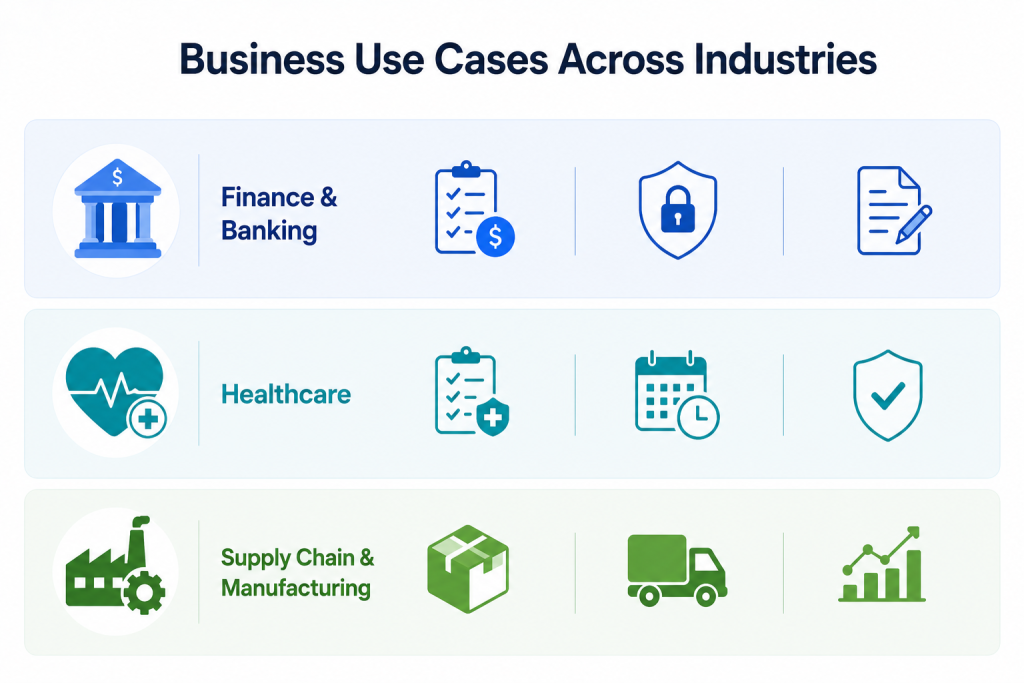
Business Use Cases Across Industries
Both technologies are reshaping industries by automating work that once required human input — driving efficiency and unlocking new opportunities.
| Industry | Where RPA and IA apply |
| Finance & Banking | Accounts reconciliation; KYC/AML checks and fraud detection; loan processing (data entry, credit checks, document verification) |
| Healthcare | Insurance claims processing; patient intake and appointment scheduling; compliance checks against changing regulations |
| Supply Chain & Manufacturing | Inventory automation and restocking; order-to-delivery fulfilment; demand forecasting from historical data |
Benefits and Challenges of Merging RPA with IA
Benefits of IA over RPA alone
| Benefit | What it delivers |
| Adaptability | Adjusts to changing processes without constant human input |
| Scalability | Scales automation across functions more effectively |
| Better insights | AI-powered analytics surface deeper operational insight |
| Enhanced accuracy | ML models reduce errors by learning from experience |
Implementation challenges
| Challenge | What to plan for |
| Change management | IA-driven models require organisational change and training |
| Upfront costs | IA tools often carry higher initial investment than RPA |
| Skills shortage | Skilled IA professionals can be hard to find and retain |
| Algorithmic bias | AI decision-making must be governed to manage bias |
Future Trends and the Rise of the Autonomous Enterprise
Automation is trending toward autonomous enterprises — systems that run independently, manage tasks end-to-end, and need minimal human involvement.
| Trend | What it looks like |
| Hyperautomation ecosystems | Automating all feasible processes — simple to complex — using RPA, process mining, AI, and ML so automation scales across the business |
| The role of generative AI | LLMs enable bots to generate human-like responses, write content, and solve complex problems in real time |
Do You Need to Replace Your Existing RPA?
A common worry is that adopting intelligent automation means scrapping existing RPA investments. In practice, the opposite is usually true: IA is built on top of RPA. Your current bots can keep running, with AI, NLP, and OCR layered in where they add value — for exception handling, document understanding, or decision points.
The realistic path depends on your bots’ maturity, data quality, and integration points. Before committing, a discovery session lets USER assess what to keep, what to enhance with intelligence, and where a fresh build is genuinely warranted.
When to Act Sooner Rather Than Later
Do not wait for a manual bottleneck or an error problem to worsen before acting. Consider a discovery session if:
| Sign | Why it matters |
| Teams spend hours on repetitive data work | Strong RPA candidate; delay means continued cost and error |
| Bots keep failing on exceptions or document variety | Adding intelligence (IA) can resolve the breakage |
| Decisions rely on guesswork rather than data | AI/analytics can unlock better, faster outcomes |
| A process spans many disconnected systems | Hyperautomation can remove handoffs and rework |
| You have a mandate but no roadmap | A structured discovery turns ambition into a staged plan |
| Competitors are automating faster | Time-to-value compounds; early movers gain an edge |
Engagement, Scoping & Cost Questions
Cost and scope vary with process complexity, data readiness, integration depth, and whether you need RPA, IA, or a staged combination. RPA generally has a lower upfront cost; IA carries higher initial investment but a broader payoff. Confirm the essentials before you begin.
Before engaging, ask:
| Question | Why it matters |
| Is this a rule-based task or a decision-heavy one? | Determines whether RPA suffices or IA is needed |
| Is our data structured, or unstructured? | Unstructured inputs point to IA (NLP/OCR) |
| Do we already have RPA we can build on? | May lower cost and speed up an IA rollout |
| What does a pilot cost vs a full rollout? | Lets you stage investment and prove value first |
| How will we measure ROI? | Confirms the initiative is delivering, not just running |
| What governance covers AI decisions? | Manages bias, compliance, and accountability |
This removes one of the biggest barriers to starting: uncertainty about scope, cost, and readiness.
What to Expect in a Discovery / Consultation Session
Your first session is a discovery conversation to understand your objectives, current systems and bots, data, and constraints — and what is blocking the outcome you want.
| Step | What happens |
| Goals & context | You discuss the business problem, current state, and target outcomes |
| Process & bot review | The team reviews candidate processes, existing RPA, and data sources |
| Opportunity mapping | Use cases are prioritised by value, feasibility, and data readiness |
| Approach recommendation | A view on RPA, IA, or a staged combination — and platform fit |
| Delivery path | A staged plan: discovery → design → pilot → scale → optimise |
| Next steps | You leave with a clear, lower-risk path forward |
Come prepared with your priority processes, any existing automation, and known data or integration constraints. Documentation and process maps help but are not required.
If you’re looking for a partner company who can make the right IA or RPA process work for you, USER is one of the most excellent choices. Talk to one of our sales reps now to know more.
Expertise & Credentials You Can Trust
USER helps Singapore and regional organisations make that call and then deliver on it. As a pioneer UX and digital transformation company in South East Asia with 15+ years of enterprise IT experience, 100+ MNCs served, and an authorised partner ecosystem including UiPath, IBM, Microsoft, and Snowflake, USER designs and builds automation that is tied to measurable results.
USER’s automation work is backed by capability signals that matter for an enterprise programme:
- 15+ years of enterprise-level IT experience and 100+ MNCs served across the globe.
- ISO 9001:2015 (QMS) and ISO 27001:2022 (ISMS) certified — disciplines that matter for automation, AI, and data work.
- An authorised partner ecosystem spanning UiPath (RPA/IA), IBM, Microsoft, Snowflake, Adobe, and Qualtrics.
- A UX and user-research foundation, so automation is designed around how people actually work — improving adoption, not just deployment.
Why Choose USER for RPA & Intelligent Automation
| Differentiator | Benefit to you |
| Outcome-first approach | Automation tied to measurable business results, not buzzwords |
| Full spectrum capability | RPA, AI-enhanced IA, and hyperautomation — under one provider |
| Authorised platform partnerships | Objective platform advice (e.g. UiPath) over a one-tool default |
| UX and research heritage | Higher adoption because automation fits real workflows |
| Enterprise track record | 15+ years and 100+ MNCs served, ISO-certified delivery |
| Singapore-based, regional reach | Local engagement with South East Asia delivery experience |
Frequently Asked Questions
RPA automates rule-based tasks, while intelligent automation integrates AI and machine learning to enhance decision-making, learning, and adaptation to new situations.
No. RPA remains crucial for automating repetitive tasks that don’t require decision-making. IA adds cognitive capabilities on top of it rather than replacing it.
Finance, healthcare, supply chain, and manufacturing are among the biggest beneficiaries, in tasks like claims processing, fraud detection, inventory management, and demand forecasting.
Yes. RPA handles repetitive tasks while IA adds the cognitive abilities to make decisions and handle more complex scenarios. They commonly coexist.
Leading platforms include UiPath, Automation Anywhere, Blue Prism, and IBM. As an authorised UiPath partner, USER can advise on fit objectively.
AI lets bots understand unstructured data, make predictions, and improve decision-making over time through learning.
High upfront costs, a shortage of skilled professionals, algorithmic bias, and change-management demands.
Some platforms offer low-code or no-code options, but advanced implementations and customisation may require coding expertise.
Some platforms offer low-code or no-code options, but advanced implementations and customisation may require coding expertise.
Initial implementation can be costly, but long-term efficiency gains and savings typically justify the investment.
AI-powered customer-service chatbots, claims processing in healthcare, and fraud detection in banking, among others.
Start with Clarity, Then Build
Choosing between RPA and intelligent automation should not stall your roadmap. RPA reliably executes the repeatable work; intelligent automation adds the judgement to handle ambiguity and change — and the strongest programmes usually combine the two, often starting with RPA and layering intelligence where it pays off.
If you are evaluating where RPA or intelligent automation could deliver value, the most useful next step is a focused conversation about your goals, current state, and the outcomes that matter most.
Ready to start? Request a discovery or consultation session with USER, or message the team on WhatsApp at +65 8233 2376.

