
Large Language Models (LLMs) like GPT-5 have revolutionised how artificial intelligence interacts with humans. From generating text to answering questions, these models are now capable of performing an array of tasks autonomously. But what if they could do even more—think for themselves, plan actions, use tools, and remember past interactions? Enter the world of LLM agents, a new frontier in AI that takes LLM capabilities to the next level.
In this article, we will dive deep into the world of LLM agents, examining their definitions, architecture, use cases, and potential challenges. We will also look at the tools and frameworks that make these systems work, and how businesses can adopt them to drive efficiency and innovation. By the end of this article, you’ll have a comprehensive understanding of LLM agents and their significance in the future of artificial intelligence.
LLM Agents at a Glance
This guide lays out the practical applications, principles, and frameworks described in various sections, covering core concepts, benefits, considerations, and adoption pathways.
If you are evaluating LLM Agents, focus on understanding the core concepts, real-world use cases, and trade-offs first—so any decisions, investments, or implementations are aligned to actual outcomes.
Scope & Considerations
| Scope area | What to consider | Why it matters |
| Core concepts | Definitions, terminology, and underlying principles | Establishes a shared baseline for stakeholders |
| Use cases & applications | Where the topic delivers measurable value | Helps prioritise where to invest effort first |
| Benefits | Efficiency, quality, cost, risk, and experience gains | Quantifies business impact and ROI potential |
| Limitations & risks | Trade-offs, dependencies, and known constraints | Reduces surprises during planning and execution |
| Implementation steps | Discovery, design, pilot, scale, and optimisation | Provides a repeatable, lower-risk delivery path |
| Success metrics | Adoption, outcomes, ROI, and quality indicators | Confirms whether the initiative is delivering value |
What Are LLM Agents?
LLM agents are AI systems built on large language models that possess the ability to autonomously plan, remember, use tools, and execute tasks sequentially. Unlike traditional LLMs, which rely on a single-step interaction, they are designed to perform more complex, multi-step operations. They can autonomously reason, handle workflows, and respond to a sequence of inputs and outputs, creating the foundation for “agentic AI.”
Definition & Key Characteristics
LLM agents are defined by a few key characteristics:
- Planning: The ability to break down tasks into smaller, actionable steps.
- Sequential Reasoning: Understanding the order of operations and maintaining logical flow.
- Tool Use: Integrating external tools (like databases, APIs, etc.) to enhance capabilities.
- Memory: Retaining context over time, enabling more efficient decision-making.
- Autonomy: Acting without constant human intervention.
These traits distinguish LLM agents from their traditional counterparts, which lack the sophisticated, autonomous capabilities of a true agentic AI system.
RAG vs. Traditional LLMs
Standard LLMs primarily focus on single-step tasks, often providing one-off responses to queries. They don’t “think” or retain information beyond a single conversation. In contrast, Retrieval-Augmented Generation (RAG) systems go beyond simple responses by incorporating external knowledge bases, but they still rely on prompt-based responses and don’t possess the autonomous planning or memory features inherent in LLM agents.
LLM agents, on the other hand, represent the next step in the evolution of AI, offering a blend of reasoning, task decomposition, and tool use that enables them to operate more like an autonomous assistant than just a reactive model.
Core Architecture of LLM Agents
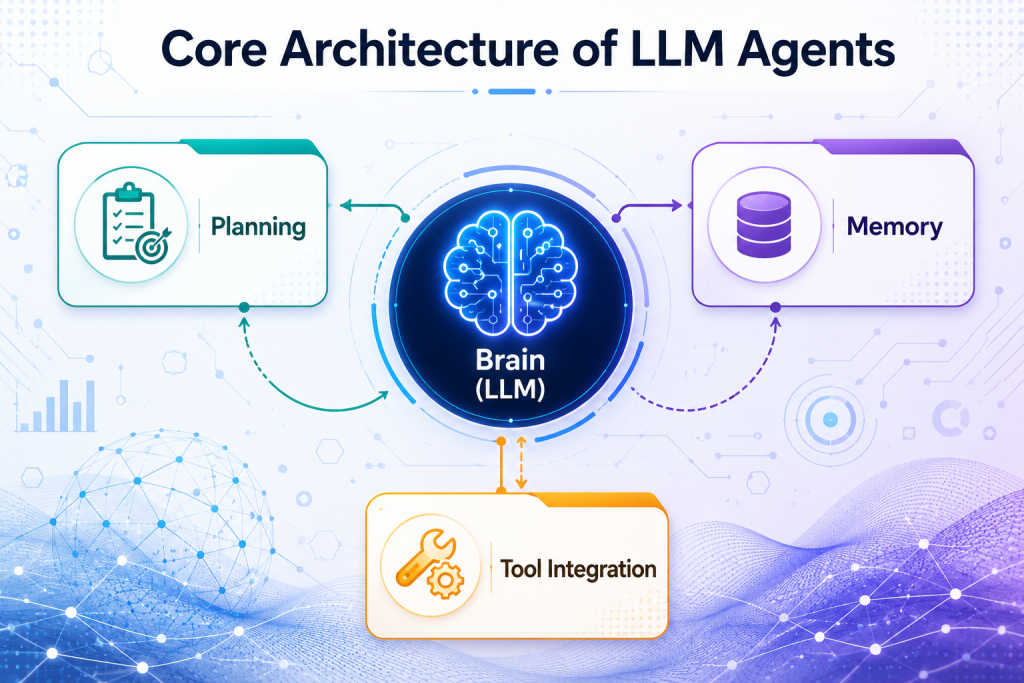
The architecture of LLM agents is complex, involving several core components that work together to enable their autonomous behaviour. The key elements include:
- Brain (LLM): This is the model’s core, which generates responses and makes decisions.
- Planning: A mechanism that decomposes tasks into smaller, manageable steps.
- Memory: Both short-term and long-term memory allow the agent to retain context and information from past interactions.
- Tool Integration: This includes connecting the agent to external tools such as databases, APIs, and other software systems.
Agent Brain & Planning Module
The “agent brain” refers to the underlying LLM that generates responses based on input. The planning module allows the system to decompose complex tasks into smaller, sequential steps. This planning capability enables LLM agents to handle multi-step processes, such as schedulling meetings, generating reports, or analyzing data over time.
Memory Systems
Memory in LLM agents is crucial for maintaining context. Short-term memory is used to retain immediate context, like the current conversation. Long-term memory, on the other hand, allows agents to store past interactions or knowledge, which can be recalled to improve future decision-making and provide more personalised responses.
Tool Use & External Integration
LLM agents are not limited to their internal capabilities. They can integrate with external tools such as databases, APIs, and other specialised systems. This ability to leverage external resources allows the agent to perform more complex tasks, such as querying databases for information, performing mathematical calculations, or interacting with other software platforms.
Implementation readiness means an organisation has the people, processes, data, and systems needed to adopt LLM Agents in a way that delivers measurable, sustainable value.
[The strongest results come from teams that pair clear business outcomes with disciplined execution—not from chasing the latest buzzwords or tools.]
Popular Frameworks & Platforms
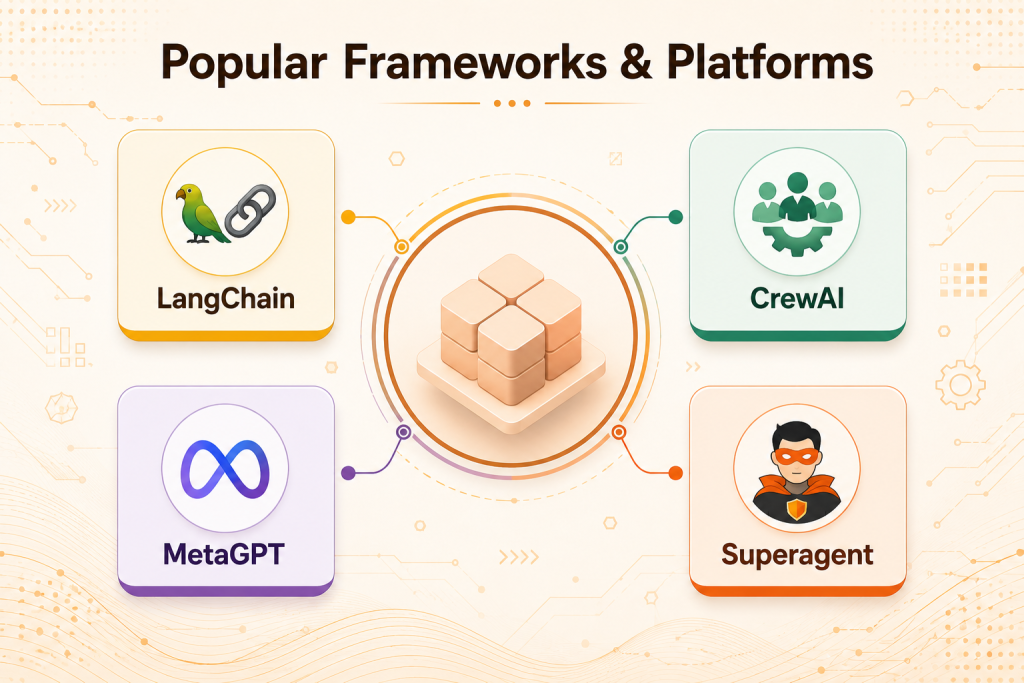
To build LLM agents, developers rely on various frameworks and platforms that provide the necessary tools and infrastructure. Some of the most popular frameworks include:
- LangChain: A powerful tool that enables LLMs to interact with external APIs, databases, and other services. It allows developers to control the flow of logic in an agent and orchestrate tools to complete tasks.
- CrewAI: A platform that focuses on providing solutions for multi-agent environments, allowing multiple agents to collaborate and solve complex problems.
- MetaGPT: A system designed to provide autonomous collaboration between AI models and human agents to maximise productivity.
- Superagent: This platform focuses on helping businesses build LLM agents with minimal coding by providing templates and customisable features.
LangChain & LangGraph
LangChain is one of the most well-known frameworks for building LLM agents. It provides an easy way to integrate language models with external tools and APIs. By using LangGraph, developers can create visual representations of task flows, making it easier to manage multi-step workflows and agent interactions.
Other Emerging Platforms
Other emerging platforms like AutoGen and open-source tools from research institutions are helping push the boundaries of what’s possible with LLM agents. These platforms focus on enabling easier integration of multiple LLM agents in collaborative, multi-agent environments.
Top Use Cases & Industry Applications
LLM agents have a broad range of applications across multiple industries. Some of the most prominent use cases include:
Research & Summarisation
LLM agents excel in fields that require the processing of large amounts of information. In research, agents can assist in literature reviews, legal precedent mapping, and large document summarisation. By leveraging memory and planning, they can digest extensive documents, extract key information, and summarise findings efficiently.
Productivity & Automation
In the workplace, LLM agents can help improve productivity by automating mundane tasks like schedulling meetings, managing emails, and generating reports. They can also assist in more complex workflows like code generation and data analysis, freeing up valuable time for more strategic tasks.
Specialised Fields
LLM agents are particularly valuable in healthcare, finance, customer service, and legal sectors, where tasks often involve detailed analysis, document review, or customer interactions. In healthcare, for example, agents can assist doctors by analyzing medical records and suggesting treatment plans based on historical data.
Benefits & Challenges
Strengths
The key benefits of LLM agents include improved efficiency, scalability, and autonomous problem-solving. By leveraging planning, memory, and tool integration, these agents can handle multi-step tasks with high accuracy, reducing the need for manual intervention and speeding up decision-making.
Common Pitfalls
However, LLM agents are not without challenges. Some of the most common issues include prompt brittleness, memory limits, and costs associated with computation. Furthermore, concerns around reliability and ethical issues, such as the potential for bias or unintended outcomes, need to be addressed.
Risk Mitigation Strategies
To mitigate these risks, organisations should implement governance models, establish clear evaluation frameworks, and focus on prompt tuning. Regular monitoring and updating of the agents’ capabilities are essential to ensure they remain effective and aligned with business objectives.
Potential Developments
The future of LLM agents is bright, with many exciting trends emerging on the horizon. One major development is the shift toward autonomous agents, which can operate without human oversight for long periods. Additionally, the integration of more sophisticated tool protocols, like MCP (Multi-Channel Protocol), will further enhance the abilities of LLM agents.
Autonomy Spectrum & Agentic AI
We are already seeing the evolution of LLM agents from simple assistants to autopilot systems that can perform tasks independently, requiring minimal input from users.
Ecosystem & Standards
The rise of standards like Agent2Agent protocols and evaluation systems will help ensure that LLM agents interact seamlessly and securely across different platforms.
Business Outlook
As we approach 2025, we expect significant growth in enterprise adoption of LLM agents. These systems will become essential for improving productivity and achieving cost savings, representing a strategic shift toward more autonomous workflows.
Conclusion
LLM agents represent the future of artificial intelligence. By incorporating planning, memory, and tool use, they can perform complex, autonomous tasks that go far beyond traditional AI systems. As industries continue to explore new ways to leverage LLM agents, we can expect significant advancements in productivity, decision-making, and automation.
At User Experience Researchers, we help organisations evaluate, design, and implement AI solutions that align with real user needs and business objectives. Whether you’re exploring LLM agents, AI-powered workflows, or enterprise adoption strategies, we help ensure technology delivers meaningful and measurable outcomes.
Email: project@user.com.sg
Contact page: https://www.user.com.sg/contact-user/
Frequently Asked Questions (FAQ)
LLM agents are autonomous systems built on large language models that can plan, remember, and execute multi-step tasks without constant human intervention.
Unlike standard chatbots or RAG systems, LLM agents can perform more complex, multi-step tasks and leverage memory and planning to execute actions autonomously.
LLM agents typically include four core components: the brain (LLM), planning module, memory, and tool integration.
LLM agents are used in various fields, including research, productivity automation, legal analysis, healthcare, finance, and customer service.
Popular frameworks include LangChain, CrewAI, MetaGPT, and Superagent.
LLM agents face challenges such as prompt brittleness, memory limits, and cost. Ethical concerns and security risks also need to be addressed.
Organisations should focus on governance models, prompt tuning, and regular monitoring to ensure LLM agents are deployed securely and ethically.
Key trends include the rise of autonomous agents, integration of advanced tool protocols, and growing enterprise adoption in the coming years.
Sources:
– [NVIDIA: Introduction to LLM Agents](https://developer.nvidia.com/blog/introduction-to-llm-agents)
– [Superannotate: LLM Agents](https://www.superannotate.com/blog/llm-agents)
– [LangChain: LangChain Overview](https://blog.langchain.dev)

