

Every organisation today depends on digital systems and data, and that dependence makes cybersecurity a business priority rather than a purely technical concern. As cyber threats grow in volume and sophistication, the question for leaders is not whether cybersecurity matters, but why it matters so much and what is at stake if it is neglected. Understanding the core reasons makes the case for treating security as the strategic priority it has become.
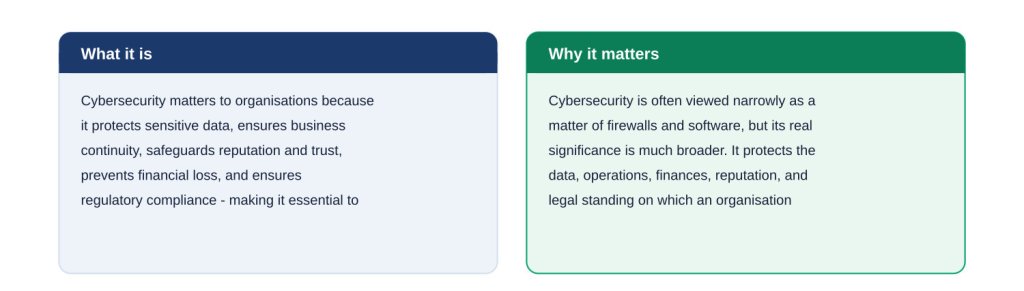
Cybersecurity is often viewed narrowly as a matter of firewalls and software, but its real significance is much broader. It protects the data, operations, finances, reputation, and legal standing on which an organisation depends. A serious security failure can disrupt every part of a business, while strong security underpins resilience, trust, and the confidence to operate and grow in a digital world.
This guide sets out the five most important reasons why cybersecurity matters for your organisation, explains the consequences of getting it wrong, and outlines how to make the case and get started. Whether you are a leader building the argument for investment or seeking to understand the stakes, the goal is a clear, practical understanding of why security deserves priority.
What Cybersecurity means
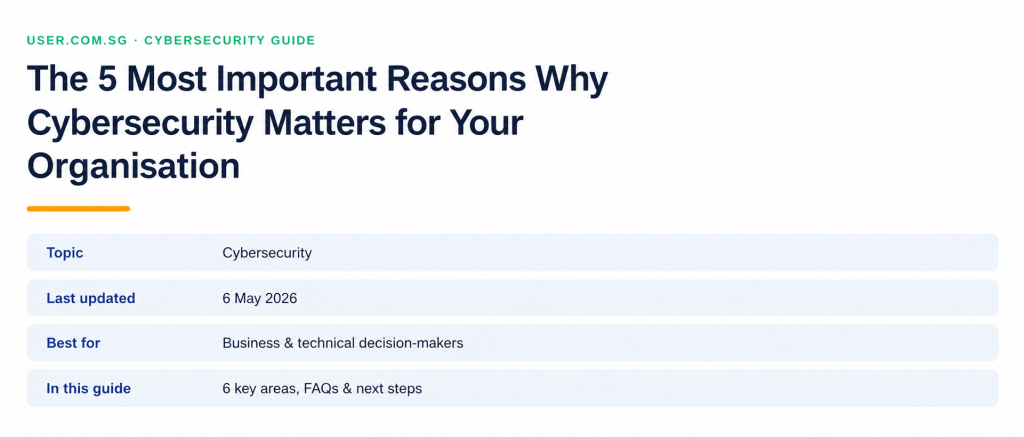
Cybersecurity matters to organisations because it protects sensitive data, ensures business continuity, safeguards reputation and trust, prevents financial loss, and ensures regulatory compliance — making it essential to the resilience, credibility, and viability of any organisation that depends on digital systems and information.
Cybersecurity: what it is, and why it matters for your organisation.
“If you are evaluating Cybersecurity, focus on the core concepts, real-world use cases, and trade-offs first — so any decisions, investments, or implementations are aligned to real outcomes.”
Why Cybersecurity Has Become a Business Priority
Cybersecurity has moved from the server room to the boardroom because the stakes have risen dramatically. Organisations now run on digital systems and data, and the threats to those systems have grown in number, sophistication, and impact. A successful attack can halt operations, expose sensitive information, drain finances, and damage reputation, making security a matter of organisational survival rather than mere IT housekeeping.
The expanding reliance on technology has widened the attack surface that organisations must defend. Cloud services, remote working, connected devices, and complex digital supply chains all create new opportunities for attackers. At the same time, adversaries have become more capable and better organised, deploying sophisticated techniques at scale. This combination makes robust cybersecurity essential for every organisation, regardless of size or sector.
Crucially, the consequences of security failures reach far beyond the technical aspects. They affect customers, finances, legal standing, and the trust which businesses depend on. This is why cybersecurity is increasingly understood as a strategic business issue that demands
leadership attention and investment. The reasons it matters are best understood by examining what cybersecurity actually protects, which the following sections set out.
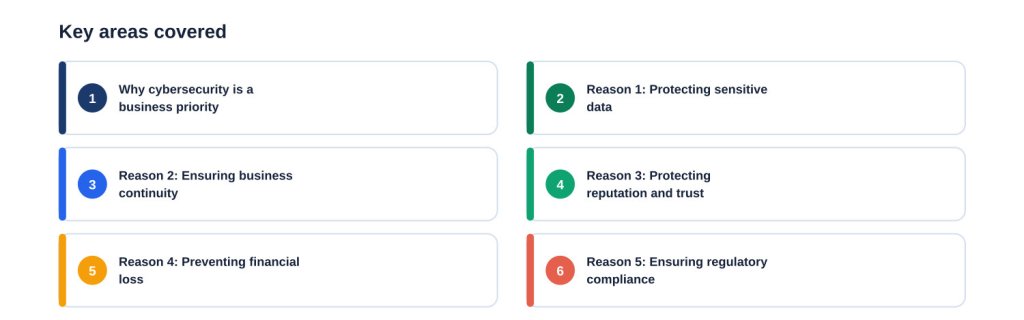
The key areas this guide covers across Cybersecurity.
Reason 1: Protecting Sensitive Data
The first and most fundamental reason cybersecurity matters is the protection of sensitive data. Organisations hold vast amounts of valuable information. From customer data, financial records, intellectual property,to employee details, and confidential business information. This data is essential to operations and is a prime target for attackers, making its protection a core purpose of cybersecurity.
The consequences of a data breach are severe and varied. Beyond the immediate loss or exposure of information, breaches can lead to financial losses, legal liability, regulatory penalties, and lasting damage to trust. Stolen data can be used for fraud, sold, or exploited, harming the organisation and individuals whose information is compromised. Protecting data is therefore essential to avoiding these wide-ranging harms.
Effective data protection relies on a combination of measures — controlling access, encrypting information, securing systems, and monitoring threats — that together keep sensitive data safe from unauthorised access and theft. Because data is so central to modern organisations and so attractive to attackers, safeguarding it is one of the clearest and most important reasons why cybersecurity matters, and a foundation on which the other reasons build.
Reason 2: Ensuring Business Continuity
The second reason is that cybersecurity ensures business continuity. Modern organisations depend on their digital systems to operate continuously, and cyberattacks can disrupt or halt these systems, bringing operations to a standstill. Attacks such as ransomware, which locks up critical data and systems, can cause significant downtime that affects everything from production and service delivery to customer support.
The impact of such disruption can be substantial. Downtime means lost productivity, lost revenue, missed commitments, and disruption to customers, and the longer it lasts, the greater the damage. For organisations that depend on continuous operation, even short interruptions can be costly, and major incidents can threaten the viability of the business. Cybersecurity protects against these disruptions and the harm they cause.
Strong cybersecurity supports continuity by preventing attacks from succeeding and by enabling rapid recovery when incidents occur. Measures such as securing systems, detecting and responding to threats quickly, and maintaining reliable backups all help keep operations running and minimise downtime. By protecting the systems organisations depend on, cybersecurity ensures they can continue to operate even in the face of cyber threats, making continuity a vital reason it matters.

How user.com.sg moves from discovery to measurable, scalable value.
Reason 3: Protecting Reputation and Customer Trust
The third reason cybersecurity matters is the protection of reputation and customer trust. In a connected world, an organisation’s reputation is priceless, and trust is central to its relationships with customers, partners, and stakeholders. A security breach can severely damage both, causing customers to lose confidence in an organisation’s ability to protect their information.
The reputational impact of a breach can be long-lasting and difficult to repair. News of a security failure can erode the trust built over years, leading customers to take their business elsewhere and making it harder to attract new ones. The damage to reputation can outweigh the direct costs of an incident, affecting an organisation’s standing and prospects well beyond the immediate aftermath.
Conversely, strong cybersecurity supports and strengthens trust. When an organisation demonstrably protects the data entrusted to it and operates securely, it builds confidence among customers and partners. In an environment where people are increasingly concerned about how their information is handled, good security can be a differentiator that reinforces relationships and reputation. Protecting trust is therefore a compelling priority.
Reason 4: Preventing Financial Loss
The fourth reason cybersecurity matters is the prevention of financial loss. Cyberattacks can be extremely costly and the financial impact comes from many directions. Direct costs include ransom payments, the expense of responding to and recovery from incidents and restoring systems and data. Indirect costs include lost revenue from downtime, legal fees, regulatory fines, and the long-term effects of reputational damage.
These costs can be substantial and in serious cases, threatening to the organisation’s financial health. The cumulative impact of a major incident — combining direct response costs, lost business, legal and regulatory consequences, and reputational harm — can be far greater than organisations anticipate. For many, the financial consequences of a serious breach are among the most significant risks they face.
Investing in cybersecurity is, an investment in avoiding these losses. By preventing attacks and limiting their impact, security protects the organisation from the significant financial consequences that incidents bring. When weighed against the potential costs of a breach, the investment in cybersecurity is readily justified, making financial protection a clear and pragmatic reason it matters to every organisation.
Reason 5: Ensuring Regulatory Compliance
Cybersecurity is ensuring regulatory compliance and legal protection. Organisations are increasingly subject to laws and regulations governing the protection of data and the security of their systems. These requirements carry real obligations and failing to meet them can result in significant penalties, legal liability, and other consequences.
The regulatory landscape has grown more demanding as the importance of data protection and security has been recognised. Organisations must implement appropriate security measures, protect the data they hold, and often demonstrate their compliance. Non-compliance, particularly when it contributes to a breach, can lead to substantial fines and legal action, adding to the harm an incident may cause.
Cybersecurity is essential to meeting these obligations and protecting the organisation legally. By implementing the security measures that regulations require and protecting data appropriately, organisations comply with their legal duties and reduce their exposure to penalties and liability. As regulation continues to expand, the role of cybersecurity in ensuring compliance and legal protection becomes ever more important, completing the core reasons it matters.
Beyond the Five Reasons: Competitive Advantage
While the five aforementioned reasons make a compelling case, cybersecurity offers benefits that go further, including competitive advantage. In a market where customers and partners care about how their data and interests are protected, strong security can distinguish an organisation from less secure competitors, building confidence and supporting business relationships.
Security can also be an enabler of opportunity rather than just a protector against threats. Strong cybersecurity allows organisations to adopt new technologies, enter new markets, and pursue digital initiatives with confidence, knowing they can manage the associated risks. It supports innovation and growth by providing the secure foundation on which digital ambitions can be built.
Increasingly, demonstrating good security is also a requirement for doing business, as customers and partners expect their suppliers to protect shared data and systems. Organisations with strong security are better positioned to meet these expectations and win business. Viewed this way, cybersecurity is not only a defence but a source of advantage and opportunity, adding to the reasons it deserves priority and investment.
The Real Cost of Neglecting Cybersecurity
Understanding why cybersecurity matters is sharpened by considering the cost of neglecting it. Organisations that under-invest in security expose themselves to the full range of harms that the core reasons address — data breaches, operational disruption, reputational damage, financial loss, and regulatory penalties — often at a far greater cost than the investment they avoided.
The consequences of a serious incident frequently exceed expectations. Beyond the immediate disruption and direct costs, organisations face the lingering effects of lost trust, ongoing legal and regulatory consequences, and the diversion of attention and resources to recovery. In the worst cases, a major breach can threaten the survival of a business, demonstrating that neglecting security is a serious risk, not a saving.
This asymmetry — where the cost of an incident vastly outweighs the cost of prevention — is at the heart of the case for cybersecurity. Treating security as an optional expense to be minimised is a false economy that exposes the organisation to disproportionate risk. Recognising the true cost of neglect makes clear why proactive investment in cybersecurity is both prudent and necessary.
Building a Security-First Culture
Effective cybersecurity is not only about technology; it depends heavily on people and culture. Many security incidents involve human factors, such as falling for phishing or making mistakes, which means that building a security-aware culture is essential. When everyone in an organisation understands their role in security and takes it seriously, the organisation is far better protected.
Creating a security-first culture involves educating and engaging people at all levels. Training staff to recognise and avoid threats, fostering good security habits, and ensuring leadership champions security all contribute to an environment where security is everyone’s responsibility. This human dimension complements technical measures, addressing one of the most common ways that attacks succeed.
Leadership plays a particularly important role in establishing this culture. When leaders treat cybersecurity as a priority, allocate appropriate resources, and set the tone, security becomes embedded in how the organisation operates. Building this culture is a key part of realising the reasons cybersecurity matters, ensuring that good security is sustained across the organisation rather than depending on technology alone.
Making the Case and Getting Started
For those seeking to strengthen cybersecurity, making the case to decision-makers is often the first step. The five reasons — protecting data, ensuring continuity, safeguarding reputation, preventing financial loss, and ensuring compliance — provide a compelling, business-focused argument. Framing security in terms of the risks it mitigates and the value it protects helps secure the attention and investment it requires.
Getting started effectively means understanding the organisation’s specific risks and priorities. Assessing what data and systems matter most, where the vulnerabilities lie, and what the most significant threats are allows security efforts to be focused where they deliver the greatest protection. This risk-based approach ensures that investment is targeted and effective rather than scattered.
From there, building strong cybersecurity is an ongoing process of implementing appropriate measures, fostering a security-aware culture, and continuously improving as threats evolve. Many organisations benefit from expert guidance in assessing their risks and building effective security. Approaching cybersecurity strategically — understanding why it matters, making the case, and acting on it deliberately — is what turns recognition of its importance into real protection, and it is exactly the kind of support user.com.sg provides.
Cybersecurity Matters for Organisations of Every Size
A common misconception is that cybersecurity matters mainly for large organisations, and that smaller ones are unlikely targets. In reality, organisations of every size face cyber threats, and smaller organisations are often targeted precisely because they may have weaker defences. The reasons cybersecurity matters apply across the board, regardless of an organisation’s size or sector.
For smaller organisations, the impact of a serious incident can be especially severe, as they may have fewer resources to absorb the financial, operational, and reputational consequences. This makes effective cybersecurity just as important for them as for larger enterprises, even though their approach may need to be proportionate to their size and resources. No organisation can safely assume it is too small to be at risk.
The practical implication is that every organisation should take cybersecurity seriously and implement protection appropriate to its risks and circumstances. The principles are the same — understand the risks, protect what matters most, build good practices and awareness, and improve over time — even if the scale of investment differs. Recognising that cybersecurity matters universally is an important part of ensuring organisations are not caught unprepared.
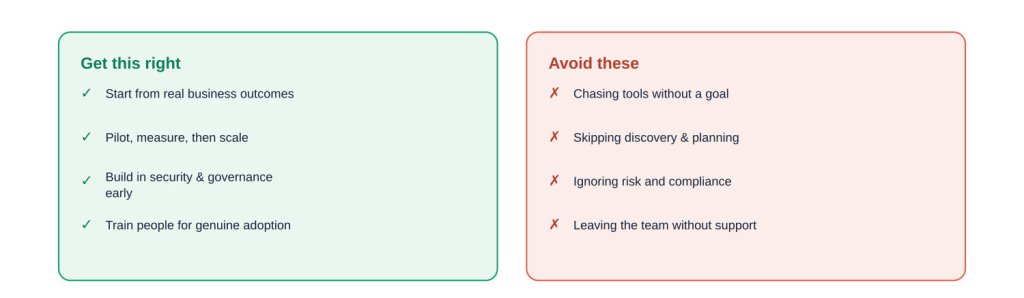
What to get right with Cybersecurity — and the common mistakes to avoid.
Key takeaways
- Cybersecurity is best approached around clear business outcomes, not tools or hype.
- Why cybersecurity is a business priority.
- Reason 1: Protecting sensitive data.
- Reason 2: Ensuring business continuity.
- Reason 3: Protecting reputation and trust.
- Pilot, measure, and then scale — with security, governance, and adoption built in.
- user.com.sg can help you plan, implement, and optimise Cybersecurity for your context.
Conclusion
Cybersecurity matters to your organisation for reasons that reach to the heart of its viability and success: it protects sensitive data, ensures business continuity, safeguards reputation and trust, prevents significant financial loss, and ensures regulatory compliance. These five reasons make clear that security is not a narrow technical concern but a strategic priority that underpins resilience, credibility, and the confidence to operate in a digital world. Beyond them, cybersecurity also offers competitive advantage and enables growth, while the cost of neglecting it can be severe.
Acting on this understanding means treating cybersecurity as the priority it has become — making the business case, understanding the organisation’s specific risks, building a security-aware culture, and investing in effective protection. The asymmetry between the cost of prevention and the cost of a serious incident makes proactive security both prudent and necessary. For any organisation that depends on digital systems and data, which today means virtually all of them, strong cybersecurity is essential to protecting what matters and securing the future.
Work with USER on Cybersecurity
If you are exploring Cybersecurity for your organisation, the most valuable next step is a focused conversation about your goals, current state, and the outcomes that matter most. To build on your cybersecurity measures, it must be assessed first. User Experience Researchers (USER) is a Singapore-based pioneer in UX and AI-powered digital solutions that can help assess your website or digital infrastructure’s security measures. The user.com.sg team can recommend the right discovery, planning, or implementation pathway for your context.
Book a tailored discovery or consultation session with USER
Frequently Asked Questions
Cybersecurity matters because it protects sensitive data, ensures business continuity, safeguards reputation and trust, prevents financial loss, and ensures regulatory compliance. As organisations depend on digital systems and face growing threats, security has become essential to their resilience and viability.
The five most important reasons are protecting sensitive data, ensuring business continuity, protecting reputation and customer trust, preventing financial loss, and ensuring regulatory compliance. Together these make a compelling business case for treating cybersecurity as a strategic priority.
A data breach can cause financial losses, legal liability, regulatory penalties, and lasting damage to reputation and trust. Stolen data can be used for fraud or sold, harming both the organisation and the individuals affected, with consequences that often exceed the immediate incident.
Cybersecurity protects continuity by preventing attacks that disrupt or halt operations and by enabling rapid recovery when incidents occur. Securing systems, detecting threats quickly, and maintaining reliable backups help keep operations running and minimise costly downtime.
Yes. Cyberattacks cause financial loss through direct costs such as ransom payments and recovery, and indirect costs such as lost revenue from downtime, legal fees, regulatory fines, and reputational damage. These cumulative costs can be substantial, making prevention a sound investment.
Organisations are increasingly subject to laws and regulations requiring them to protect data and secure their systems. Cybersecurity is essential to meeting these obligations, and failing to comply can result in significant penalties and legal liability, particularly if it contributes to a breach.
Neglecting cybersecurity exposes an organisation to data breaches, operational disruption, reputational damage, financial loss, and regulatory penalties, often at a far greater cost than the investment avoided. In serious cases, a major breach can threaten the survival of the business.
An organisation can strengthen cybersecurity by understanding its specific risks, implementing appropriate measures, building a security-aware culture, and continuously improving as threats evolve. Securing leadership support and expert guidance helps ensure security efforts are focused and effective.

