
UI and UX design shape how people complete tasks in digital products. A UI UX design agency in Singapore helps organisations make apps, portals, and platforms clearer, faster to use, and easier to trust.
In a market where many services are already digital, the difference is rarely “having a system”. The difference is whether people can use it confidently, without workarounds, repeated calls, or hidden errors.
What Does a UI UX Design Agency Do?
A UI UX design agency typically supports both how the product works (UX) and how the product looks and communicates (UI).
- UX (User Experience) focuses on task flows, clarity, information structure, and friction points. It answers: Can users complete the job easily, correctly, and consistently?
- UI (User Interface) focuses on layout, visual hierarchy, components, and interaction patterns. It answers: Does the screen communicate clearly, and do controls behave predictably?
In practice, good UI/UX is not merely “decoration”. It is creating design that is “operational”. It reduces rework, prevents errors, and improves adoption.
A strong UI UX design agency engagement often results in:
- Research insights and user need
- Clear user journeys and workflow map
- Wireframes and interactive prototype
- UI screens and component librarie
- A design system that keeps teams consisten
- Validation through usability testing and iteration
Why Singapore Organisations Invest in UI/UX Design
Singapore organisations, especially businesses, often operate in high-stakes environments: regulated services, enterprise workflows, and cross-department systems. UI/UX is the difference between “implemented” and “adopted”.
Faster adoption in complex workflows
When labels are inconsistent and steps are unclear, people slow down, repeat actions, or rely on informal training. UI/UX design improves predictability so users can move through tasks without guessing.
Better self-service, fewer support tickets
Clear navigation, better microcopy, and error prevention reduce avoidable tickets. If users can understand what happened and what to do next, they do not need to escalate.
Trust and governance in regulated environments
In Singapore, many systems handle personal or sensitive information. UI/UX supports better governance by making permissions, confirmations, audit trails, and status visibility easier to understand. The Personal Data Protection Act (PDPA) sets a baseline standard for how organisations handle personal data, which affects how data is collected, used, and protected across digital touchpoints.
Accessibility and inclusive service delivery
Accessibility is part of quality. The Web Content Accessibility Guidelines (WCAG 2.2) is a widely recognised standard for making web content more accessible to people with disabilities and is structured around principles like perceivable, operable, understandable, and robust.
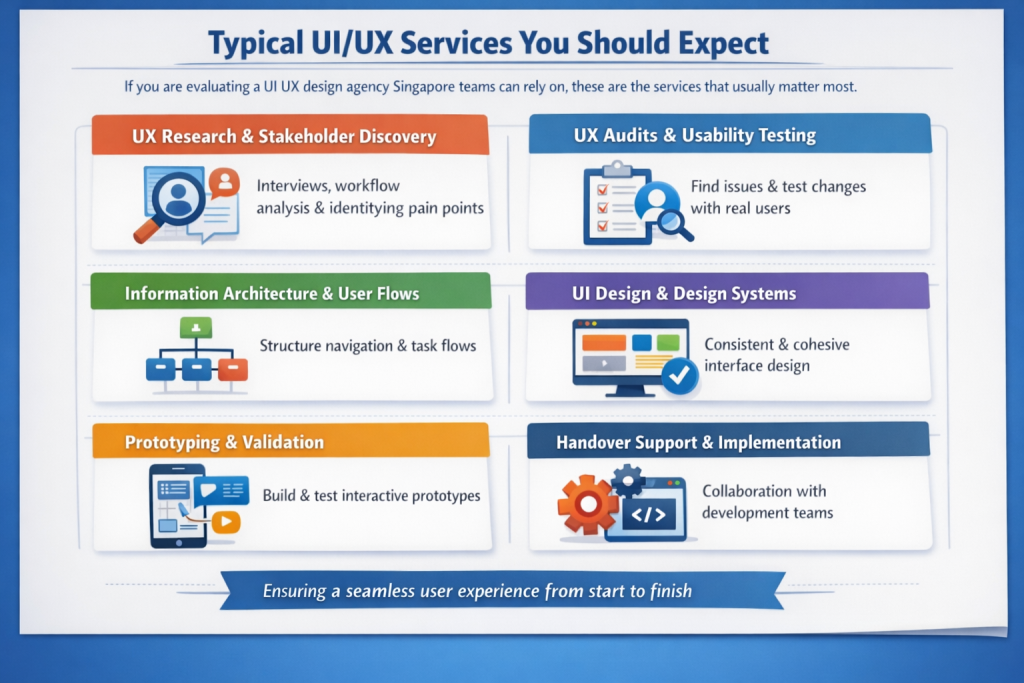
Typical UI/UX Services You Should Expect
If you are evaluating options for a UI UX design agency Singapore teams can rely on, these are the services that usually matter most.
UX research and stakeholder discovery
This includes interviews, workflow walkthroughs, and analysing existing pain points. Many agencies position UX research as the starting point to understand user needs and uncover opportunities before design begins.
UX audits and usability testing
Audits identify where users drop off, get confused, or make preventable errors. Usability testing validates whether proposed changes work with real users.
Information architecture and user flows
This stage clarifies navigation, grouping, and the steps required to complete key tasks. It reduces cognitive load and prevents “where do I go next?” moments.
UI design and design systems
A design system brings consistency across screens and teams. It reduces redesign work, speeds development, and improves user confidence through familiar patterns.
Prototyping and validation
Interactive prototypes allow teams to test flows before development. This prevents costly rework later and gives stakeholders something concrete to align on.
Handover support and implementation alignment
Design must survive delivery. A good UI UX design agency work closely with developers to ensure components, states, and edge cases are implemented properly.
How USER Approaches UI/UX Design Projects
User Experience Researchers (USER) is a Singapore-based UI/UX firm at the forefront of user-focused movements in Asia, providing efficient research and technology services to organisations and enterprises. Founded in 2010, we have helped teams improve experiences across their products, from public-facing apps to internal portals for employees. Since then, we have expanded our experience-focused services for creating and developing solutions, providing talent for teams, and various consultancy services.
Our approach is designed to reduce ambiguity, protect quality, and improve adoption.
1) Discovery and user research
We start by understanding:
- What users are trying to achiev
- Where the workflow breaks dow
- What constraints exist (policy, security, approvals, legacy systems)
This phase sets the foundation; making design decisions evidence-led, not opinion-led.
2) Journey mapping and workflow design
We translate research into:
- Task flows that reduce steps and confusio
- Clear status and confirmation pattern
- “Recovery design” for errors, timeouts, and interruptions
3) UI design built for clarity and consistency
UI is where trust becomes visible. We focus on:
- Consistent labels and component
- Clear hierarchy so users notice the right thing at the right tim
- Forms that prevent errors, not just report them
4) Testing and iteration
We validate designs through testing and refine the interface based on what users actually do, not what we assume they do.
5) Design system and delivery support
We support implementation alignment so the final product matches the intent: predictable behaviour, consistent components, and fewer edge-case surprises.
USER also highlights quality and security posture on its site, including ISO-aligned compliance statements.
UI UX Design Agency in Singapore: What to Look For
Singapore has many agencies. The best choice depends on how critical the workflow is and how much risk you need to reduce. When evaluating partners, prioritise evidence and process clarity.
Process clarity and evidence of outcomes
A credible agency can explain what they will do, when, and how decisions are made. Industry directories commonly recommend reviewing an agency’s workflow and portfolio before deciding.
Sector experience and governance awareness
If your systems include approvals, audits, and access control, you need a team that designs for governance, not just aesthetics.
PDPA and data handling readiness
PDPA affects collection, use, disclosure, and care of personal data, so your design must avoid dark patterns, unclear consent, and risky handling of sensitive inputs.
Accessibility standards awareness
Ask how the agency considers WCAG 2.2 in layout, contrast, keyboard navigation, focus states, and error messaging.
Collaboration model and long-term support
UI/UX work is rarely “one and done”. Strong partners support iteration, design governance, and system evolution.
Why Choose USER as Your UI UX Design Agency in Singapore
If you need UI/UX that improves real workflows, USER is built for that.
- Established in 2010 with a Singapore base and regional delivery capability.
- Research-led UX so designs reflect real behaviours, not internal assumptions.
- Enterprise-ready mindset focused on clarity, governance, and adoption.
- Quality and security posture aligned with structured delivery expectations.
Case Examples (Anonymised)
Case 1: Internal approvals workflow for a regulated organisation
Challenge: Users repeated submissions because statuses were unclear and confirmations were missing.
Approach: Map the approval journey, redesign statuses and confirmations, simplify steps, test with real users.
Outcome: Fewer resubmissions, clearer accountability, smoother handovers.
Case 2: Citizen or customer portal with high-volume forms
Challenge: Form errors caused drop-offs and repeated calls to support.
Approach: Improve field-level guidance, add examples, clarify error messages, validate through usability testing.
Outcome: Higher completion confidence and fewer avoidable escalations.
Case 3: Operations dashboard for cross-team decision-making
Challenge: Teams interpreted the same metrics differently due to unclear labels and inconsistent UI components.
Approach: Align terminology, redesign information hierarchy, establish a component library, validate with stakeholders.
Outcome: Faster decision-making and more consistent reporting behaviour.
Common Questions About UI/UX Design Agencies
Cost depends on scope: number of journeys, screens, research depth, and whether a design system is included. For enterprise work, most teams start with a discovery phase to scope properly.
A focused UX audit or prototype can take weeks. Larger platforms with multiple roles and workflows may take months, especially if research and testing are included.
Often, yes. Requirements describe what the system should do. Research reveals how people actually work, where ambiguity exists, and what will drive adoption.
At minimum: key journeys, wireframes or prototypes, UI screens, and handover notes. For larger programmes: a design system and governance guidance.
Build accessibility in from the start using recognised guidelines like WCAG 2.2, and ensure data flows respect PDPA obligations.
About USER
User Experience Researchers Pte Ltd (USER) is a leading UX-focused company specialising in digital transformation consultancy, agile development, and workforce solutions. We have a steadfast commitment to innovating the best of today’s technology to promote sustainable growth for businesses and industries.
For more information, contact USER throughproject@user.com.sg

