
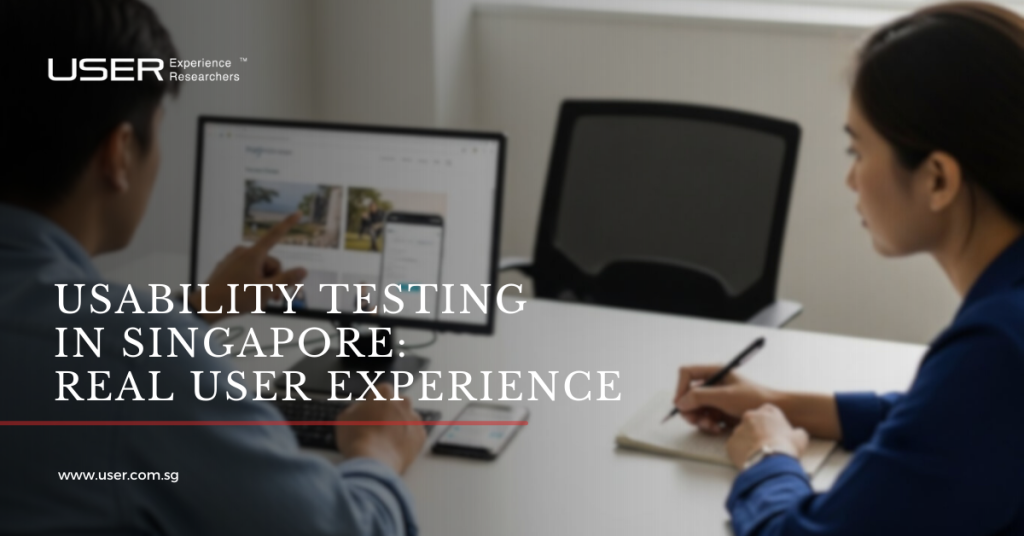
Great design is not built on assumptions—it is built on evidence. Usability testing provides that evidence by observing how real users interact with a product, revealing friction points, misunderstandings, and opportunities for improvement.
For organisations in Singapore, usability testing plays an important role in ensuring digital products meet user expectations for clarity, efficiency, and trust. Rather than relying on internal opinions or best guesses, usability testing allows teams to make informed decisions based on actual user behaviour.
What Is Usability Testing?
Usability testing is a user research method used to evaluate how easily people can use a digital product such as a website, mobile application, or software system. During a usability test, participants are asked to complete realistic tasks while researchers observe their behaviour, challenges, and decision-making process.
The aim is to assess three core aspects of usability:
- Effectiveness – whether users can complete tasks successfully
- Efficiency – how easily and quickly tasks are completed
- Satisfaction – how users feel about the experience
Usability testing complements analytics and surveys by explaining why certain problems occur, rather than only showing what happens.
Why Usability Testing Matters in the Singapore Context
Singapore’s digital environment is highly competitive, with users accustomed to polished, well-designed digital services across banking, e-commerce, government platforms, and SaaS products. Expectations for usability are high, and tolerance for confusion is low.
Usability testing in Singapore is particularly valuable because:
- Users come from diverse linguistic and cultural backgrounds
- Usability testing is not limited to digital products
- Many platforms serve regulated or high-stakes functions
- Trust and clarity strongly influence adoption and continued use
Testing with local users helps ensure insights reflect real behaviours rather than assumptions based on other markets.
Common Types of Usability Testing
Different usability testing approaches are used depending on research goals, timelines, and product maturity.
Moderated Usability Testing
A researcher guides participants through tasks in real time, allowing for deeper questioning and clarification.
Unmoderated Usability Testing
Participants complete tasks independently, enabling faster feedback from a larger sample.
Remote Usability Testing
Users participate from their own environment, which can provide more natural behavioural insights.
In-Person Usability Testing
Face-to-face sessions allow for richer observation, especially for complex systems or enterprise tools.
Prototype and Live Product Testing
Usability testing can be conducted on early concepts, interactive prototypes, or fully launched products to validate and improve design decisions.
Who Benefits from Usability Testing?

Usability testing is valuable across many industries and organisational contexts, including:
- Financial services and fintech
- E-commerce and retail platforms
- SaaS and B2B products
- Government and public services
- Healthcare and education technology
It supports designers, product managers, developers, and business stakeholders by aligning decisions around user needs.
How Usability Testing Drove Measurable Growth
Here are two examples of how usability testing helped boost the business growth in real-world scenarios:
UK-based Gymshark has long prioritised customer feedback, evolving from early product tests into structured usability testing with its usability testing partner to improve its digital experience. By combining in-person interviews with unmoderated testing of competitor app users, the Gymshark team aligned product and engineering decisions around real customer behaviour across the purchase journey.
Insights from their studies revealed that shoppers often left the site to read reviews before buying, prompting changes that kept carts intact and increased checkout rates by 11%. Further usability testing and A/B experiments made the sizing guide more visible, boosting its use by 40% in six weeks, while improvements to the training app addressed key usability issues and helped double its user base within a month.
Another story is AutoTrader.com, one of the world’s largest online marketplaces for used cars., The company found itself under pressure as competitors with stronger digital experiences began gaining ground, proving that in modern e-commerce, user experience can outweigh size or legacy.
With most of its traffic coming from organic search and limited room for risky redesigns that could affect SEO, AutoTrader took a careful, research-led approach. Collaborating with a research partner, they conducted live and remote interviews with real car shoppers and uncovered a critical insight: most users entered the site through inner pages from search engines, not the homepage, and often lacked context when they arrived.
By redesigning these inner pages to function as clear entry points rather than assuming prior familiarity, AutoTrader aligned its site more closely with real customer journeys, demonstrating how usability testing, even with a small team and budget, can drive smarter design decisions while balancing SEO and user needs.
When Should Usability Testing Be Conducted?
Usability testing is not limited to a single stage of development. It can be conducted:
- During early concept or wireframing stages
- On prototypes before development
- Prior to product launch
- After launch to validate improvements or identify new issues
Regular testing supports continuous improvement rather than one-time validation.
Using Usability Testing to Make Better Design Decisions

Usability testing provides clarity in a process often influenced by assumptions and opinions. By observing how users actually interact with a product, teams gain evidence that helps them prioritise improvements, reduce risk, and design experiences that work in real-world conditions.
For organisations operating in Singapore’s fast-paced digital ecosystem, usability testing is a practical tool for aligning design decisions with user needs and expectations.
As digital products grow more complex and stakes increase, many organisations turn to UX consulting agencies in Singapore for specialised research expertise. These agencies help teams move beyond internal assumptions by providing structured testing, independent analysis, and practical recommendations grounded in user behaviour. In a market shaped by high user expectations, regulatory considerations, and rapid product cycles, experienced UX consultants play a critical role in helping organisations make confident, evidence-based decisions before committing to scale or launch.
Applying Usability Testing Insights in Practice
Understanding usability issues is only the first step. The real value of usability testing comes from translating observations into clear, prioritised actions that teams can confidently implement. This requires not only research expertise, but also a strong understanding of business goals, technical constraints, and real-world user behaviour.
In Singapore, many organisations choose to work with experienced usability researchers to ensure studies are methodologically sound and insights are actionable. USER (User Experience Researchers Pte Ltd) is one such practice, supporting teams across industries by conducting usability testing in Singapore with local users and providing evidence-based recommendations that inform design and product decisions.
Rather than focusing on surface-level feedback, USER’s work emphasises clarity, rigour, and practical outcomes—helping teams understand not just what users struggle with, but why those challenges occur and how they can be addressed through effective usability testing.
For organisations looking to incorporate usability testing into their product development or improvement process, partnering with an experienced research team can help ensure insights are reliable, relevant, and grounded in real user behaviour.
About User Experience Researchers Pte Ltd
User Experience Researchers Pte Ltd (USER) is a leading UX-focused company specialising in digital transformation consultancy, agile development, and workforce solutions. We have a steadfast commitment to innovating the best of today’s technology to promote sustainable growth for businesses and industries.
Frequently Asked Questions About Usability Testing in Singapore
Small studies of 5–8 users often uncover the majority of usability issues, though larger studies may be used for validation.
Yes. Remote testing is widely used and effective, particularly for digital products.
Timelines vary, but many studies can be completed within one to three weeks.
No. Startups, SMEs, and large enterprises all benefit from usability testing.
For more information, contact USER through project@user.com.sg

