
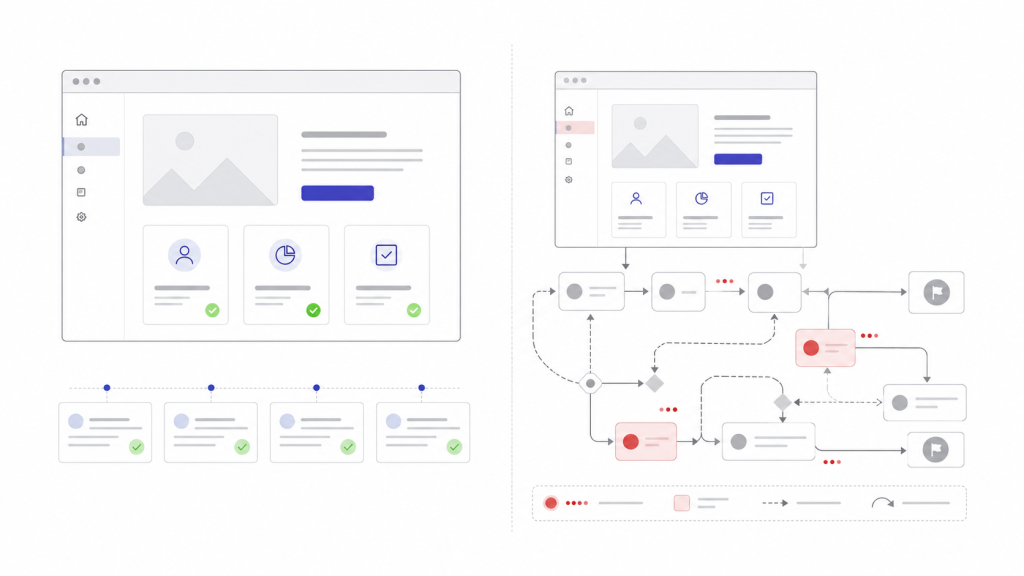
A design can pass every stakeholder review and still confuse the people it was built for.
That does not mean the review was careless. It means internal confidence and real user behaviour are two different things.
Stakeholder reviews are useful. They help teams check structure, compliance, content accuracy, visual consistency, and business logic. But they cannot fully show how people interpret labels, make decisions, recover from uncertainty, or find their way through a system without internal context. That’s something only users understand from their perspective.
This is what makes formative and summative usability testing valuable.
Formative testing helps teams identify issues while the design is still being shaped. Summative testing helps validate whether the final experience works clearly enough before launch or approval.
Together, they reveal the layer that stakeholder reviews often miss: what users actually experience when they try to complete a task.
The Review Conundrum
How can a design look clear in review but become confusing in use?
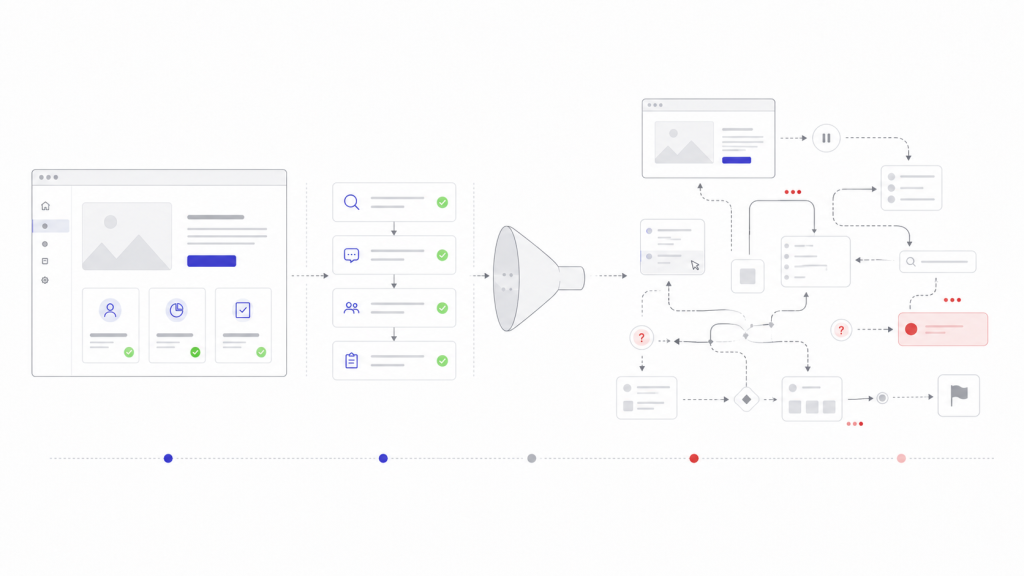
This happens more often than teams expect.
A page can look organised.
A navigation menu can look logical.
A form can look complete.
A user journey can look simple when explained in a meeting.
Then a user tries it out.
They hesitate at a label. They skip the section the team expected them to notice. They choose the wrong option, go back, reread the page, and try again.
Nothing looks broken in the obvious sense.
But something is not working as clearly as the team believed.
That is the review conundrum. To the people who built the system, the experience feels familiar. To the people using it for the first time, the same experience can feel uncertain.
Why Stakeholder Reviews Feel So Reliable
Stakeholder reviews feel sufficient because they are usually thorough.
Teams look at the design from several important angles. They check whether the layout is clean, whether the content is accurate, whether the navigation matches the intended structure, and whether the design follows internal guidelines.
In many organisations, this process involves people who know the system deeply. Product owners, department leads, compliance reviewers, designers, developers, and subject matter experts all bring useful judgement.
That judgement matters.
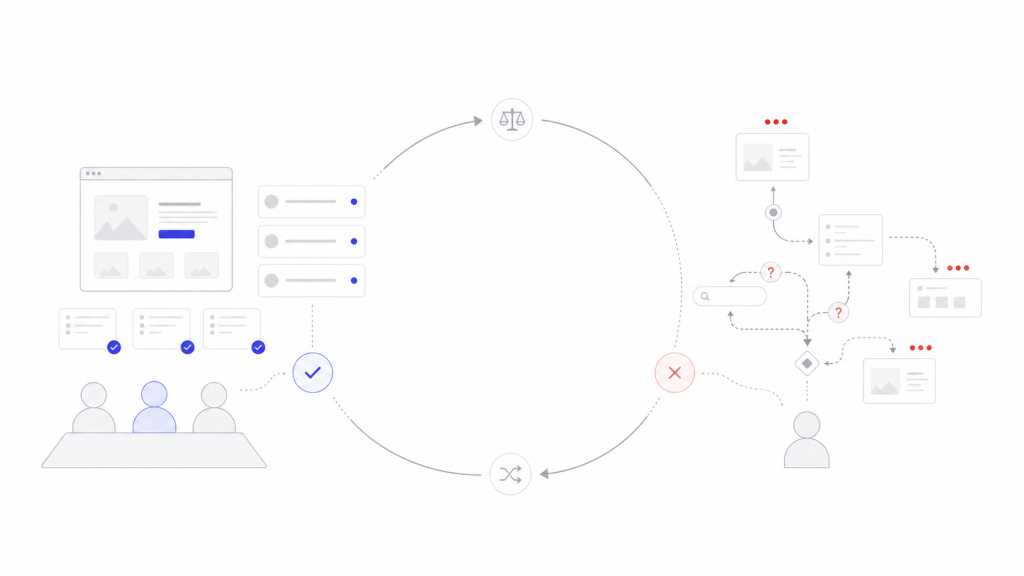
The problem is that everyone in the room often shares one thing users do not have: context.
They know why the content is grouped that way.
They know what the labels mean.
They know which department owns which service.
They know what the next step is supposed to be.
When the team reviews the experience, they are not only seeing the interface, they are also seeing everything they already know and what’s behind it.
Users do not have that knowledge.
What Internal Reviews Cannot Show
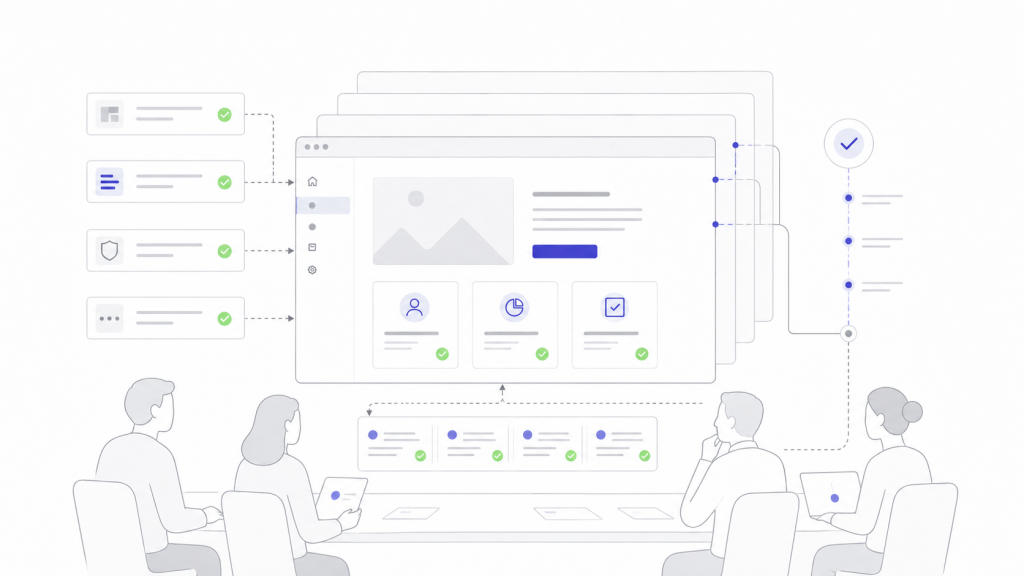
Internal reviews can catch many visible issues. They can identify inconsistent layouts, missing content, unclear visual hierarchy, and gaps in compliance. They are, to some extent, knowledgeable on what end-users can see.
But they cannot fully show how people behave when they are unsure.
They cannot show whether a user will understand a label in the anticipated moment. They cannot show which option someone will choose when two choices seem similar. They cannot show whether users will notice an important instruction or whether they will recover confidently after choosing the wrong path.
Most importantly, they cannot show small pauses that reveal doubt.
A user may complete a task successfully, but only after rereading the same section three times. They may reach the correct page, but only after taking a longer route. They may submit the right form, but only after second guessing every step.
On a review screen, this looks fine. Butin real use, it feels difficult.
What Usability Testing Makes Visible
Usability testing changes the conversation because it moves the design out of the meeting room and into real behaviour.
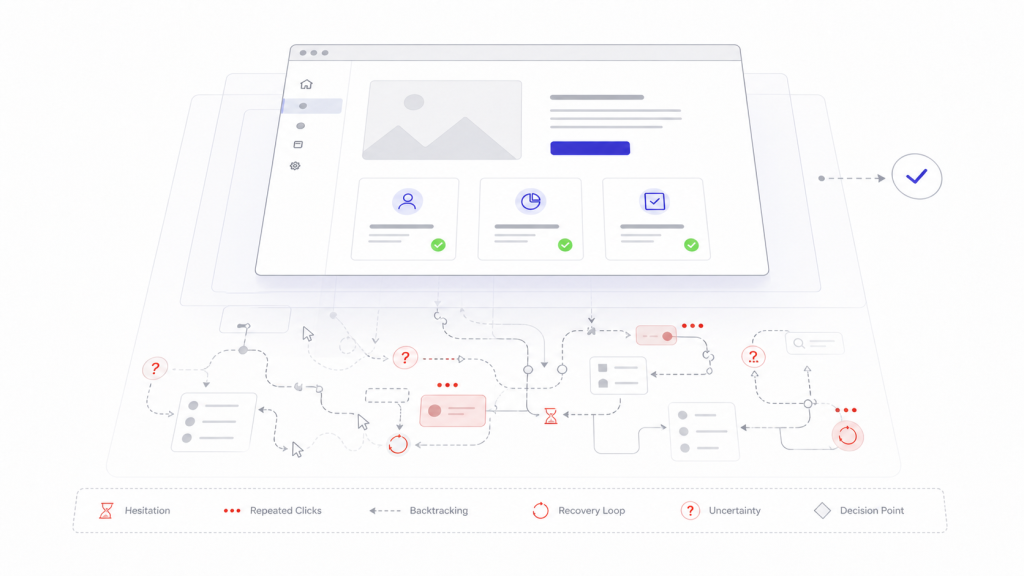
When users perform realistic tasks, patterns begin to appear.
They may choose paths outside of the expected patterns. They may ignore content that was designed to guide them. They may misunderstand words that sound clear internally. They may rely on search because the navigation does not match how they think. They may complete the task, but with unnecessary effort.
A successful task does not always mean a good experience.
If users finish the task only after hesitation, backtracking, repeated checking, or trial and error, the system may still be creating friction. The issue is not always failure. Sometimes, the issue is effort.
And effort is easy to miss when a review focuses only on whether the design looks correct.
Where Formative and Summative Usability Testing Fit
Formative and summative usability testing serve different purposes, but both help teams make better design decisions.
Formative testing is most useful while a design is still being shaped. It helps teams understand whether users can follow the intended path, understand the labels, notice important content, and recover when something feels unclear.
This type of testing gives teams room to improve the experience before decisions become too costly or difficult to change.
Summative testing is useful when a team needs stronger evidence before launch, approval, or wider rollout. It helps assess whether users can complete key tasks clearly, confidently, and without unnecessary effort.
In simple terms, formative testing helps teams improve the design. Summative testing helps teams validate whether the design is ready.
Both are important because they shift the discussion from internal confidence to user evidence.
The Real Gap Is Perspective
There are usually two reasons this gap appears.
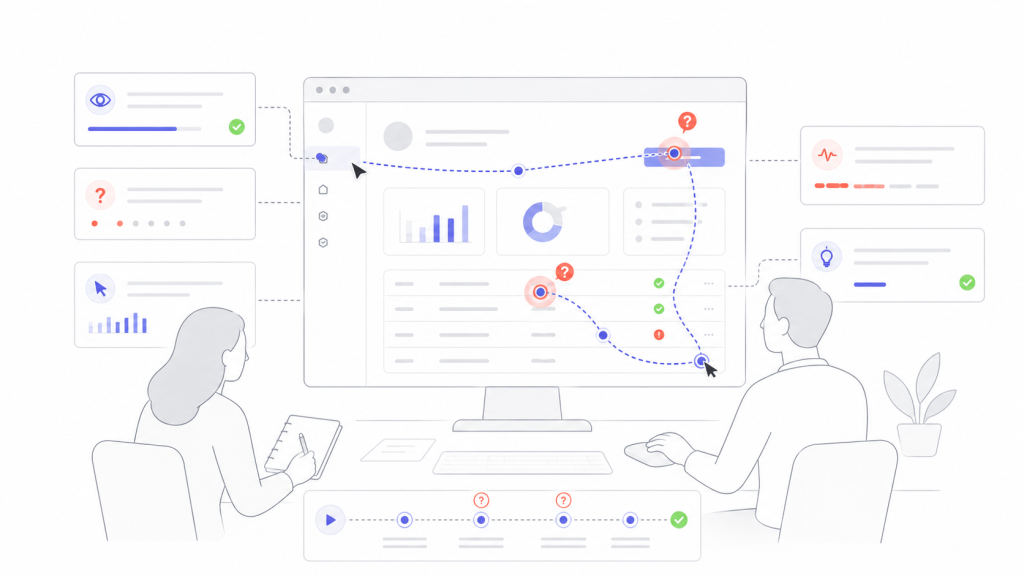
The first is familiarity bias.
Teams know the design too well. They understand the internal structure, terminology, intended flow, and reason behind every design decision. That makes the experience feel more obvious than it really is.
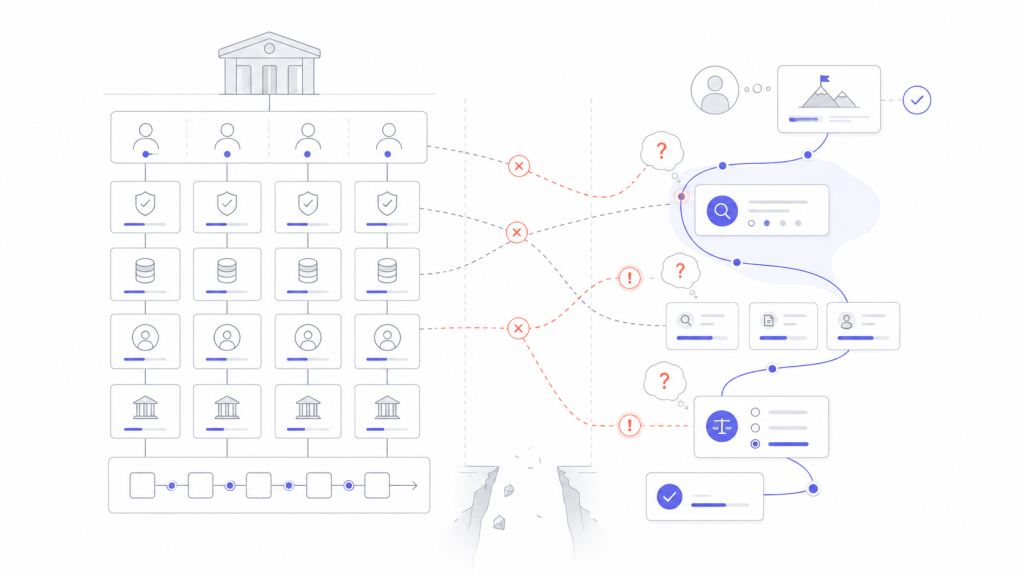
The second is the difference between internal logic and user thinking.
Organisations often structure content around departments, policies, systems, ownership, or operational responsibilities.
Users rarely think that way, unless the users of the system will be the designers themselves.
More often, users think in terms of tasks, goals, questions, and problems.
They are not asking, “Which department owns this process?”
They ask:
Where do I start?
What applies to me?
What happens next?
Which option is correct?
How do I fix this if I make a mistake?
When the system answers from an internal point of view, users have to translate. That translation creates friction.
Why Small Moments of Confusion Matter
It is tempting to treat these issues as minor.
After all, if users eventually complete the task, is there really a problem?
Yes, because small moments of confusion compound quickly.
A confusing label can lead to the wrong page. A weak confirmation message can create doubt. Hidden instructions can increase errors. A poorly placed next step can trigger support requests. A journey that takes two minutes longer than expected may feel acceptable once, but frustrating when repeated across many users and many tasks.
In complex systems, these small gaps affect more than satisfaction.
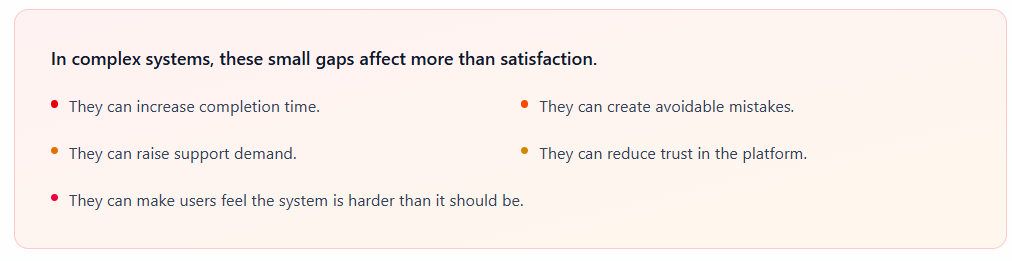
They can increase completion time,
create avoidable mistakes, .raise support demand.reduce trust in the platform, andcan make users feel the system is harder than it should be.
Since these problems often happen during use, they rarely appear in stakeholder reviews alone.
How These Insights Are Identified
The strongest usability findings usually come from watching what users do, not only listening to what they say.
In moderated usability testing, users are asked to complete realistic tasks while researchers observe their choices, hesitation, questions, and recovery behaviour.
The focus is not only on whether they complete the task. It is also on how they get there.
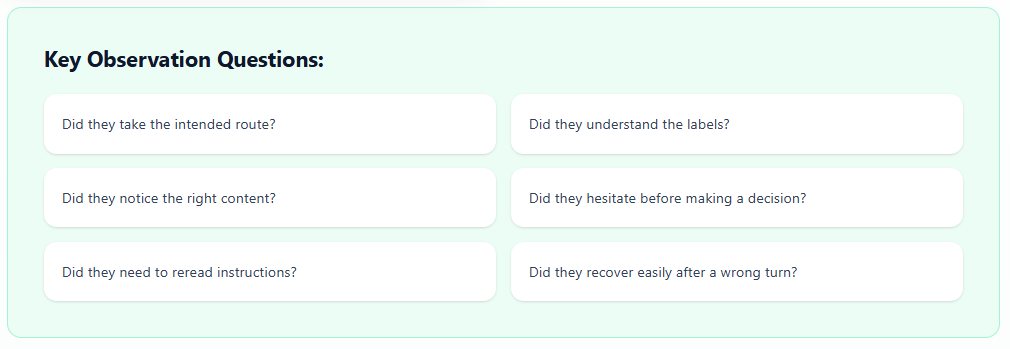
- Did they take the intended route?
- Did they understand the labels?
- Did they notice the right content?
- Did they hesitate before making a decision?
- Did they need to reread instructions?
- Did they recover easily after a wrong turn?
These observations are then compared against the intended design flow. When the same issues appear across users or across systems, they become patterns.
That is where formative and summative usability testing become especially valuable. They move the discussion from opinion to evidence.
What Better Decision-Making Looks Like
A better design process does not remove stakeholder reviews. It strengthens them with user evidence.
Stakeholder reviews are still needed. They help ensure that business needs, policy requirements, brand standards, and technical constraints are considered.
But they should not be the final proof that an experience works.
Better decision-making means testing early enough for findings to shape the design. It means validating navigation, labelling, task flows, and content structure before they become difficult to change.
It also means observing the quality of the path users take, not only whether they reach the end.
That can feel uncomfortable, especially when the original structure makes sense internally. But this is often where the most useful design improvements begin.
A UX consultant can help teams see where internal assumptions and user behaviour start to separate. A UX consultancy can also help turn those findings into practical improvements that support clearer journeys, better decisions, and stronger user confidence.
The Point of Usability Testing
Usability testing is sometimes treated as a way to find mistakes.
That is only part of its value.
Its deeper purpose is to understand how people think when they use a system without the same context as the team that built it.
It reveals where clarity holds.
It reveals where confidence drops.
It reveals where internal language does not match user language.
It reveals where a journey looks simple in theory but feels uncertain in practice.
In other words, usability testing does not simply ask, “Can users complete this?”

It asks, “What does it take for them to complete this?”
That is a much better question.
Conclusion
A design can perform well in a stakeholder review and still perform poorly in real use.
The reason is simple. Reviews show what the team understands. Usability testing shows what users experience.
For complex systems, that difference matters. It can reveal hidden friction, unclear decisions, inefficient paths, and trust gaps that are difficult to see from the inside.
The goal is not to prove stakeholders wrong. The goal is to give teams better evidence before important decisions are finalised.
The real test of a design is not whether it makes sense in the room;
It is whether it makes sense to the people who have to use it.
Want to Discuss This Further?
If our team is making decisions based mostly on internal reviews, formative and summative usability testing can help reveal important gaps before they become costly.
User Experience Researchers can help review user journeys, test key tasks, and identify where users experience friction in complex systems.
Email: project@user.com.sg
Contact page: https://www.user.com.sg/contact-user/

