

Smart SEO and UX: Making Policy Institutes Visible and Heard
“The greatest ideas are nothing without the means to share them.” – Victor Hugo
Policy institutes, more popularly known as “think tanks,” such as the Heritage Foundation, S. Rajaratnam School of International Studies (RSIS), and Brookings Institution are respected houses of knowledge. They produce in-depth research, informed policy recommendations, and thought leadership that can shape entire economies and societies. Yet, an uncomfortable reality remains. Many of these valuable insights fail to reach the audiences that need them most. Why? Often, the problem is not the quality of the work, but the accessibility and visibility of the platform that hosts it.
For policy institutes in the post-digital age, the website is the main gateway to influence for both its intended and secondary audiences. If search engines cannot find their content and if visitors cannot easily navigate it, the chances of shaping public discourse diminish dramatically. Optimising search engine visibility while delivering an exceptional user experience is the new fundamental objective to fulfilling the mission.
This brings us to a crucial question: what exactly does excellent SEO supported by great UX mean for a Policy institute’s success?
The Power of Smart SEO = UX Excellence
Having smart SEO is about more than just ranking higher on search engines. It is about ensuring the right audience finds your content for the appropriate search context. For “think tank” institutions, smart SEO means policymakers, journalists, academics, and the public should be able to discover their research without wading through endless irrelevant search results.
An excellent UX strategy amplifies this goal. When users arrive on a site that delivers their expected content, loads quickly, presents information logically, and offers intuitive navigation, search engines take note. Metrics such as low bounce rates, longer visit durations, and higher engagement signal to algorithms that the content is valuable and relevant.
For a policy institute, the benefits of aligning SEO with UX include:
- Greater visibility of policy papers, research reports, and expert commentaries.
- Increased credibility as a trusted source of information.
- Stronger engagement from target audiences, leading to greater influence in debates and policy decisions.
- Improved accessibility, ensuring that research is easy to find and understand for a wide range of users.
Yet, despite these advantages, many policy institutes struggle to achieve them. Which leads to the next question: what is getting in the way?
Common SEO Challenges for Policymakers and Their UX Connection
Policy institute websites face unique hurdles in the digital space, many of which stem from a disconnect between SEO and UX priorities.
-
Poor content and meta data optimisation
Dense academic language and missing metadata make it harder for search engines to understand and index the content effectively. In addition, poorly written meta data can lead to ineffective indexing and crawling.
-
Complex site structures
Large archives of research, event pages, and commentary articles often become a maze. Without clear categorisation and navigation, both search engines and human visitors struggle to find what they need.
-
Outdated content management systems
Older CMS platforms may not support the latest SEO practices, such as schema markup or responsive design, which are critical for mobile performance and search ranking.
-
Slow page load times
High-resolution PDFs, unoptimised images, and heavy scripts can frustrate users and cause search engines to rank the site lower.
-
Neglecting accessibility
Failing to consider screen reader compatibility, font size, or colour contrast not only alienates users but can also impact SEO.
The consequences of these challenges are tangible. For instance, a 2022 analysis by the European Council on Foreign Relations found that despite producing world-class research, their content was often buried in search results due to structural and technical inefficiencies. This meant fewer policymakers and journalists were exposed to their work, limiting its real-world impact (source).
The good news is that each of these challenges can be overcome with targeted action and an understanding that UX and SEO must work together.
How UX Can Transform Think Tanks with Smart SEO
The solution lies in treating SEO and UX not as separate disciplines but as two sides of the same coin. By integrating UX best practices into strategies, policy institutes can create websites with smart SEO to make them both discoverable and delightful to use.
Here are some practical steps:
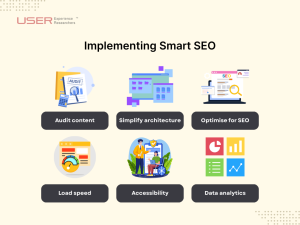
- Conduct a technical and content audit to identify SEO weaknesses and usability pain points.
- Simplify site architecture so that content is grouped logically, making it easier for both humans and algorithms to find relevant material.
- Optimise for readability, balancing scholarly rigour with clear, concise language and structured headings.
- Improve load speeds by compressing images, reducing unnecessary scripts, and using content delivery networks.
- Adopt accessibility standards to ensure inclusivity and compliance, which in turn benefits SEO.
- Use data analytics to track user journeys and adjust design elements for better engagement.
When these measures are applied, the results can be transformative. Imagine a scenario where a journalist covering a breaking policy issue finds your policy institute’s report on the first page of search results, navigates effortlessly to supporting materials, and cites them in a widely read article. Smart SEO makes influence bear action and results.
By committing to this integrated approach, policymakers and experts can ensure their research not only exists but reaches and resonates with the audiences that matter most.
Conclusion
The work of a policy institute is too important to be hidden behind poor visibility or clunky user experiences. As this article has explored, optimising visibility by implementing smart SEO backed by a strong UX strategy delivers three critical advantages: increased reach to key stakeholders, improved engagement with valuable content, and enhanced credibility in the eyes of both audiences and search engines.
Having expert guidance in establishing smart SEO can make all the difference. UX solutions providers such as User Experience Researchers (USER) can help organisations amplify their productivity with human-focused technologies and strategies.
With expertise in optimising digital platforms for discoverability and engagement, USER ensures that your insights do not just sit in an archive, they shape conversations, inform decisions, and drive change.
About User Experience Researchers
At the forefront of innovation, User Experience Researchers is committed to elevating the user journey and value across all touchpoints. Our expertise range across UX consulting, digital transformation, and IT staffing solutions – fulfilling crucial strategy, technology, and talent needs. We are committed to drive progress in sustainable ways. Unlock your full potential with digital by partnering with us.

